Ukrainian midrange drones reshape the battlefield by targeting Russian supply lines
Advertisement
Read this article for free:
or
Already have an account? Log in here »
To continue reading, please subscribe:
Digital Subscription
One year of digital access for only $1.44 a week*
- Enjoy unlimited reading on winnipegfreepress.com
- Read the E-Edition, our digital replica newspaper
- Access News Break, our award-winning app
- Play interactive puzzles
*Billed as $5.77 plus GST every four weeks. After 52 weeks, price increases to the regular rate of $19.95 plus GST every four weeks. Offer available to new and qualified returning subscribers only. Cancel any time.
To continue reading, please subscribe:
Add Free Press access to your Brandon Sun subscription for only an additional
$1 for the first 4 weeks*
- Enjoy unlimited reading on winnipegfreepress.com
- Read the E-Edition, our digital replica newspaper
- Access News Break, our award-winning app
- Play interactive puzzles
*Your next Brandon Sun subscription payment will increase by $1.00 and you will be charged $17.95 plus GST for four weeks. After four weeks, your payment will increase to $24.95 plus GST every four weeks.
Read unlimited articles for free today:
or
Already have an account? Log in here »
KHARKIV REGION, Ukraine (AP) — Through the grainy gray-and-white haze of thermal images streamed from a drone, Ukrainian pilots watch the roads that keep Russian forces supplied, hunting for targets with a fleet of midrange drones that is reshaping the battlefield.
In a basement command post in Ukraine’s Kharkiv region, hundreds of kilometers from the drone over Russian-held territory, pilots wait for movement. When a vehicle appears, they will nudge the controller, sending the aircraft diving toward its target to disrupt Russian supplies deep behind the front.
“Our mission is to cut logistics,” said Kat, commander of Ukraine’s K-2 brigade, which fires midrange drones. “Cut off their supply lines, and the infantry on the front line have no food, no ammunition, no night vision, no batteries. Nothing. That’s how we’re wearing them down in every sense.”
Soldiers spoke to The Associated Press on condition their call signs and not real names be used, in line with military regulations.
By repeatedly striking the highways that carry fuel, ammunition and reinforcements, Ukrainian commanders say they have made logistics slower, costlier and far less predictable, helping stall Russian advances and enabling Ukrainian counterattacks and strikes into illegally annexed Crimea to isolate the peninsula from the mainland.
Until recently, much of that territory lay beyond Ukraine’s reach. Front-line drones lacked the range, while long-range drones were reserved for strategic targets hundreds of kilometers away. Between them stretched a 25- to 200-kilometer (15- to 125-mile) corridor where Russian troops and supplies moved with relative freedom.
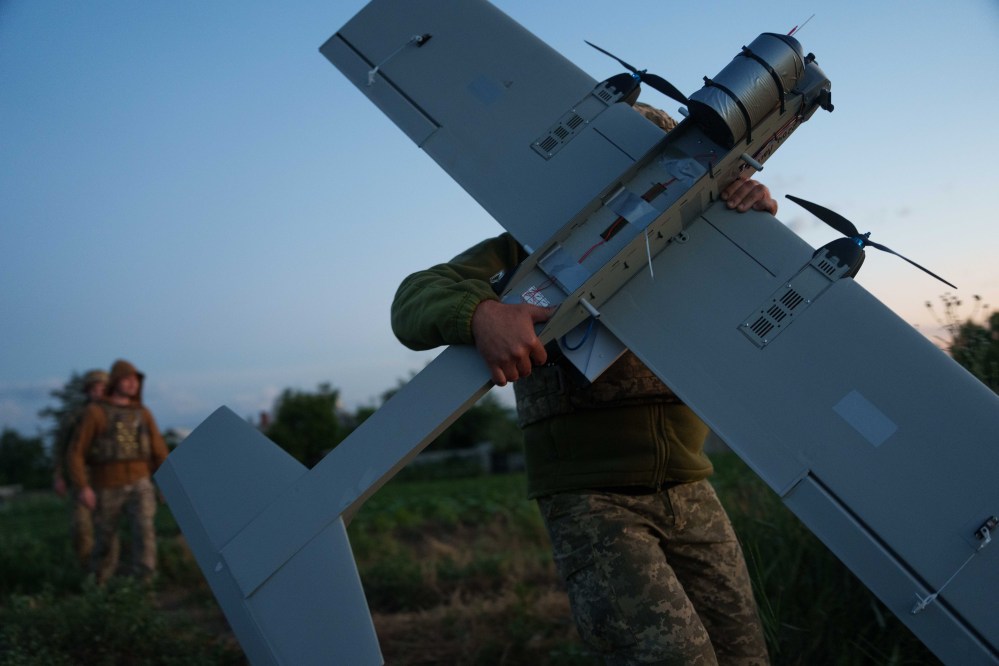
Fixed-wing midrange drones equipped with Starlink satellite communications have begun closing that gap, turning Russia’s logistical rear into an active battlefield.
“They’re ensuring that the Russians are constantly pressured along their supply logistics lines and that they are unable to supply certain parts of the front so that the situation may be more controllable,” said Samuel Bendett, a researcher at the Center for Naval Analyses.
Ukraine will have to sustain the pressure while Russia develops countermeasures, Bendett said. He expects Moscow to adapt eventually but said its larger military allows it to absorb heavier losses in the meantime.
“The question is whether Ukraine can keep this pressure up over the next few weeks and months,” he said.
From a drab office, Ukrainian drone operators target Russian supplies
The machinery of the midrange campaign hides in plain sight. An ordinary office is a command post. A carpenter’s workshop is a drone assembly point. A quaint village house, a launch site.
The nerve center of K-2, one of Ukraine’s most elite drone units, sits in a drab workspace. The workstations are cluttered with coffee mugs, energy drink cans and e-cigarettes.
In May, the unit launched 800 midrange drones, 650 of which struck intended targets — all from this room.
Dressed in civilian clothes, the pilots sit beneath harsh fluorescent lights, eyes fixed on computer screens, as if working late over spreadsheets.
But the grids on their monitors are target lists and satellite maps. As they plot each flight before takeoff, a separate unit launches the aircraft more than 200 kilometers (125 miles) away. Control then passes to the pilots in Kharkiv, who fly it for up to four hours more than 100 kilometers (60 miles) behind Russian lines.
Some who were driven from their hometowns by Russia’s invasion now revisit familiar streets through a drone’s lens, passing old schools and childhood haunts, searching the places where they once played for concealed Russian troops and ammunition depots.
A whiteboard tracks an ongoing competition among the unit’s 10 drone crews. The current record stands at 17 consecutive hits.
Missing a high-value target can be as memorable as hitting one. After one such miss, brigade commander Col. Kyrylo Veres called the crew and scolded: “Are you drunk?”
Some days, the screen reveals little more than a truck hauling fuel and supplies or a lone soldier on a motorcycle. Other days, it lights up with more prized targets: a loaded multiple rocket launcher or a cluster of Russian troops.
Among the top pilots is Pharaon, 20, who said the work comes naturally — an extension of the video games he grew up playing.
“When I was a kid, I used to go to computer clubs where we played Counter-Strike over a local network,” he said. “The competition here is pretty much the same. It’s about who can kill more enemy troops or take out the biggest target.”
Starlink enabled the breakthrough drone campaign
Ukraine’s breakthrough came earlier this year when SpaceX cut off Russian forces’ unauthorized access to Starlink satellite services, disrupting Russia’s drone operations and communications.
That gave Ukraine an advantage, allowing upgraded drones to evade detection, resist jamming and strike more accurately while Russia raced to adapt.
“The blocking of Starlink for Russian forces was one of the most significant battlefield developments of the year,” said Rob Lee, senior fellow in the Foreign Policy Research Institute’s Eurasia Program.
The success of Ukraine’s midrange campaign is a consequence of that shift.
“What’s changed is that now eight out of every 10 sorties are successful,” said Pharaon. Just a few months ago, the success rate was the reverse, he said.
K-2 flies the Dart, one of the cheaper models in Ukraine’s expanding fleet of midrange drones. Built from polystyrene, wood and 3D-printed parts, the Dart primarily targets Russian logistics convoys. Larger drones, such as the Hornet, carry heavier payloads to strike bridges and other infrastructure.
Before launch, crews inspect the batteries, cameras, flight controllers and the most critical component, the Starlink satellite communications system that keeps the drone connected throughout the mission.
From the assembly point, the drones are transported to concealed launch sites near the front line. There, a soldier with the call sign Buckwheat moves between aircraft, ensuring each Starlink terminal is connected before the drones are catapulted into the sky.
“It’s gotten a little quieter now. You can tell the pressure from the enemy has eased,” he said.
Russia, caught by surprise, is playing catch-up
Russian forces were caught off guard when the campaign intensified three months ago. Now they have started deploying mobile fire groups and other countermeasures to intercept the drones. But the campaign’s speed, scale and element of surprise have so far kept Ukraine a step ahead.
Russia’s Achilles’ heel is coordination between units, Bendett said. Some sectors of the front may identify the threat, but unless that information is quickly shared with neighboring units, Russia will struggle to intercept the drones.
Ukraine’s campaign focuses on the highways linking occupied Mariupol, Berdyansk, Melitopol and the Crimean Peninsula, the main arteries supplying Russian forces fighting in southern and eastern Ukraine. Commanders say sustained attacks have forced Russia onto slower, less efficient resupply routes.

Ukrainian military intelligence says the drones have made sections of the land corridor linking Russia to Crimea too dangerous, slowing the movement of fuel, ammunition and reinforcements.
To defend against the drone campaign, Russia is “significantly increasing the number of their mobile anti-aircraft units and fixed machine-gun positions, and are deploying more interceptor crews near major cities,” Pharaon said.
Drone pilots now plot routes around known mobile fire group positions. Through the camera, they can sometimes spot the flashes of anti-aircraft fire as the drone slips past.
Russia is deploying electronic warfare systems against Starlink after testing it since 2024, Lee said. So far, however, their effectiveness has been limited.
“I think they have some success, but we’ll have to wait and see,” he said.