Faint new planet is revealed around a young star after a decade in hiding

Advertisement

Advertise with us

CAPE CANAVERAL, Fla. (AP) — Astronomers have discovered a faint, elusive planet orbiting a young star after more than a decade of cosmic hide-and-seek.

Read this article for free:


By clicking the button above, an account will be created and you will begin to receive some of our recommended newsletters. You may opt out of any newsletter by visiting your Email and Communication Preferences page or by clicking "unsubscribe" at the bottom of any email.

or

Already have an account? Log in here »

To continue reading, please subscribe:

Digital Subscription

One year of digital access for only $1.44 a week*

  • Enjoy unlimited reading on winnipegfreepress.com
  • Read the E-Edition, our digital replica newspaper
  • Access News Break, our award-winning app
  • Play interactive puzzles

*Billed as $5.77 plus GST every four weeks. After 52 weeks, price increases to the regular rate of $19.95 plus GST every four weeks. Offer available to new and qualified returning subscribers only. Cancel any time.

To continue reading, please subscribe:

Add Free Press access to your Brandon Sun subscription for only an additional

$1 for the first 4 weeks*

  • Enjoy unlimited reading on winnipegfreepress.com
  • Read the E-Edition, our digital replica newspaper
  • Access News Break, our award-winning app
  • Play interactive puzzles
Start now

*Your next Brandon Sun subscription payment will increase by $1.00 and you will be charged $17.95 plus GST for four weeks. After four weeks, your payment will increase to $24.95 plus GST every four weeks.

CAPE CANAVERAL, Fla. (AP) — Astronomers have discovered a faint, elusive planet orbiting a young star after more than a decade of cosmic hide-and-seek.

In an unusual twist, two groups working independently detected the cold gas giant a few days apart late last year using different telescopes. It’s the dimmest planet ever directly imaged from Earth, scientists reported Wednesday.

A Scottish and German-led team spied the new planet around the star Beta Pictoris using the European Southern Observatory’s Very Large Telescope in Chile, then dug through archives to confirm its orbit. The planet had remained hidden in the data all this time, overshadowed by its considerably brighter star and two companion planets.
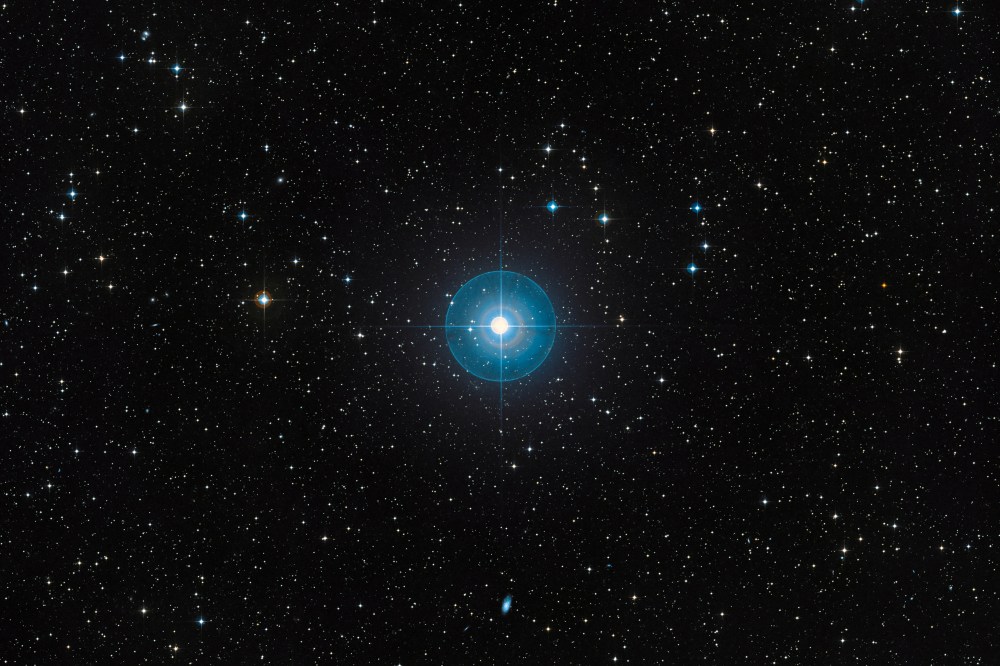
This image provided by the European Southern Observatory shows the Beta Pictoris region on March 6, 2014. (ESO/Digitized Sky Survey 2 via AP)

“It was very much playing hide-and-seek for 11 years,” said the European Southern Observatory’s Markus Bonse, co-leader of the first team.

The California-led team made the discovery with NASA’s Webb Space Telescope. Two observations were all it took with Webb, the biggest and most powerful telescope ever launched into space. Both teams reported their findings in the Astrophysical Journal Letters.

The find was serendipitous. Each team was studying one of the star’s already identified planets when they spotted a less massive one — 100 times fainter — lurking farther out. They deliberately kept their work from one another so as not to bias the results.

The new planet is slightly bigger than Jupiter and takes 91 years to orbit its star, a little longer than it takes Uranus to orbit our sun. Born into a star system that’s barely 20 million years old — a kid compared to the sun’s 4.5 billion-year-old neighborhood — the planet is probably similar to a much younger Jupiter, said the University of California San Diego’s Aidan Gibbs, who led the second team.

“The giant planets have formed, but smaller terrestrial planets could still be forming,” Gibbs said in an email. Beta Pictoris “is probably our best look at a planetary system just after it has formed and is still in the process of stabilizing” from hurtling asteroids and comets.

Beta Pictoris is located in the easel-shaped southern constellation Pictor, or painter, and 63 light-years from Earth. A light-year is nearly 6 trillion miles (more than 9 trillion kilometers).

Fewer than 100 of the more than 6,000 confirmed exoplanets — planets around other stars — have been detected through direct imaging, according to NASA. Most were found while passing in front of their star, briefly dimming it.

“We’ve now built a picture of this planet,” the University of Edinburgh’s Ben Sutlieff said in an email, “and we are very excited to see what more can be learned about it.”

___

The Associated Press Health and Science Department receives support from the Howard Hughes Medical Institute’s Department of Science Education and the Robert Wood Johnson Foundation. The AP is solely responsible for all content.


Report Error Submit a Tip

More Stories

Katz ‘violated public trust,’ Sheegl lacked ‘moral compass,’ police HQ inquiry commissioner concludes

Joyanne Pursaga 8 minute read Preview

Katz ‘violated public trust,’ Sheegl lacked ‘moral compass,’ police HQ inquiry commissioner concludes

Joyanne Pursaga 8 minute read Monday, Oct. 19, 2026

The final report from the public inquiry into the scandal-plagued Winnipeg Police Service headquarters construction project concludes that former mayor Sam Katz and former city CAO Phil Sheegl broke public trust and engaged in unethical conduct.

And the report, released Monday by inquiry commissioner Garth Smorang, says the cost of the project — transforming a downtown Canada Post office tower and warehouse into the police HQ — soared, in part, because main contractor Caspian Projects overcharged the city by more than $40 million in expenses.

The project’s initial $135-million initial price tag rose to about $209 million in the end. The city purchased the complex in 2009; construction was completed in 2016.

Smorang’s report concludes Katz “violated the public trust” and council code of conduct, and Sheegl suffered from a “complete lack of a moral compass.”

Read
Monday, Oct. 19, 2026

MPI gambles with low rate request

Editorial 4 minute read Preview

MPI gambles with low rate request

Editorial 4 minute read Updated: 10:16 AM CDT

It sounds a bit like a gamble from a player in an industry that is almost pathologically averse to gambling.

Read
Updated: 10:16 AM CDT

Province looks to keep nearly $1M from traffic stop

Erik Pindera 4 minute read Preview

Province looks to keep nearly $1M from traffic stop

Erik Pindera 4 minute read Monday, Oct. 19, 2026

The RCMP constable could see that Alireza Haghgoo was nervous. The 22-year-old, seated as a passenger in a rental Nissan SUV the Mountie pulled over for speeding outside Brandon in late July, was breathing heavily and tapping his foot constantly.

Read
Monday, Oct. 19, 2026

Multiple safety concerns in final report on fatal 2025 mid-air collision near Steinbach

Chris Kitching 6 minute read Preview

Multiple safety concerns in final report on fatal 2025 mid-air collision near Steinbach

Chris Kitching 6 minute read Updated: 1:55 PM CDT

A federal investigation into a mid-air collision that killed two student pilots near Steinbach last year identified concerns about radio calls, situational awareness and visual detection methods.

The Transportation Safety Board of Canada’s final report, released Wednesday, said the two planes, belonging to Harv’s Air Service, became entangled and crashed while both pilots were on their final approach to Steinbach airport on the morning of July 8, 2025.

The victims were identified by their families as Savanna May Royes, 20, and Sreehari Sukesh, 23.

Investigators concluded the crash highlighted the limitations of the “see-and-avoid” principle (a basic method used by pilots for visual surveillance and collision avoidance), and why it is important for pilots to actively listen to radio calls from other planes to maintain situational awareness.

Read
Updated: 1:55 PM CDT

Manitoba First Nation taking federal government, department to court over damage to sturgeon population

Morgan Modjeski 4 minute read Preview

Manitoba First Nation taking federal government, department to court over damage to sturgeon population

Morgan Modjeski 4 minute read 11:27 AM CDT

A remote Manitoba First Nation is taking the federal government to court over claims a Manitoba Hydro project is hurting the sturgeon population in the lower Churchill River.

In an Oct. 15 statement of claim filed in Manitoba’s Court of King’s Bench, Tataskweyak Cree Nation said the Churchill River diversion operated by Manitoba Hydro has had widespread ecological effects and damaged sturgeon populations in the area.

The lawsuit alleges Ottawa has breached its treaty obligations to protect the community’s right to harvest the fish.

The lawsuit names both His Majesty the King in Right of Canada, the minister of fisheries and Oceans Canada as defendants.

Read
11:27 AM CDT

Katie Zacharia and the telling of lies

Pam Frampton 5 minute read Preview

Katie Zacharia and the telling of lies

Pam Frampton 5 minute read 2:00 AM CDT

U.S. President Donald Trump’s new press secretary made her debut last week and was almost universally panned and parodied, lasting just five days before being fired.

Read
2:00 AM CDT