Remains of dinosaur skull found in B.C. campground belonged to T. rex ‘great-uncle’

Advertisement

Advertise with us

The remains of a dinosaur skull found in British Columbia campground belonged to a tyrannosaur that was lighter and faster than its more famous relative, the T. rex, say the authors of a new study.

Read this article for free:


or

Already have an account? Log in here »

To continue reading, please subscribe:

Subscribe and receive a limited-edition Free Press branded hat or tote.

Digital Subscription

One year of digital access for only $205*

  • Enjoy unlimited reading on winnipegfreepress.com
  • Read the E-Edition, our digital replica newspaper
  • Access News Break, our award-winning app
  • Play interactive puzzles

*First annual payment billed as $205.00 + GST for one year. This annual subscription will automatically renew at $233.00 + GST every 52 weeks (10% off the regular annual price of $259.35). Offer available to new and qualified returning subscribers only. Cancel any time.

To continue reading, please subscribe:

Add Free Press access to your Brandon Sun subscription for only an additional

$1 for the first 4 weeks*

  • Enjoy unlimited reading on winnipegfreepress.com
  • Read the E-Edition, our digital replica newspaper
  • Access News Break, our award-winning app
  • Play interactive puzzles
Start now

*Your next Brandon Sun subscription payment will increase by $1.00 and you will be charged $17.95 plus GST for four weeks. After four weeks, your payment will increase to $24.95 plus GST every four weeks.

The remains of a dinosaur skull found in British Columbia campground belonged to a tyrannosaur that was lighter and faster than its more famous relative, the T. rex, say the authors of a new study.

University of Alberta and McGill University researchers studied the cast of a partial skull impression that was left about 76 million years ago and discovered it belonged to a horned dinosaur known as Gorgosaurus.

Their findings, published in the journal Palaeogeography, Palaeoclimatology, Palaeoecology last month, give new insight into a species that once roamed what is now Western Canada, said lead author Colton Coppock from the University of Alberta.
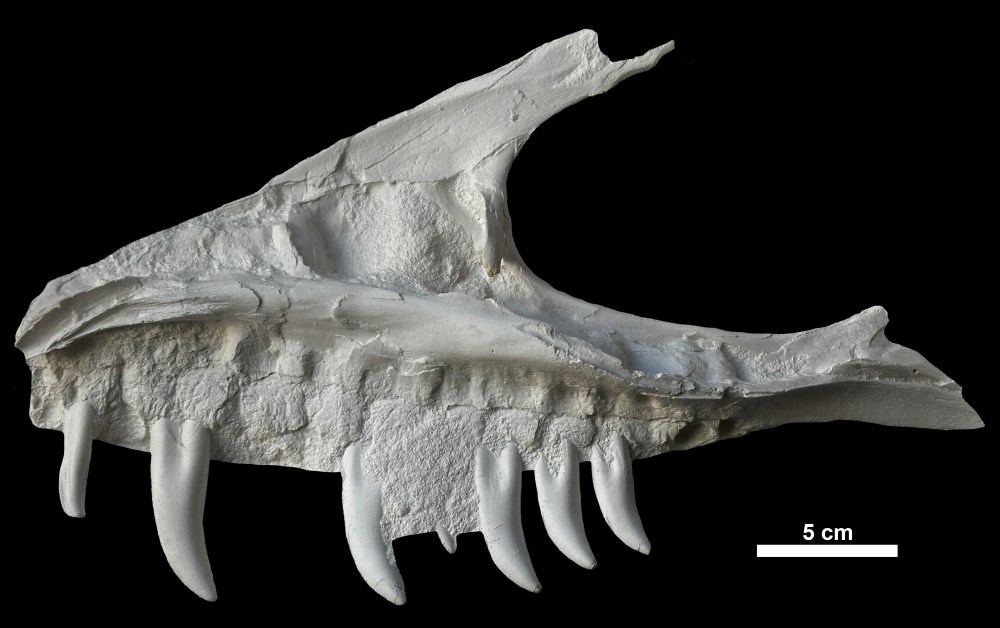
A cast of a partial dinosaur skull impression found in a sandstone block in 2017 in Tumbler Ridge, B.C., is shown in this undated handout image. THE CANADIAN PRESS/Handout — Colton Coppock (Mandatory Credit)

“We were able to identify (Gorgosaurus) based on a unique set of characteristics on this impression,” Coppock said.

The Royal Tyrrell Museum in Alberta says the species could reach nine metres in length.

The journey toward the dinosaur’s identification started in 2017, when B.C. resident Rick Lambert found a strange-looking rock at a campground in Tumbler Ridge, near the Alberta boundary, during a hike.

Lambert said a childhood spent hunting for fossils in England gave him a keen eye — though it also helped that a squirrel directed his attention to the rock near the river’s edge.

The Tumbler Ridge Museum Foundation sent one of its paleontologists to take a look at the find, and it turned out that Lambert had uncovered the first tyrannosaur skull ever found in B.C.

“We do have a lot of dinosaur material here, just not a lot of bone material,” the museum’s curator Eamon Drysdale said, adding the museum keeps the original impression found etched in a sandstone block preserved under tight environmental controls.

The imprint of partial skull bones included the dinosaur’s maxilla, or upper jaw.

Though most of the actual bone had eroded away, the impression was well preserved enough that researchers were able to create a highly detailed cast that kept the skull’s unique features.

Coppock said his supervisor dropped the cast on his lap at a barbecue last August, and he immediately knew it likely belonged to Gorgosaurus libratus.

The species lived 76 million years ago, about 10 million years before its T. rex cousin was stomping around.

“It’s probably like T. rex’s great-uncle,” Coppock said.

He said the dinosaurs had similar stubby arms and long tails, but Gorgosaurus had triangular horns above its eyes.

“They’re kind of the more lightly built tyrannosaurs with longer limbs. Think of like a faster T. rex,” Coppock said.

The cast allowed Coppock and his co-authors to see the internal surface of the maxilla and compare it to more complete Gorgosaurus skull bones.

Gorgosaurus is one of the most well documented tyrannosaurs in Alberta, and was one of the first dinosaurs discovered in the province’s Dinosaur Park Formation, giving the researchers a lot to work with.

Some of the clues linking the partial skull to Gorgosaurus included bone sutures in the nasal area and a rod of bone separating openings in its upper jaw that were distinct to the dinosaur, Coppock said.

He said the dinosaur’s teeth showed it was likely a juvenile when it died.

“Since these animals don’t have large, really muscular jaws early on in life, we think they were using these incisiform teeth to precisely cut up flesh, rather than just going in with brute force and taking huge chunks out with their blade-like teeth (like the adults),” he said.

Coppock said the researchers also learned that Gorgosaurus traversed a much larger area than previously thought, similar to the expanse covered by grizzly bears and cougars today.

He said the dinosaur’s range extended from the north part of eastern B.C. down to northern Montana, spanning around 198,000 square kilometres.

Lambert’s discovery points to British Columbia as a potential gold mine of future dinosaur discoveries.

“B.C. is kind of like the new frontier in terms of dinosaur research,” Coppock said.

But for Lambert, finding the fossil all those years ago meant something more.

“It represents the stability of our planet,” he said.

“We live in an amazing place. Where things that have lived, have lived for so long. That is an incredible thing.”

This report by The Canadian Press was first published July 20, 2026.

Report Error Submit a Tip

More Stories

Port of Churchill signs agreement with Dutch port

Aaron Epp 2 minute read Preview

Port of Churchill signs agreement with Dutch port

Aaron Epp 2 minute read Yesterday at 4:40 PM CDT

Arctic Gateway Group, operator of the Port of Churchill, has signed an agreement with the Port of Rotterdam in the Netherlands to attract business and strengthen supply chains linking Western Canada and Europe.

The agreement enables the two ports to work together to develop new trade in critical minerals and energy products, connect Canadian producers with European buyers, and identify opportunities to improve the supply chain from Western Canadian resource projects through Churchill and into European markets.

The Port of Rotterdam is Europe’s largest port and home to more than 3,000 businesses across its industrial complex, serving as a major gateway for critical raw materials and energy.

Meanwhile, the Port of Churchill has been identified as a transformative national strategy for Canada and is emerging as a northern trade corridor connecting Western Canada’s resources to global markets.

Read
Yesterday at 4:40 PM CDT

Retiree sues neighbour over alleged dog attack

Scott Billeck 2 minute read Yesterday at 2:00 AM CDT

A Winnipeg man is suing his neighbour over an alleged dog attack he says occurred while he was helping him with a lawnmower.

Arthur Cabel, a retiree who lives on Selkirk Avenue, is seeking unspecified damages from neighbour Saisamone Saegone, according to a statement of claim filed in the Manitoba Court of King’s Bench last week.

Cabel claims he went to Saegone’s home in the afternoon on Sept. 23, 2024, to help him with his lawnmower.

According to the lawsuit, Saegone’s large dog, initially in a fenced backyard, escaped, approaching Cabel and “mauling, attacking and biting him.”

Canada resorting to its tried and true playbook

Niigaan Sinclair 5 minute read Preview

Canada resorting to its tried and true playbook

Niigaan Sinclair 5 minute read Monday, Sep. 28, 2026

In 1846, Britain faced an emergency influenced by the Irish famine, so leaders repealed the country’s “Corn Laws” and restrictions on imported food and grain, transitioning to a system of free trade.

This created a crisis in the then Province of Canada, which had relied on British “preferential” status to prop up its agricultural and resource industries.

As a result, Canada looked south for new markets and eventually negotiated a free trade agreement with the United States.

This required land to be acquired and converted for industrial use quickly, so Canada quickly dispatched Commissioner William Robinson to negotiate with Indigenous communities along Lake Huron and Lake Superior for land.

Read
Monday, Sep. 28, 2026

Now-independent ex-Tory leader skips legislature’s first question period in four months

Chris Kitching 5 minute read Preview

Now-independent ex-Tory leader skips legislature’s first question period in four months

Chris Kitching 5 minute read Yesterday at 6:03 PM CDT

Crime rates, the cost of living and the state of health care were on the agenda Tuesday when the legislature’s fall sitting began a day after Obby Khan’s abrupt resignation from the Tory caucus.

Read
Yesterday at 6:03 PM CDT

Jets pick up netminder as relatively new 23-man roster announced

Mike McIntyre 7 minute read Preview

Jets pick up netminder as relatively new 23-man roster announced

Mike McIntyre 7 minute read Monday, Sep. 28, 2026

Let’s get the caveats out of the way: Nothing is set in stone, nor written in permanent ink, and what you see right now could change in the blink of an eye.

With that being said, allow us to introduce you to the 2026-27 Winnipeg Jets — where change is very much in the air.

The 23-man roster submitted to the NHL offices by Monday’s 4 p.m. deadline includes seven players who were not on the team at this time last year. In fact, there could be as many as 10 new faces in the opening-night lineup on Friday against Boston when you factor in three regulars didn’t start the 2025-26 campaign due to injury.

That’s a lot of turnover, which isn’t surprising for a team that finished 26th overall in the standings and was — to most fans and pundits — too old and too slow.

Read
Monday, Sep. 28, 2026

Obsessed stalker who shot, killed young woman at bus stop in 1993 dies behind bars at age 74

Erik Pindera 3 minute read Preview

Obsessed stalker who shot, killed young woman at bus stop in 1993 dies behind bars at age 74

Erik Pindera 3 minute read Yesterday at 5:53 PM CDT

A Winnipeg man who stalked a woman for several years before shooting her dead in the street in 1993 has died in Stony Mountain prison.

On Monday, 74-year-old Ronald Edd Bell died of apparent natural causes at the federal prison just north of Winnipeg, the Correctional Service of Canada said.

Bell had been in prison since May 30, 1994, when he was given a life sentence with no chance of parole for 18 years for killing Terry-Lyn Babb, 25, on Jan. 21, 1993.

Bell walked up behind an unsuspecting Babb, who was waiting at a bus stop at Sherbrook Street and Wolseley Avenue, and shot her in the head with a pistol in front of horrified witnesses, says the Free Press report of his sentencing hearing.

Read
Yesterday at 5:53 PM CDT