International criminal groups use technology to expand in and beyond Asia, UN report says

Advertisement

Advertise with us

BANGKOK (AP) — Southeast Asia-based criminal groups are using increasingly integrated networks and technology to build a rapidly growing illicit economy with tentacles that reach far beyond Asia, with scams alone causing estimated combined losses of $88.3 billion to $114.1 billion in 2025, a U.N. report says.

Read this article for free:


or

Already have an account? Log in here »

To continue reading, please subscribe:

Subscribe and receive a limited-edition Free Press branded hat or tote.

Digital Subscription

One year of digital access for only $205*

  • Enjoy unlimited reading on winnipegfreepress.com
  • Read the E-Edition, our digital replica newspaper
  • Access News Break, our award-winning app
  • Play interactive puzzles

*First annual payment billed as $205.00 + GST for one year. This annual subscription will automatically renew at $233.00 + GST every 52 weeks (10% off the regular annual price of $259.35). Offer available to new and qualified returning subscribers only. Cancel any time.

To continue reading, please subscribe:

Add Free Press access to your Brandon Sun subscription for only an additional

$1 for the first 4 weeks*

  • Enjoy unlimited reading on winnipegfreepress.com
  • Read the E-Edition, our digital replica newspaper
  • Access News Break, our award-winning app
  • Play interactive puzzles
Start now

*Your next Brandon Sun subscription payment will increase by $1.00 and you will be charged $17.95 plus GST for four weeks. After four weeks, your payment will increase to $24.95 plus GST every four weeks.

BANGKOK (AP) — Southeast Asia-based criminal groups are using increasingly integrated networks and technology to build a rapidly growing illicit economy with tentacles that reach far beyond Asia, with scams alone causing estimated combined losses of $88.3 billion to $114.1 billion in 2025, a U.N. report says.

The report by the United Nations Office on Drugs and Crime outlines how transnational crime that used to be concentrated in Southeast Asia has expanded to other regions, while global criminal groups are increasingly engaging in drug, human and wildlife trafficking in Asia.

Criminals are using new technologies to launder money through global financial systems and using artificial intelligence to steal from victims worldwide, said the report, released Tuesday.
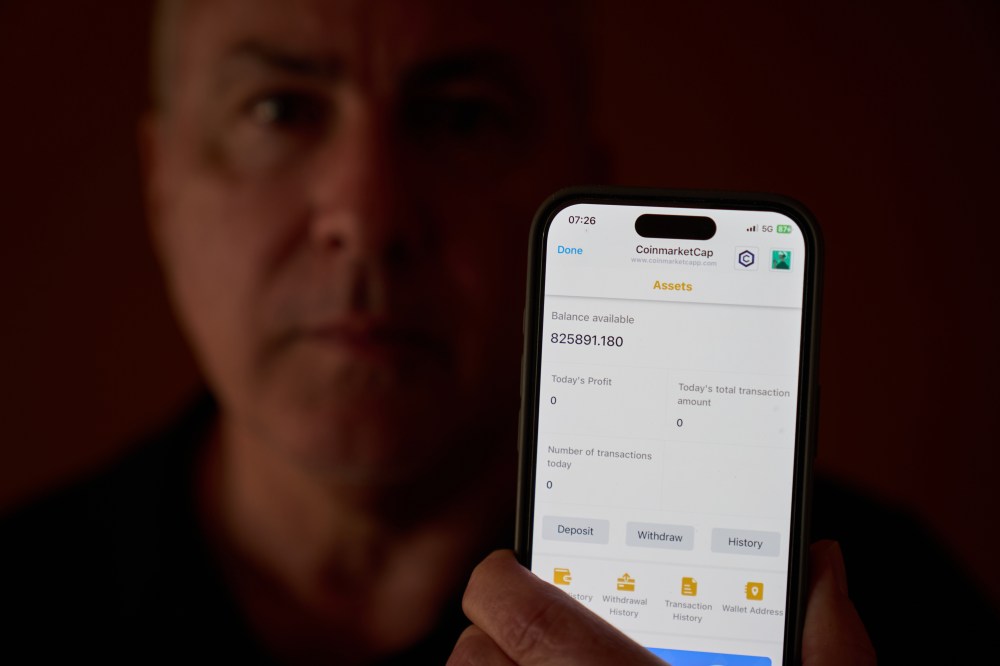
Chris Colocousis holds up a screenshot of the fake app where he invested his savings showing his account had more than doubled to nearly $826,000 as part of a scam in which he says he lost $400,000 at his home in Raynham, Mass., Tuesday, March 10, 2026. (AP Photo/David Goldman)

Children are increasingly at risk

One key finding of the report is the threat to children both from AI and from online gaming, as hundreds of scam compounds scattered across Southeast Asia provide venues for sex trafficking and selling of child sexual abuse content.

“There is a huge jump in AI-generated child sexual images … communicated through encrypted communications platforms,” said Inshik Sim, UNODC researcher and coordinator for the report, told reporters at a briefing at the Foreign Correspondents Club of Thailand.

East Asian crime syndicates are running businesses that use malware, generative AI and deepfakes for sexual extortion and exploitation in a trend that increases risks of in-person abuse as well as livestreamed abuse and grooming of victims. Apart from outright trafficking for the sex industry, victims can be sold into domestic servitude, forced begging and forced labor, among other forms of exploitation, the report says.

Social media and online gaming and gambling also pose dangers for children, the report notes, citing surveys showing that hundreds of children and teens across Southeast Asia are engaged in online gambling, some to the extent of addiction.

Trafficking in drugs, guns tobacco and wildlife is expanding

The report estimates the combined annual sales of illicit drugs in Southeast Asia and nearby countries at up to $109 billion, with seizures of illegal shipments soaring. That includes methamphetamines, heroin and ketamine.

It points to the Sulu-Celebes maritime “triangle” between Indonesia, Malaysia and the Philippines as an increasingly important corridor for shipments of cocaine from Latin America to Asia, with illicit cargoes sometimes embedded in legitimate shipments such as Chinese tea.

The area is also often used for smuggling of wildlife and small arms, the report says.

Meanwhile, Thailand and Vietnam increasingly are the source of cannabis sent to Japan, where it is illegal, and to Europe, it says.

Earlier this year, authorities in Malaysia’s Sabah seized more than 3 tons of methamphetamine, ketamine and ecstasy in the largest such seizure for Sabah so far.

Money laundering and other tools keep criminals in business

The report outlines how cross border financial and technology networks are supporting what it calls a “criminal service infrastructure” that facilitates global organized crime.

The tools used include cryptocurrency, encrypted and private communications platforms and generative AI to create convincing phishing content, deploy real-time deepfake videos and voice calls. Using AI-powered translations, they can target victims across many languages at the same time, the report says.

Satellite communications also enable scam compounds to operate in places that are remote or subject to close surveillance.

To counter this growing criminal ecosystem, authorities need a coordinated, cross-border strategy that integrates enforcement across data, communications and financial systems, and online services and marketplaces, the report said.

Crackdowns drive scam centers offshore and underground

As authorities in Thailand, China and elsewhere have raided industrial-sized scam centers mostly located in border regions of Myanmar, Laos and Cambodia, criminals have responded by shifting to other parts of the world or operating on a smaller scale.

“They were destroyed, but none of the operations stopped,” said Seong Jae Shin, an analyst and counter-terrorism office at the UNODC.

Scam centers moved to villas and other properties, he said, going underground.

“It’s much harder for the Cambodian authorities to crack down now,” he said.

Report Error Submit a Tip

More Stories

Westwood standoff ends with two arrested

Morgan Modjeski and Erik Pindera 3 minute read Preview

Westwood standoff ends with two arrested

Morgan Modjeski and Erik Pindera 3 minute read Thursday, Sep. 3, 2026

An hours-long standoff in Westwood came to an end Thursday with Winnipeg police arresting two men and seizing a gun.

Winnipeg Police Service officers were called to Byrd Avenue shortly before 9:30 a.m. after a man was seen walking with what appeared to be a firearm, said police spokesman Const. Claude Chancy.

Officers identified a home connected to the investigation, he said.

Two men were arrested but Chancy could not yet say what they will be charged with. It’s not clear whether either of the men arrested was the male spotted with a gun.

Read
Thursday, Sep. 3, 2026

Smith’s pretzel logic confuses

Editorial 4 minute read Preview

Smith’s pretzel logic confuses

Editorial 4 minute read Yesterday at 2:01 AM CDT

Alberta Premier Danielle Smith had both sides of her mouth working overtime on Aug. 30, when she spoke at an event in Calgary to commemorate Alberta Day, the annual celebration of the province’s entry into Confederation in 1905 (officially Sept. 1, it was celebrated on the weekend).

Smith’s comments — and the things she did not say — revealed a lot about the political tightrope the premier is trying to walk over the challenges currently faced by her province. At the top of that list of challenges is a persistent campaign to separate Alberta from the aforementioned Confederation. A campaign that Smith appears to both support and oppose, depending on which day of the week it is.

Her Alberta Day remarks were an excellent case in point.

Smith has decided that on Oct. 19, Albertans will vote on a series of non-binding propositions in a province referendum. One of those questions will ask Albertans whether they want to hold a referendum on separation, thus making this fall’s vote a “referendum on whether to hold a referendum,” as some observers have dubbed it.

Read
Yesterday at 2:01 AM CDT

Klein put on defensive as mayoral run made official

Malak Abas 7 minute read Preview

Klein put on defensive as mayoral run made official

Malak Abas 7 minute read Thursday, Sep. 3, 2026

Kevin Klein faced a barrage of attacks from the city’s incumbent mayor and largest union as he officially entered Winnipeg’s mayoral race Thursday.

While the former city councillor and Progressive Conservative cabinet minister was registering to run at city hall, Mayor Scott Gillingham’s team sent out a news release noting Klein was one of two councillors to vote against pursuing legal action against participants in the Winnipeg police headquarters scandal.

Shortly after, Canadian Union of Public Employees Local 500 accused Klein of blaming Canada for its ongoing trade war with the U.S. and called him an “unfit” candidate who would “bend a knee to American interests” in a news release of its own.

Klein defended himself outside city hall after putting in his papers.

Read
Thursday, Sep. 3, 2026

‘Quite a journey’: dozens move into transitional housing downtown

Carol Sanders 4 minute read Preview

‘Quite a journey’: dozens move into transitional housing downtown

Carol Sanders 4 minute read Friday, Sep. 4, 2026

Dozens of residents have moved into transitional housing units in a former university building in downtown Winnipeg.

Housing, Addictions and Homelessness Minister Bernadette Smith said 42 residents have moved into suites on the third and fourth floors of a seven-storey building previously owned by Providence University College and Theological Seminary. There will be space for as many as 118 people who were in encampments or otherwise homeless.

The remaining units under renovation are expected to be ready and occupied in the coming weeks, Smith said.

“This has been two years in the making,” the minister said at a media event with residents, staff, neighbours and supporters. The building cost the province $24.4 million to purchase and renovate.

Read
Friday, Sep. 4, 2026

International criminal groups use technology to expand in and beyond Asia, UN report says

The Associated Press 4 minute read Preview

International criminal groups use technology to expand in and beyond Asia, UN report says

The Associated Press 4 minute read Tuesday, Jul. 21, 2026

BANGKOK (AP) — Southeast Asia-based criminal groups are using increasingly integrated networks and technology to build a rapidly growing illicit economy with tentacles that reach far beyond Asia, with scams alone causing estimated combined losses of $88.3 billion to $114.1 billion in 2025, a U.N. report says.

The report by the United Nations Office on Drugs and Crime outlines how transnational crime that used to be concentrated in Southeast Asia has expanded to other regions, while global criminal groups are increasingly engaging in drug, human and wildlife trafficking in Asia.

Criminals are using new technologies to launder money through global financial systems and using artificial intelligence to steal from victims worldwide, said the report, released Tuesday.

Children are increasingly at risk

Read
Tuesday, Jul. 21, 2026

Letters, Sept. 5

7 minute read Yesterday at 2:01 AM CDT

Clearing the airRe: QDoc patients in middle of billing dispute (Sept. 4)

QDoc has been fortunate to have a genuine partner in the Manitoba government over the past several years. Premier Wab Kinew and Health Minister Uzoma Asagwara have been consistently clear that no Manitoban should go without care because of where they live, and that commitment is exactly why virtual care exists as a permanent, publicly available option today. We built MediNav, the province’s online appointment booking system, together with Manitoba Health, and that same collaborative spirit has helped make more than 350,000 patient visits possible through our platform — many of them evenings, overnights and weekends, reaching rural and underserviced communities that need it most.

We want to be direct with the people who rely on us: QDoc is not going anywhere. We continue to see patients today, and we will keep doing so tomorrow. The issue reported this week is a technical billing matter, not a service disruption, and we are actively working with the province to resolve it quickly, so we can keep growing our capacity to serve Manitobans rather than limiting it.

We also want to take responsibility for our part in the recent confusion. Our Aug. 24 message to a small subset of our patients was meant to keep our community informed, but its tone left some people more worried than they needed to be, and for that we apologize. That was never our intention.