Private mission launches to extend life of out-of-gas communication satellites

Advertisement

Advertise with us

CAPE CANAVERAL, Fla. (AP) — A two-armed space robot blasted off on a private salvage operation Tuesday to slap life-extending jetpacks on old satellites running low on fuel thousands of miles up.

Read this article for free:


or

Already have an account? Log in here »

To continue reading, please subscribe:

Subscribe and receive a limited-edition Free Press branded hat or tote.

Digital Subscription

One year of digital access for only $205*

  • Enjoy unlimited reading on winnipegfreepress.com
  • Read the E-Edition, our digital replica newspaper
  • Access News Break, our award-winning app
  • Play interactive puzzles

*First annual payment billed as $205.00 + GST for one year. This annual subscription will automatically renew at $233.00 + GST every 52 weeks (10% off the regular annual price of $259.35). Offer available to new and qualified returning subscribers only. Cancel any time.

To continue reading, please subscribe:

Add Free Press access to your Brandon Sun subscription for only an additional

$1 for the first 4 weeks*

  • Enjoy unlimited reading on winnipegfreepress.com
  • Read the E-Edition, our digital replica newspaper
  • Access News Break, our award-winning app
  • Play interactive puzzles
Start now

*Your next Brandon Sun subscription payment will increase by $1.00 and you will be charged $17.95 plus GST for four weeks. After four weeks, your payment will increase to $24.95 plus GST every four weeks.

CAPE CANAVERAL, Fla. (AP) — A two-armed space robot blasted off on a private salvage operation Tuesday to slap life-extending jetpacks on old satellites running low on fuel thousands of miles up.

It’s the second satellite-saving mission to launch this month, all part of a growing, money-saving effort to keep spacecraft running as long as possible. Another company’s three-armed spacecraft rocketed into orbit on July 3 to boost NASA’s Swift Observatory so it doesn’t crash to Earth this fall.

Launched by SpaceX, Northrop Grumman’s mission robotic vehicle — dubbed MRV — and its jetpacks will spend the next year angling into the proper orbit 22,300 miles (36,000 kilometers) above Earth. Hundreds of satellites orbit at this so-called geosynchronous orbit, where they match the speed of Earth’s rotation and keep to the same part of the sky for continuous coverage.
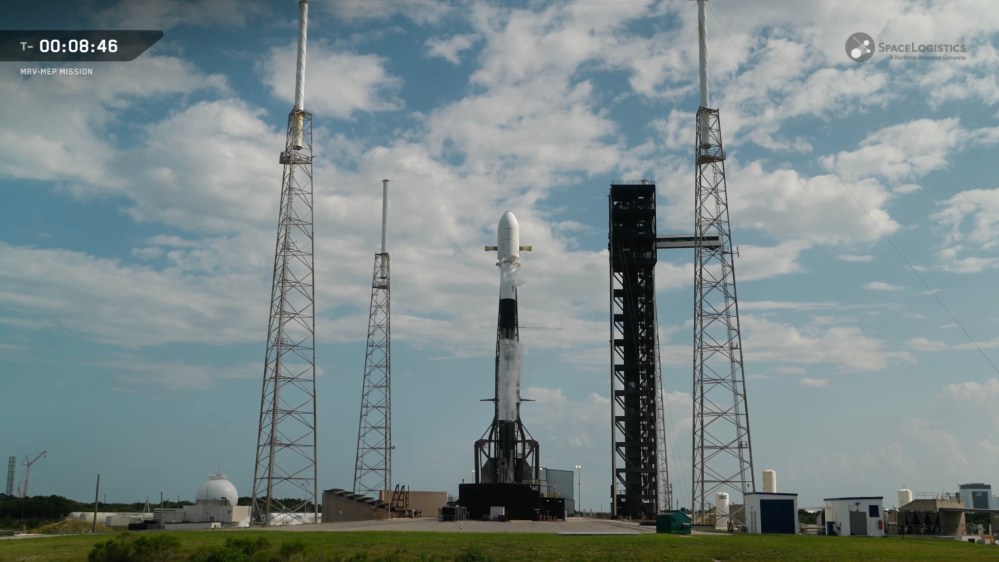
This image from video provided by SpaceX shows a Falcon 9 rocket carrying Northrop Grumman’s mission robotic vehicle — dubbed MRV, preparing for launch from Cape Canaveral, Fla., on Tuesday, July 21, 2026. (SpaceX via AP)

Once in place by mid-2027, the minivan-sized spacecraft will use its 10-foot (9-meter) arms to attach a jetpack to an aging communication satellite. Then it will zip off to two more satellites in need.

For its debut flight, the spacecraft was accompanied by three electric-propelled jetpacks that peeled away separately following liftoff. Like the MRV, the jetpacks will use their own xenon gas thrusters to get to the desired orbit. Once in place, the jetpacks will wait for the robot to grab them, one at a time, and plug them into their designated satellites.

Each jetpack — the size of a washing machine — will provide the necessary oomph for an out-of-gas satellite to keep operating for several more years instead of retiring. If it works, it will be a boon for satellite operators SES of Luxembourg and Optus of Australia, saving them millions of dollars in replacement costs.

This is Northrop Grumman’s latest foray into the satellite-servicing business. In 2019 and again in 2020, the company launched a pair of spacecraft that latched onto faltering communication satellites and steered them, providing extra years of life.

Northrop Grumman designed its new robotic helpers to be even more resourceful. The company envisions future versions repairing and relocating live satellites, and even latching onto dead ones for removal from highly trafficked orbits. The company is collaborating with the U.S. Naval Research Laboratory and the Defense Advanced Research Projects Agency.

Katalyst Space Technologies, meanwhile, continues to test its Link satellite helper in orbit before rushing to the Swift Observatory’s rescue. Flight controllers had to overcome initial communication and pointing problems with Link, beaming up software patches.

Launched in 2004, NASA’s Swift telescope has been sinking faster than usual because of all the recent solar activity. A boost by Link in the coming weeks could give the nearly $400 million gamma ray observatory many more years of studying some of the biggest explosions in the universe.
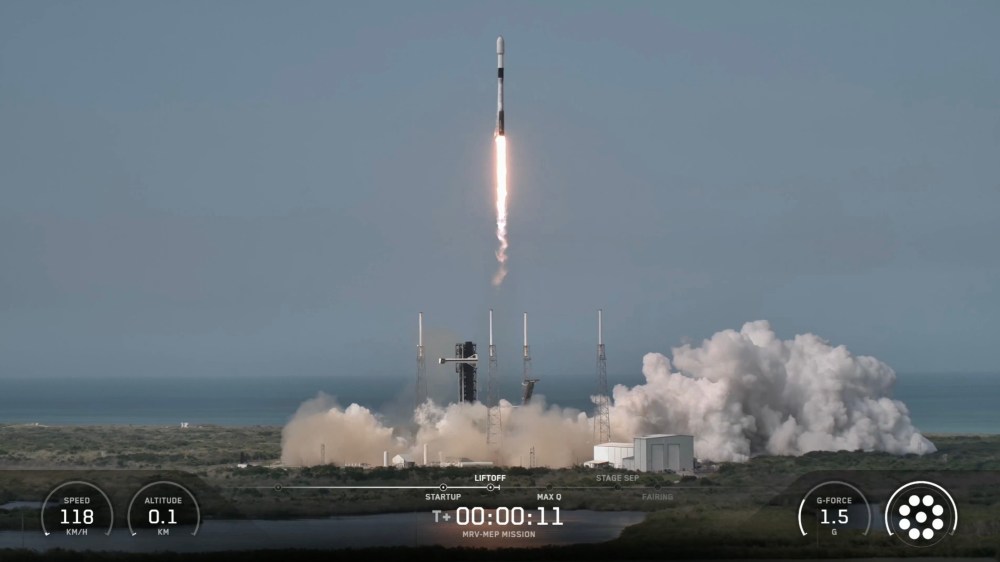
This image from video provided by SpaceX shows a Falcon 9 rocket carrying Northrop Grumman’s mission robotic vehicle — dubbed MRV, launches from Cape Canaveral, Fla., on Tuesday, July 21, 2026. (SpaceX via AP)

NASA is paying Kataylst $30 million to raise Swift to its original 373-mile (600-kilometer) altitude. Northrop Grumman provided Link’s ride to orbit, using a plane-launched Pegasus rocket.

___

The Associated Press Health and Science Department receives support from the Howard Hughes Medical Institute’s Department of Science Education and the Robert Wood Johnson Foundation. The AP is solely responsible for all content.


Report Error Submit a Tip

More Stories

Letters, Oct. 5

7 minute read 2:01 AM CDT

Fighting the good fight

Re: Transit, roads and city council’s priorities (Oct. 2)

Many thanks to Erna Buffie for once again speaking up for transit.

When will Winnipeg finally make the shift from a car-dependent culture to a greener and more efficient way?

Bombers on outside looking in after beatdown from Als

Taylor Allen 7 minute read Preview

Bombers on outside looking in after beatdown from Als

Taylor Allen 7 minute read Yesterday at 6:34 PM CDT

The visitors’ locker room at Percival Molson Memorial Stadium was eerily quiet late Saturday night.

Many of the Winnipeg Blue Bombers sat in their stalls with dejected looks on their faces, trying to wrap their heads around what had just transpired: a 37-10 beatdown at the hands of the Montreal Alouettes.

“(That game) felt like s—-, honestly,” receiver Tim White told the Free Press postgame.

And the Bombers have plenty of reason to feel that way, especially when looking at the West Division standings.

Read
Yesterday at 6:34 PM CDT

Wasteful operations should be held accountable

Barry E. Prentice 5 minute read Preview

Wasteful operations should be held accountable

Barry E. Prentice 5 minute read 2:00 AM CDT

Rising water bills are a top-of-mind issue for residents of Winnipeg going into the fall election. Management of the water and waste system is under question, with citizen’s groups, as well as the Free Press, calling for proper oversight of rates (Time for the PUB to review Winnipeg water rates, Editorial, Sept. 26).

The need to increase rates to build the North End sewage plant is understandable. Siphoning off utility proceeds to make up other tax revenue shortfalls is another matter. But it is not the only questionable practice. If there was Public Utilities Board oversight of Winnipeg’s water and sewer rates, it would certainly be asking why the city is spending more than $3 million annually to operate the 164-kilometre-long, Greater Winnipeg Water District railway (GWWD) on ratepayers’ behalf.

The GWWD has come to the attention of the Railway Relocation Study, led by Lloyd Axworthy. All existing rail lines within the city are under review, as is the feasibility of a new railway bypass.

The GWWD is an example of a railway that has outlived its usefulness and sits on a pocket of land close to downtown that could be converted to higher-value uses.

Read
2:00 AM CDT

Board game company charts winning path

Aaron Epp 5 minute read Preview

Board game company charts winning path

Aaron Epp 5 minute read Friday, Oct. 2, 2026

Dennis Northcott has launched a game without frontiers.

The Winnipeg entrepreneur is the co-designer of Galactic Cruise, a board game published last year by Kinson Key Games LLC, the business he co-founded. Since its release, Galactic Cruise has been translated into 11 languages and sold around 50,000 copies worldwide.

It’s also one of three finalists for this year’s Deutsche Spiele Preis, a prestigious community-voted board game award. Northcott will travel to Essen, Germany, later this month, where the winner will be announced at Spiel Essen, an annual board game trade fair.

“It’s been amazing,” Northcott said of the response to Galactic Cruise during an interview in his Island Lakes neighbourhood home earlier this week. “The sales have been great, but it’s also been amazing in terms of people giving their reviews.”

Read
Friday, Oct. 2, 2026

Thank Manitoba’s teachers by investing in students

Lillian Klausen 5 minute read 2:00 AM CDT

Manitoba’s students are settling into a new school year. Whether you graduated in 1986 or 2006, today’s classrooms look very different from the ones you remember.

Students reflect the changing makeup of our communities — differences in social, emotional, physical and cognitive abilities and socioeconomic stresses are all increasingly present and adding to the complexity of our classrooms.

Meeting these differing individual needs is no easy feat. It requires manageable class sizes, school counsellors, social workers, specialized resource teachers and investment in the systems that can help students thrive. But when those supports aren’t available, students’ needs don’t disappear. Increasingly, it falls to classroom teachers to try to fill the gaps.

When I started working as a teacher more than 30 years ago, we had budgets for resources when we needed them. Today, the needs of students have diversified and increased, but the funding for our public schools is failing to meet them.

Six high school hockey programs ceased operations following new Hockey Manitoba policy

Joshua Frey-Sam 7 minute read Preview

Six high school hockey programs ceased operations following new Hockey Manitoba policy

Joshua Frey-Sam 7 minute read Friday, Oct. 2, 2026

She lived the best of both worlds.

For the last three years, the 17-year-old wore a sweater for two different hockey programs — her high school team and AAA club in the Manitoba Female Hockey League — and was preparing to flourish in both colours again this winter.

Recently, however, the blue-liner was disappointed to learn she is no longer eligible to play her Grade 12 season with her school owing to a new policy imposed by Hockey Manitoba that bans players from participating in the Manitoba Women’s High School Hockey League if they are rostered on a U18 AAA team.

The rule applies to all athletes who play for both Winnipeg-based and rural AAA teams.

Read
Friday, Oct. 2, 2026