Cheaper, open and intelligent: Chinese AI models gain ground, as they make inroads in the US
Advertisement
Read this article for free:
or
Already have an account? Log in here »
To continue reading, please subscribe:

Digital Subscription
One year of digital access for only $205*
- Enjoy unlimited reading on winnipegfreepress.com
- Read the E-Edition, our digital replica newspaper
- Access News Break, our award-winning app
- Play interactive puzzles
*First annual payment billed as $205.00 + GST for one year. This annual subscription will automatically renew at $233.00 + GST every 52 weeks (10% off the regular annual price of $259.35). Offer available to new and qualified returning subscribers only. Cancel any time.
To continue reading, please subscribe:
Add Free Press access to your Brandon Sun subscription for only an additional
$1 for the first 4 weeks*
- Enjoy unlimited reading on winnipegfreepress.com
- Read the E-Edition, our digital replica newspaper
- Access News Break, our award-winning app
- Play interactive puzzles
*Your next Brandon Sun subscription payment will increase by $1.00 and you will be charged $17.95 plus GST for four weeks. After four weeks, your payment will increase to $24.95 plus GST every four weeks.
Read unlimited articles for free today:
or
Already have an account? Log in here »
HONG KONG (AP) — China has a hot new product in the United States: artificial intelligence.
San Francisco-based Raffi Krikorian, the chief technology officer at Mozilla, which runs the Firefox browser, switched to Chinese AI startup Moonshot’s Kimi K3 for many of his day-to-day activities within days of the new, powerful model’s launch more than a week ago.
“It just seems snappier,” he said of K3, comparing it to the acclaimed and more expensive Claude Fable chatbot from San Francisco company Anthropic. Earlier, he had been using another high-performing Chinese model, Z.ai’s GLM-5.2, for routine tasks such as managing his calendar, documents and email.
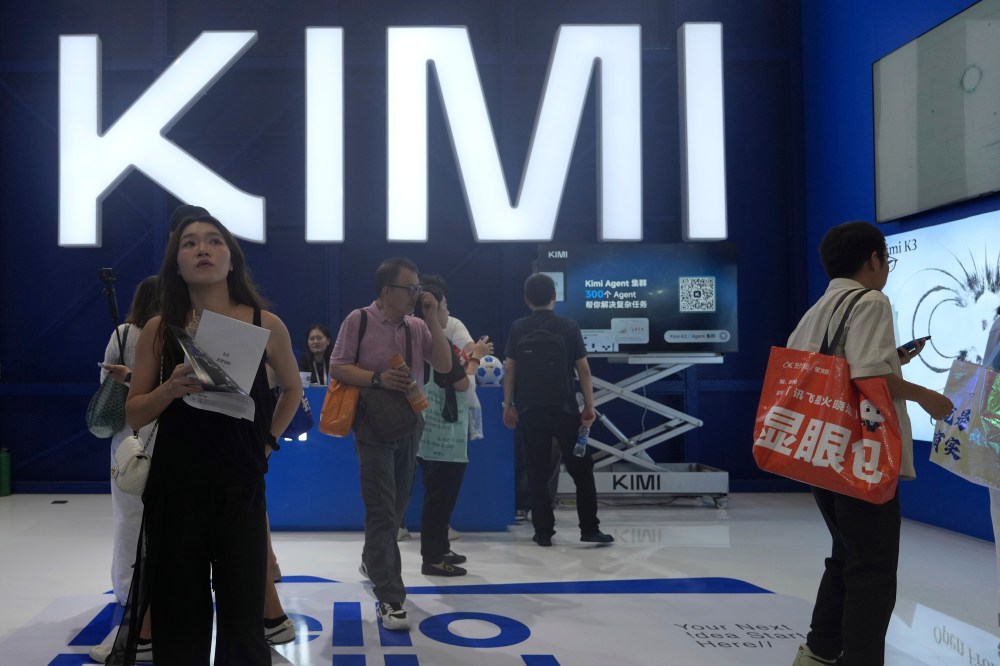
Krikorian is one of a growing number of Americans adopting Chinese AI systems, which are gaining ground around the world because they are more affordable and increasingly efficient. U.S. companies like cryptocurrency exchange Coinbase said they’re switching to Chinese AI models to help trim costs.
Their popularity has frustrated some U.S. tech giants, but short of an outright ban, they’re likely to continue to appeal to independent software developers in the U.S. and elsewhere.
American-led restrictions block China from accessing some of the world’s most advanced technologies including cutting-edge AI chips and U.S. Treasury Secretary Scott Bessent has warned more sanctions could be coming to protect American intellectual property.
U.S. President Donald Trump’s administration on Wednesday accused Moonshot of using “covert” but not necessarily illegal methods to build K3 off the back of Anthropic’s Fable. Some U.S. politicians and AI companies including Anthropic have accused Chinese startups of illicit “distillation” of their models to extract their technologies, a claim that Beijing rejects as “groundless.”
China’s AI models are cheaper and ‘good enough’
The rapid rise of cutting-edge Chinese AI models this year shows the China-U.S. race in AI has moved on from early last year, when Chinese startup DeepSeek shook up the U.S. technology industry and put China on the map with an AI model that performed on par with those in the U.S. but much more cheaply.
The latest AI models launched by startups Z.ai, or Zhipu, in June, and Moonshot in July are nearly as intelligent as the frontier models from OpenAI and Anthropic, experts say. Also in July, China’s Alibaba previewed its Qwen3.8 Max AI model. In April, DeepSeek rolled out previews of its latest V4 model, challenging OpenAI’s GPT and Google’s Gemini.
Those constant advances are bearing fruit. Curt Meinhold, a Greensboro, North Carolina-based technology executive, said he increasingly prefers to use DeepSeek for tasks such as finding business leads or ways to generate sales.
“At the end of the day, most of us, the vast majority of us, 90 plus percent, don’t need (Anthropic’s) Mythos or Fable,” said Meinhold, who founded digital legacy platform LilyList. “Like, we just don’t need it, we need something good enough.”
Chinese AI models are reaching a “critical stage” for wide adoption, U.S. investment bank Goldman Sachs wrote in a July research report, especially when a surge of global “agentic” AI usage, which requires the AI models to autonomously conduct multistep, complex tasks, is driving higher demand for cost effective AI models.
AI prices are calculated per million tokens for both input and output, so the use of AI “agents” is dramatically compounding cost differences, according to analysts including Alex Colville of the Australian Strategic Policy Institute.
“The Chinese models, you know, I find them to be pretty close on code and research,” said Meinhold. “If I can pay a handful of cents per million output tokens versus 30 bucks or 40 bucks or 50 bucks, then it’s good enough.”
Moonshot’s Kimi K3 leads, but Chinese AI models have limits
Based on data over the past month, the top five most popular models on OpenRouter, a platform that tracks data across AI models, were Chinese.
Estimates from Sensor Tower, a market intelligence firm, showed Kimi had more than 930,000 downloads during the week after K3’s July release, an increase of 200% from the week before. In the U.S. it was downloaded around 86,000 times, a 387% jump.
K3 proved so popular that Moonshot had to temporarily suspend new subscriptions after overwhelming demand pushed its capacity close to its limits.
Still, while Chinese models are becoming serious competitors to the U.S., they lag American AI leaders across their overall, full-range capabilities, said Anastasios Angelopoulos, co-founder and CEO of Arena, a platform for evaluating AI systems.
And U.S. AI firms are also looking for more options to reduce pricing, such as with cheaper alternatives of competitive models, added Yasir Atalan, with the Center for Strategic and International Studies.
US policy could boost Chinese AI models
Most Chinese AI models are open-source — meaning anyone can examine and build on them — at a time when frontier models from U.S. companies like Anthropic and OpenAI are closed-source.
Chinese model vendors are expected to leverage open-source software to promote their global usage and adoption, said Lian Jye Su, of the technology research and advisory group Omdia.
As Chinese open-source models are increasingly almost as good as closed systems made by leading U.S. companies, said Mozilla’s Krikorian, “the open frontier is becoming increasingly Chinese-built.” While the U.S. weighs restricting Chinese AI models, a group of American tech firms including Microsoft, Meta and Nvidia signed an open letter published Friday backing “open” AI models.
Other U.S. tech policies also at times give China an upper hand, some experts say. China’s Z.ai released its GLM-5.2 model in mid-June, not long after the Trump administration put export controls on Anthropic’s Fable and Mythos models, keeping them offline for more than two weeks.
“Restricting an American model can immediately create an opening for a Chinese competitor,” said Arena’s Angelopoulos.
Chinese AI models look to expand globally
In China, people and businesses have rapidly embraced AI technologies that have prospered with state support. Chinese tech companies like Huawei and Tencent are also embedding AI in devices such as smartphones, AI glasses and humanoid robots.
Now China is increasingly looking to dominate AI abroad, too. At a flagship technology summit in Shanghai, Chinese President Xi Jinping championed open-source AI models and the importance of promoting greater global equity, while pledging Chinese involvement in raising AI capabilities especially in developing nations.
As is true for many other industries in China, intense competition at home is driving companies to expand globally. Leading Chinese AI startups are now raising more funding to support that effort, including through public share offerings.
Both China and the U.S. will want to “encourage widespread adoption of their AI ecosystems, while safeguarding technologies that could materially strengthen strategic rivals,” said Chelsey Tam, with investment research firm Morningstar.

“The competition is no longer simply the United States against China; the Chinese labs are also putting a lot of pressure on one another,” Angelopoulos said.
But as is the case in the U.S., huge investments in AI have also raised concerns over sustainability of these Chinese startups. Z.ai, for example, reported its revenue surged 132% to 724 million yuan ($107 million) last year, but net loss jumped 60% to 4.7 billion yuan ($694 million).
For now, Chinese AI models will likely continue to march ahead including in the U.S. “I would highly recommend anyone doing any serious AI load to at least evaluate it,” said Krikorian.
___
O’Brien reported from Providence, Rhode Island. AP Business Writer Kelvin Chan in Toronto contributed to this report.