Human-caused climate change made Spanish, French fires much more likely, scientists calculate

Advertisement

Advertise with us

Climate change's fingerprints are all over the extreme fire weather that sparked this week's devastating wildfires in Spain and France and has spiked Southern Europe's burning the past eight years, two new studies conclude.

Read this article for free:


By clicking the button above, an account will be created and you will begin to receive some of our recommended newsletters. You may opt out of any newsletter by visiting your Email and Communication Preferences page or by clicking "unsubscribe" at the bottom of any email.

or

Already have an account? Log in here »

To continue reading, please subscribe:

Digital Subscription

One year of digital access for only $1.44 a week*

  • Enjoy unlimited reading on winnipegfreepress.com
  • Read the E-Edition, our digital replica newspaper
  • Access News Break, our award-winning app
  • Play interactive puzzles

*Billed as $5.77 plus GST every four weeks. After 52 weeks, price increases to the regular rate of $19.95 plus GST every four weeks. Offer available to new and qualified returning subscribers only. Cancel any time.

To continue reading, please subscribe:

Add Free Press access to your Brandon Sun subscription for only an additional

$1 for the first 4 weeks*

  • Enjoy unlimited reading on winnipegfreepress.com
  • Read the E-Edition, our digital replica newspaper
  • Access News Break, our award-winning app
  • Play interactive puzzles
Start now

*Your next Brandon Sun subscription payment will increase by $1.00 and you will be charged $17.95 plus GST for four weeks. After four weeks, your payment will increase to $24.95 plus GST every four weeks.

Climate change’s fingerprints are all over the extreme fire weather that sparked this week’s devastating wildfires in Spain and France and has spiked Southern Europe’s burning the past eight years, two new studies conclude.

Human-caused climate change made the hot and dry conditions responsible for Spain’s record-sized inferno 20 times more likely to happen, and it doubled the chances of extreme fire conditions for the flames in France, scientists at World Weather Attribution calculated in a rapid analysis Thursday, conducted while fires were still burning. Warming in the past 26 years has tripled the odds of the severe fire risk conditions in Spain and increased the chances in France 40%, the same report found.

At the same time, researchers published a separate study on Thursday — written and edited long before this week’s fires began — that found the number of days that Southern Europe’s weather reached extreme fire-prone levels has more than doubled compared to decades ago.
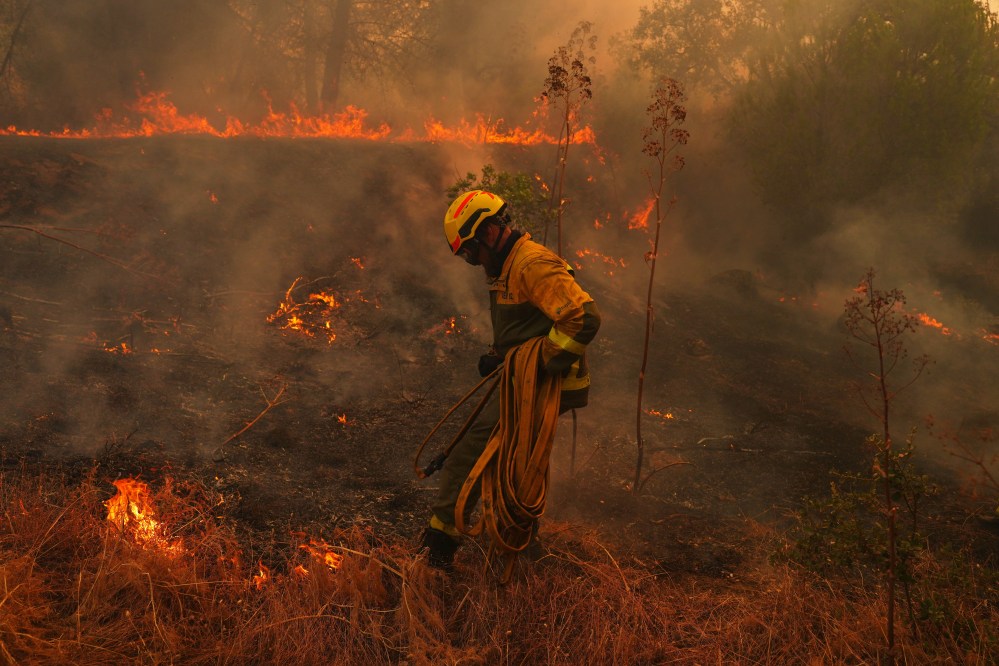
FILE - A firefighter carries a hose while battling a wildfire in San Martin de Valdeiglesias, west of Madrid, Spain, July 26, 2026. (AP Photo/Manu Fernandez, File)

Both studies examined changes in the weather that creates fire-prone conditions. The measurements factor in air temperature, drought conditions, humidity and wind.

“The change in these fire weather conditions in Spain is really extremely strong and is, I think, one of the largest changes that I’ve seen,” said Friederike Otto, an Imperial College of London climate scientist who coordinates World Weather Attribution. Spain is having its hottest summer on record, after an incredibly wet January that allowed plants to grow before a severe drought hit, a combination that increased wildfire fuel, the report said.

Spain also had the added problem of land abandonment, which left unmanaged plants and trees to dry out, Otto said. France’s Bordeaux region, meanwhile, had thick groves of pines that also burn well when a fire starts, she said.

World Weather Attribution — an international collaboration of scientists who examine extreme events to determine climate change’s role, if any — did that study so quickly, the report didn’t get peer reviewed, which is the scientific gold standard. But Otto and her colleagues used techniques that are scientifically accepted, and many of their reports are published in peer-reviewed journals later.

Warming world means fires ignite ‘more explosively’

Otto’s team calculated how much climate change — from the burning of coal, oil and gas — increased the chances for fires of this intensity to happen. They did so by comparing fire weather severity levels to past measurements for the region and to what they would be if the world was 2.5 degrees (1.4 degrees Celsius) cooler. That is how much Earth has warmed since pre-industrial times.

“This study makes sense and provides numbers to confirm what fire scientists already knew,” said Syracuse University fire scientist Jacob Bendix, who wasn’t part of either research. “We have always known that fires ignite more easily and spread more explosively under conditions of extreme heat and drought. And we’ve known for decades that extreme heat and drought are becoming more common due to anthropogenic climate change. So the general outline of these events, if not all the details, was tragically predictable.”

Thursday’s other study, in the journal Scientific Reports, finds that there were about 10 extreme fire weather days a year in Southern Europe in earlier decades, but it is now up to around 25 a year, said study author Raúl Cordero, a climate scientist at the University of Groningen in the Netherlands. And it is not just more frequent bad fire weather days. Those days are about 50% more intense than they were from 1981 to 2010, his study said.

Fires were decreasing until climate change overwhelmed gains

The number of Southern European fires and amount of land burned had decreased quite a bit from the 1980s to 2018, mostly because of better fire suppression and management techniques, Cordero said. But then things quickly got worse fast because climate change overwhelmed that improvement, he said.

“It doesn’t matter how many resources or how much money you have, you just cannot stop the propagation of a fire when the weather is so extreme,” Cordero said. “The climate forcing is so extreme nowadays that it’s just amazing.”

University of California Merced fire scientist John Abatzaglou, who also wasn’t part of either research, said, “these findings make clear that climate change is not just a future problem, it’s already here.”

“We need to stop burning fossil fuels,” Otto said. “Because as long as we keep burning fossil fuels, temperatures will increase globally. And that will mean that these fire weather conditions will get worse and worse and worse. And there are hard limits to what we can adapt to.”

___

The Associated Press’ climate and environmental coverage receives financial support from multiple private foundations. AP is solely responsible for all content. Find AP’s standards for working with philanthropies, a list of supporters and funded coverage areas at AP.org.

Report Error Submit a Tip

More Stories

Health ministers meeting ends without long-term funding commitment from Ottawa

Carol Sanders 4 minute read Preview

Health ministers meeting ends without long-term funding commitment from Ottawa

Carol Sanders 4 minute read 2:01 AM CDT

Canada’s health minister failed to deliver the promises of long-term funding increases that her provincial and territorial counterparts, who were gathered in Winnipeg this week, had been seeking.

Instead, Marjorie Michel reiterated the federal government’s commitment to working collaboratively towards renewing bilateral funding agreements and to meet again before the end of the year to discuss long-term funding.

“The decision we all agreed on is to have our public service… start the work on what will be the next step for the next negotiation on Canada Health Transfer and other agreements,” Michel said Friday at a news conference after meeting with the other health ministers.

When asked why the federal government couldn’t commit to maintaining funding levels geared, at a minimum, to the rate of inflation over the long term, Michel said that it’s time to update agreements signed a decade ago.

Read
2:01 AM CDT

Federal data on Winnipeg's number of homeless people inaccurate, advocates say

Scott Billeck 5 minute read Preview

Federal data on Winnipeg's number of homeless people inaccurate, advocates say

Scott Billeck 5 minute read Updated: Yesterday at 1:02 PM CDT

The head of End Homelessness Winnipeg says she has no confidence in data about the city’s homeless population due to problems with the federal system that tracks those numbers.

Read
Updated: Yesterday at 1:02 PM CDT

Diesel bill adds to cost-price squeeze on farm

Laura Rance-Unger 4 minute read Preview

Diesel bill adds to cost-price squeeze on farm

Laura Rance-Unger 4 minute read 2:01 AM CDT

Blessed with a week of good weather, most Manitoba farmers are now in the home stretch of harvest and beginning to assess whether their crop will earn enough to cover the cost of growing it.

Commodity market prices have surged well above the numbers used to prepare production budgets earlier this year, with the price of top-quality milling wheat up 27 per cent over a year ago. Canola and soybeans are up 36 per cent and oats by 14 per cent.

That’s a significant boost for the crops harvested in good shape before rainy weather shut down operations for a couple of weeks during the critical harvesting window. However, upwards of half of the province’s crop overall was affected by the bad weather, resulting in yet-to-be calculated yield and quality losses.

Then there’s the cost side of the balance sheet.

Read
2:01 AM CDT

A Life's Story: Musician made great contributions, advocated for fellow artists

Conrad Sweatman 7 minute read Preview

A Life's Story: Musician made great contributions, advocated for fellow artists

Conrad Sweatman 7 minute read 6:00 AM CDT

When a University of Manitoba dean came to inform Victor Davies that he was booted from pre-med in the late 1950s, it was — to permit a cliché — music to his ears.

“In his mind, what he heard was much more encouraging. He heard, ‘Follow your own dream. Listen to your own melody. Speak with your own voice,’” says Davies’s daughter, Heather.

Davies, who died at 87 from pancreatic cancer and PLS in late September, was nevertheless about to take a major gamble, one that would eventually earn him an honorary doctorate from the University of Manitoba and a nomination to the Order of Canada.

Few careers are as uncertain as music, and at a time when the composition departments were saying au revoir to tonality, embracing the heavily dissonant styles of France and Germany, Davies was about to go against the grain. He would soon find a new home across the border in Bloomington, Ind., where for four years he studied at Indiana University Jacobs School of Music.

Read
6:00 AM CDT

Backstreet Boys’ 12-show Toronto run offers millennials a ticket to simpler times

Alex Nino Gheciu, The Canadian Press 5 minute read Preview

Backstreet Boys’ 12-show Toronto run offers millennials a ticket to simpler times

Alex Nino Gheciu, The Canadian Press 5 minute read Updated: 3:01 PM CDT

When Chelsea Smith heard the Backstreet Boys were coming to Toronto, she had a simple message for the five men who soundtracked her childhood.

“Here's my credit card, take all my money.”

The 35-year-old Vancouver fan wasn’t bluffing. Having already travelled to Las Vegas to see her teenybopper crushes, she's now preparing to fly across the country for two Toronto concerts, spending roughly $600 on tickets alone.

And she's hardly the only millennial willing to pay a tidy sum to party like it’s 1999.

Read
Updated: 3:01 PM CDT

Misused ensemble, underconfident script keep Street Fighter game adaptation from landing its blows clean

Darren Ridgley 5 minute read Preview

Misused ensemble, underconfident script keep Street Fighter game adaptation from landing its blows clean

Darren Ridgley 5 minute read Updated: 8:37 AM CDT

Adaptations of fighting games come built-in with a major problem: how does one tell a coherent story about a game with no true protagonist?

Sadly, Street Fighter doesn’t know.

When it debuted in 1991, Street Fighter II (upon which most of this film is based) featured 12 “world warriors,” eight of them playable and with their own motives.

Managing such a cast requires a script capable of efficiently introducing them and then giving everyone decent reasons to interact — or homing in on a few and letting the rest be set dressing. Director Kitao Sakurai opts for the latter, focusing on Japanese warrior Ryu (Andrew Koji), American Ken Masters (Noah Centineo) and Interpol agent Chun Li (Callina Liang).

Read
Updated: 8:37 AM CDT