Human-caused climate change made Spanish, French fires much more likely, scientists calculate

Advertisement

Advertise with us

Climate change's fingerprints are all over the extreme fire weather that sparked this week's devastating wildfires in Spain and France and has spiked Southern Europe's burning the past eight years, two new studies conclude.

Read this article for free:


or

Already have an account? Log in here »

To continue reading, please subscribe:

Subscribe and receive a limited-edition Free Press branded hat or tote.

Digital Subscription

One year of digital access for only $205*

  • Enjoy unlimited reading on winnipegfreepress.com
  • Read the E-Edition, our digital replica newspaper
  • Access News Break, our award-winning app
  • Play interactive puzzles

*First annual payment billed as $205.00 + GST for one year. This annual subscription will automatically renew at $233.00 + GST every 52 weeks (10% off the regular annual price of $259.35). Offer available to new and qualified returning subscribers only. Cancel any time.

To continue reading, please subscribe:

Add Free Press access to your Brandon Sun subscription for only an additional

$1 for the first 4 weeks*

  • Enjoy unlimited reading on winnipegfreepress.com
  • Read the E-Edition, our digital replica newspaper
  • Access News Break, our award-winning app
  • Play interactive puzzles
Start now

*Your next Brandon Sun subscription payment will increase by $1.00 and you will be charged $17.95 plus GST for four weeks. After four weeks, your payment will increase to $24.95 plus GST every four weeks.

Climate change’s fingerprints are all over the extreme fire weather that sparked this week’s devastating wildfires in Spain and France and has spiked Southern Europe’s burning the past eight years, two new studies conclude.

Human-caused climate change made the hot and dry conditions responsible for Spain’s record-sized inferno 20 times more likely to happen, and it doubled the chances of extreme fire conditions for the flames in France, scientists at World Weather Attribution calculated in a rapid analysis Thursday, conducted while fires were still burning. Warming in the past 26 years has tripled the odds of the severe fire risk conditions in Spain and increased the chances in France 40%, the same report found.

At the same time, researchers published a separate study on Thursday — written and edited long before this week’s fires began — that found the number of days that Southern Europe’s weather reached extreme fire-prone levels has more than doubled compared to decades ago.
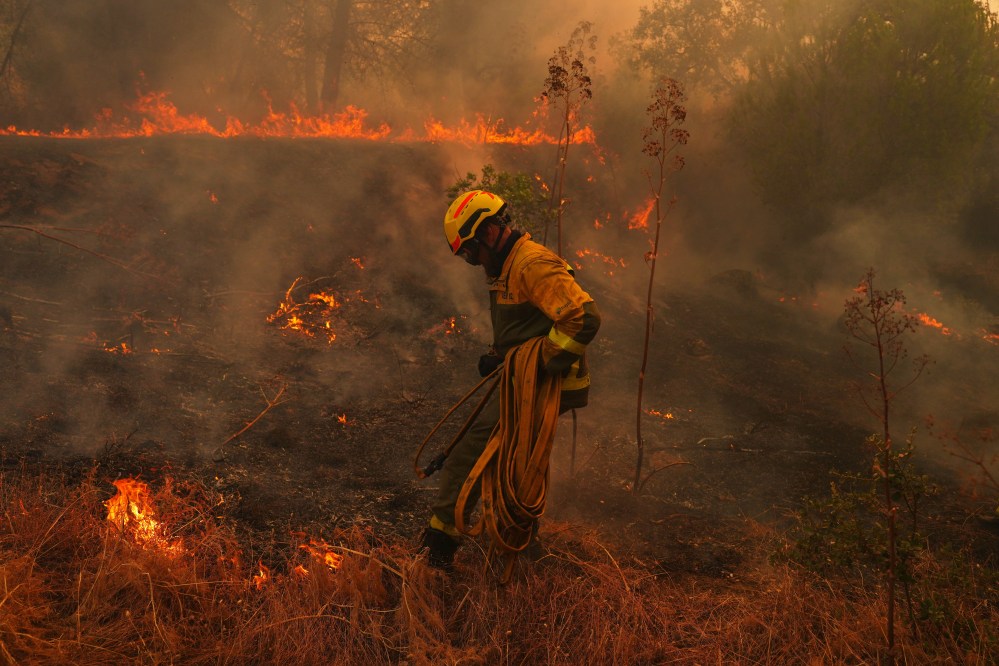
FILE - A firefighter carries a hose while battling a wildfire in San Martin de Valdeiglesias, west of Madrid, Spain, July 26, 2026. (AP Photo/Manu Fernandez, File)

Both studies examined changes in the weather that creates fire-prone conditions. The measurements factor in air temperature, drought conditions, humidity and wind.

“The change in these fire weather conditions in Spain is really extremely strong and is, I think, one of the largest changes that I’ve seen,” said Friederike Otto, an Imperial College of London climate scientist who coordinates World Weather Attribution. Spain is having its hottest summer on record, after an incredibly wet January that allowed plants to grow before a severe drought hit, a combination that increased wildfire fuel, the report said.

Spain also had the added problem of land abandonment, which left unmanaged plants and trees to dry out, Otto said. France’s Bordeaux region, meanwhile, had thick groves of pines that also burn well when a fire starts, she said.

World Weather Attribution — an international collaboration of scientists who examine extreme events to determine climate change’s role, if any — did that study so quickly, the report didn’t get peer reviewed, which is the scientific gold standard. But Otto and her colleagues used techniques that are scientifically accepted, and many of their reports are published in peer-reviewed journals later.

Warming world means fires ignite ‘more explosively’

Otto’s team calculated how much climate change — from the burning of coal, oil and gas — increased the chances for fires of this intensity to happen. They did so by comparing fire weather severity levels to past measurements for the region and to what they would be if the world was 2.5 degrees (1.4 degrees Celsius) cooler. That is how much Earth has warmed since pre-industrial times.

“This study makes sense and provides numbers to confirm what fire scientists already knew,” said Syracuse University fire scientist Jacob Bendix, who wasn’t part of either research. “We have always known that fires ignite more easily and spread more explosively under conditions of extreme heat and drought. And we’ve known for decades that extreme heat and drought are becoming more common due to anthropogenic climate change. So the general outline of these events, if not all the details, was tragically predictable.”

Thursday’s other study, in the journal Scientific Reports, finds that there were about 10 extreme fire weather days a year in Southern Europe in earlier decades, but it is now up to around 25 a year, said study author Raúl Cordero, a climate scientist at the University of Groningen in the Netherlands. And it is not just more frequent bad fire weather days. Those days are about 50% more intense than they were from 1981 to 2010, his study said.

Fires were decreasing until climate change overwhelmed gains

The number of Southern European fires and amount of land burned had decreased quite a bit from the 1980s to 2018, mostly because of better fire suppression and management techniques, Cordero said. But then things quickly got worse fast because climate change overwhelmed that improvement, he said.

“It doesn’t matter how many resources or how much money you have, you just cannot stop the propagation of a fire when the weather is so extreme,” Cordero said. “The climate forcing is so extreme nowadays that it’s just amazing.”

University of California Merced fire scientist John Abatzaglou, who also wasn’t part of either research, said, “these findings make clear that climate change is not just a future problem, it’s already here.”

“We need to stop burning fossil fuels,” Otto said. “Because as long as we keep burning fossil fuels, temperatures will increase globally. And that will mean that these fire weather conditions will get worse and worse and worse. And there are hard limits to what we can adapt to.”

___

The Associated Press’ climate and environmental coverage receives financial support from multiple private foundations. AP is solely responsible for all content. Find AP’s standards for working with philanthropies, a list of supporters and funded coverage areas at AP.org.


Report Error Submit a Tip

More Stories

Brandonmeat packer thriving on its own

Abiola Odutola 3 minute read Preview

Brandonmeat packer thriving on its own

Abiola Odutola 3 minute read Saturday, Oct. 3, 2026

BRANDON — Canada Packers has strengthened its business and laid the foundation for future growth during its first year as an independent company, its president says.

The Brandon-based pork producer, separated from Maple Leaf Foods in October 2025, established its own leadership, strategy, systems, culture and identity while continuing operations across its hog production farms and regional hog barns in southern and eastern Manitoba.

The company’s first year was focused on building a successful standalone business while continuing to serve customers, communities and shareholders, president Dennis Organ said.

“Market conditions over the past year have been more challenging than we anticipated when we became a separate entity,” he said in an email. “Despite that, we continued to execute against our priorities, including increasing processing volumes, maintaining disciplined operations and strengthening the business.”

Read
Saturday, Oct. 3, 2026

Six high school hockey programs ceased operations following new Hockey Manitoba policy

Joshua Frey-Sam 7 minute read Preview

Six high school hockey programs ceased operations following new Hockey Manitoba policy

Joshua Frey-Sam 7 minute read Friday, Oct. 2, 2026

She lived the best of both worlds.

For the last three years, the 17-year-old wore a sweater for two different hockey programs — her high school team and AAA club in the Manitoba Female Hockey League — and was preparing to flourish in both colours again this winter.

Recently, however, the blue-liner was disappointed to learn she is no longer eligible to play her Grade 12 season with her school owing to a new policy imposed by Hockey Manitoba that bans players from participating in the Manitoba Women’s High School Hockey League if they are rostered on a U18 AAA team.

The rule applies to all athletes who play for both Winnipeg-based and rural AAA teams.

Read
Friday, Oct. 2, 2026

Living the dream

Ken Wiebe 7 minute read Preview

Living the dream

Ken Wiebe 7 minute read Saturday, Oct. 3, 2026

DETROIT – As Tyrel Bauer took a left turn out of the tunnel from the Winnipeg Jets dressing room and into the stands, he was met with a hearty round of applause from the 25 friends and family members who had made the trek from various points around North America.

Bauer had just realized a childhood dream and the significance of the moment was not lost on some of his biggest supporters.

“It was a special walk, for sure. A special walk,” Bauer said on Saturday afternoon before the Jets departed for a two-game road trip that begins on Sunday in Detroit against the Red Wings. “Those people who came – and many more that weren’t there and were cheering on from afar – they’ve always been there.

“I wanted that for my family, maybe even more than I wanted it for me. They’ve been through thick and thin. I’ve stressed mom out quite a bit over the years doing my job. That meant a lot for them and I’m really happy they could be there for it.”

Read
Saturday, Oct. 3, 2026

The election of our discontent: City at a crumbling crossroads, grumbling residents say in poll

Matthew Frank 7 minute read Preview

The election of our discontent: City at a crumbling crossroads, grumbling residents say in poll

Matthew Frank 7 minute read Yesterday at 2:37 PM CDT

There’s an undercurrent of unhappiness running through the Winnipeg electorate as the municipal election day approaches.

One-half of Winnipeggers believe the city is heading in the wrong direction, according to a new Abacus Data poll, with nearly one-third unsure if Winnipeg is regressing or progressing.

Only 21 per cent of residents believe the city is on the right track, the Free Press-commissioned poll found.

That discontentment extends to how the city spends its tax dollars, with four in 10 Winnipeggers believing they receive poor value for what they pay in property taxes.

Read
Yesterday at 2:37 PM CDT

Province looks to seize notorious drug den

Erik Pindera 5 minute read Preview

Province looks to seize notorious drug den

Erik Pindera 5 minute read Saturday, Oct. 3, 2026

Provincial justice officials are trying to seize a Dominion Street drug den that has been the source of trouble in the West End for years.

The owner of 982 Dominion St., 45-year-old Robert Edward Johnson, was most recently arrested in June along with several others after a lengthy Winnipeg Police investigation into thefts and illicit drug sales connected to the house.

“The residence has a reputation within the neighbourhood as being a location where individuals habitually attend for the purpose of purchasing and/or consuming controlled substances,” reads a statement of claim filed by the province’s director of civil forfeiture in the Court of King’s Bench last week.

“For several years, the residence has been associated with criminal activity, violence, and disorder, resulting in numerous police attendances and complaints from members of the surrounding community.”

Read
Saturday, Oct. 3, 2026

Bombers get ‘whopped’ in Montreal

Taylor Allen 5 minute read Preview

Bombers get ‘whopped’ in Montreal

Taylor Allen 5 minute read Saturday, Oct. 3, 2026

MONTREAL — It’s hard to fathom that the Winnipeg Blue Bombers smacked these Montreal Alouettes five weeks ago.

The team that pulled off that 44-28 upset at Princess Auto Stadium was nowhere to be found in La Belle Province on Saturday night.

You can, however, now find them in the basement of the West Division at 7-8 after getting completely outmatched and outclassed by the Als in a 37-10 beatdown.

“This was bad,” left tackle Stanley Bryant told the Free Press postgame. “They basically had their way all around. They whopped our ass.”

Read
Saturday, Oct. 3, 2026