Partial solar eclipse, meteor shower a feast for skygazers in Canada
Advertisement
Read this article for free:
or
Already have an account? Log in here »
To continue reading, please subscribe:

Digital Subscription
One year of digital access for only $205*
- Enjoy unlimited reading on winnipegfreepress.com
- Read the E-Edition, our digital replica newspaper
- Access News Break, our award-winning app
- Play interactive puzzles
*First annual payment billed as $205.00 + GST for one year. This annual subscription will automatically renew at $233.00 + GST every 52 weeks (10% off the regular annual price of $259.35). Offer available to new and qualified returning subscribers only. Cancel any time.
To continue reading, please subscribe:
Add Free Press access to your Brandon Sun subscription for only an additional
$1 for the first 4 weeks*
- Enjoy unlimited reading on winnipegfreepress.com
- Read the E-Edition, our digital replica newspaper
- Access News Break, our award-winning app
- Play interactive puzzles
*Your next Brandon Sun subscription payment will increase by $1.00 and you will be charged $17.95 plus GST for four weeks. After four weeks, your payment will increase to $24.95 plus GST every four weeks.
Read unlimited articles for free today:
or
Already have an account? Log in here »
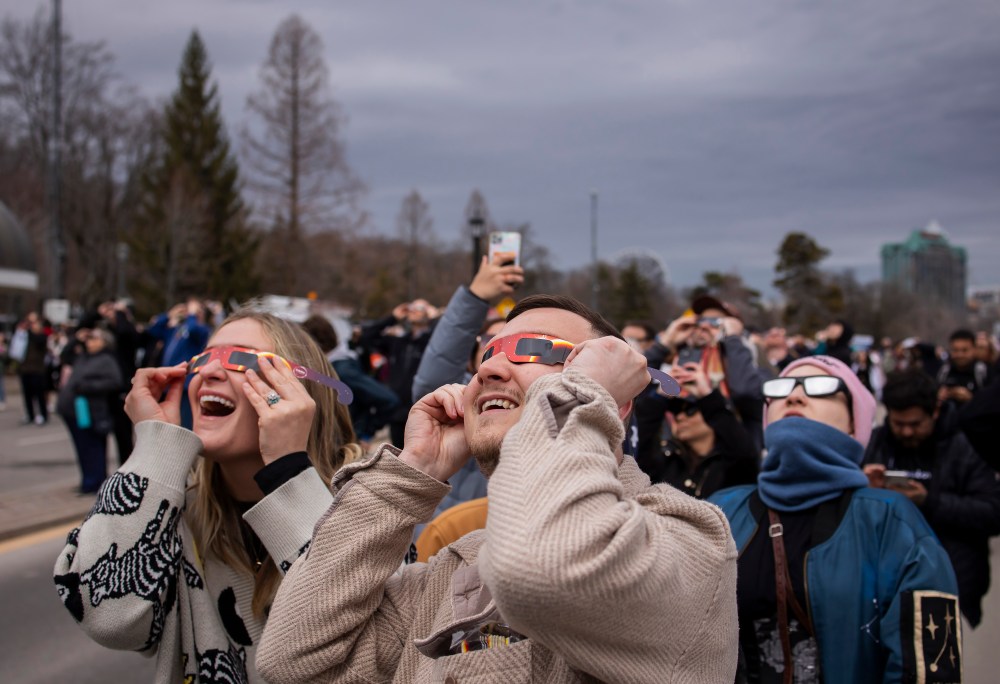
TORONTO – A partial solar eclipse was visible across the Maritimes, Ontario, Quebec and other parts of Canada on Wednesday as the annual Perseid meteor shower also reaches its peak this week.
The Canadian Space Agency said the timing of the eclipse and the amount of sun coverage differed by location. Partial eclipses happen when the moon passes between Earth and the sun and covers part of our star, and they should be viewed with special glasses to prevent eye damage.
More than 53 per cent of the sun in St. John’s, N.L., was obstructed by the moon at the eclipse’s peak while roughly 30 per cent of it was covered in Charlottetown and Halifax.
The moon covered a small portion of the sun in Toronto beginning at 12:55 p.m., reaching peak of eight per cent coverage at 1:40 p.m.
The sun coverage reached more than 18 per cent in Montreal and 15 per cent in Ottawa at the peak of the eclipse, which hit totality in parts of Europe.
Millions of people crowded in cities and towns in Spain to witness the event, which was the country’s first total solar eclipse in more than a century.
The crowds had some of mainland Europe’s best views of the eclipse. People in a sliver of Greenland and Iceland, too, may have witnessed the total eclipse — weather permitting.
Totality — when the moon completely covers the sun’s light — was expected to last less than 2 1/2 minutes, reaching its maximum duration off Iceland’s west coast.
By the time it got to a small patch of Portugal and to Spain, just before sunset, totality dwindled to a minute or so. The eclipse then ended over the Mediterranean.
The last widely visible total solar eclipse in North America, including parts of central and eastern Canada, occurred on April 8, 2024.
Skywatchers will also be able to see the Perseid meteor shower this week with 60 to 100 shooting stars per hour.
Walter Stoddard, a senior scientist at the Ontario Science Centre, said the best chance to see the Perseids is after midnight and into early morning of Thursday before dawn.
“That’s when you want to be looking, so from midnight on, let’s say, when the sky is darkest,” he said.
“You also want to find a place where you don’t have a lot of light.”
He said the Perseid meteor shower happens every year when Earth passes fields in space where asteroids or comets left debris behind.
A comet called Swift Tuttle, discovered in July 1862, passes by every 133 years and leaves a deposit of debris along its path, he said.
“As we orbit the sun every year we pass through that debris field and some of it gets caught up in our gravity, goes through our atmosphere and burns up,” he said.

“Those are the shooting stars that we see, the little bits of dust and debris left behind by the passing comet.”
Stoddard said the debris that burns in Earth’s atmosphere is not dense and contains very small minerals or ice the size of a grain of rice.
“Typically, if you have … a meteorite, something that’s survived and landed that we can pick up here on Earth,” he said, “you’ll have something that might be made of iron. They’ll often have metal in them so that they’re able to survive the heat of entry of coming through our atmosphere.”
This report by The Canadian Press was first published Aug. 12, 2026.
— With files from The Associated Press.
Related Articles
Millions crowd Spanish cities to see country's first total solar eclipse in over a century

Advertisement Advertise With Us
Advertisement Advertise With Us