Before-and-after NASA images show crater carved by a SpaceX rocket that slammed into the moon
Advertisement
Read this article for free:
or
Already have an account? Log in here »
To continue reading, please subscribe:

Digital Subscription
One year of digital access for only $205*
- Enjoy unlimited reading on winnipegfreepress.com
- Read the E-Edition, our digital replica newspaper
- Access News Break, our award-winning app
- Play interactive puzzles
*First annual payment billed as $205.00 + GST for one year. This annual subscription will automatically renew at $233.00 + GST every 52 weeks (10% off the regular annual price of $259.35). Offer available to new and qualified returning subscribers only. Cancel any time.
To continue reading, please subscribe:
Add Free Press access to your Brandon Sun subscription for only an additional
$1 for the first 4 weeks*
- Enjoy unlimited reading on winnipegfreepress.com
- Read the E-Edition, our digital replica newspaper
- Access News Break, our award-winning app
- Play interactive puzzles
*Your next Brandon Sun subscription payment will increase by $1.00 and you will be charged $17.95 plus GST for four weeks. After four weeks, your payment will increase to $24.95 plus GST every four weeks.
Read unlimited articles for free today:
or
Already have an account? Log in here »
CAPE CANAVERAL, Fla. (AP) — A NASA spacecraft circling the moon is providing the sharpest views yet of the crater carved by a crashing SpaceX rocket.
The space agency released before-and-after photos of the impact area on Tuesday.
The Falcon rocket’s upper stage plowed into the moon at 5,400 mph (8,700 kph) on Aug. 5 after drifting through space for more than a year. It launched a pair of private moon landers with experiments and even a tiny rover in 2025 as part of NASA’s push to commercialize lunar exploration.
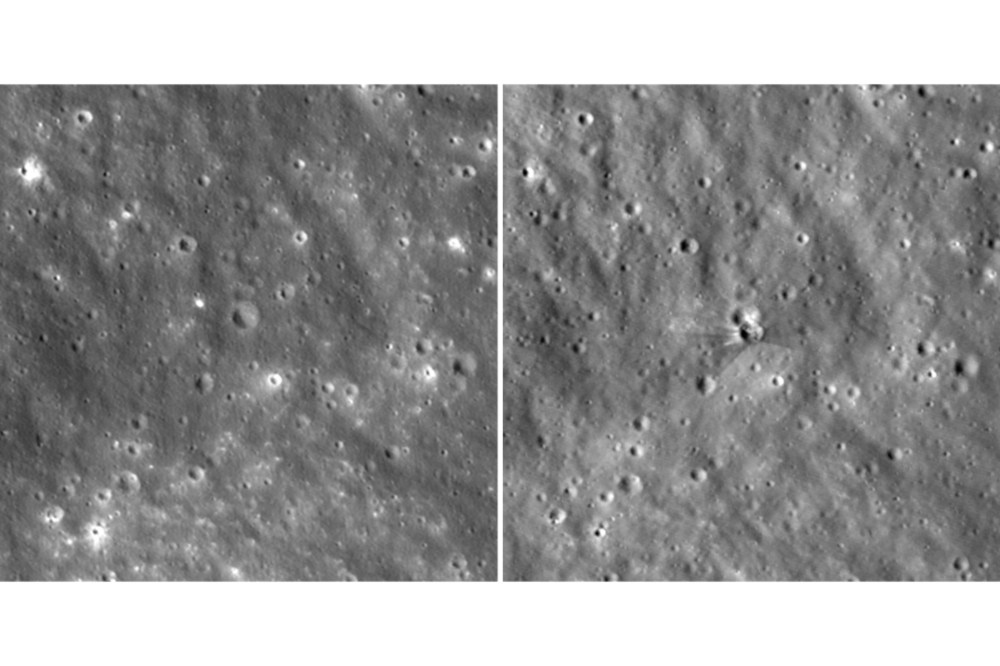
Based on these new photos by NASA’s Lunar Reconnaissance Orbiter, the fresh crater appears to be 60 feet (18 meters) across and less than 10 feet (3 meters) deep, according to scientists.
Dark and bright streaks are clearly visible emanating like butterfly wings from the crater. The darker lines represent excavated material that was close to the surface and shaped by eons of solar wind, cosmic rays and micrometeorite strikes. The brighter rays indicate fresh rocks and dirt that were hurled from farther down.
The spacecraft photographed the crater a week after the collision from 60 miles (96 kilometers) up, while zooming along at one mile per second. Flight controllers had to tilt the spacecraft so its cameras pointed toward the impact scene.

The orbiter completes a lunar polar orbit every two hours, as the moon rotates beneath. It took six days before the crash scene came into view.
South Korea’s Danuri spacecraft was first on the scene to beam back photos.
The Lunar Reconnaissance Orbiter has been orbiting the moon since 2009, serving as NASA’s up-close eyes as the space agency works to return astronauts to the lunar surface.
___
The Associated Press Health and Science Department receives support from the Howard Hughes Medical Institute’s Department of Science Education and the Robert Wood Johnson Foundation. The AP is solely responsible for all content.
Related Articles
Vietnam’s VinSpace signs deal with Elon Musk’s SpaceX to launch its first satellites in 2027

Advertisement Advertise With Us
Advertisement Advertise With Us