Telescope spies the fastest star in the Milky Way zipping around a black hole
Advertisement
Read this article for free:
or
Already have an account? Log in here »
To continue reading, please subscribe:

Digital Subscription
One year of digital access for only $205*
- Enjoy unlimited reading on winnipegfreepress.com
- Read the E-Edition, our digital replica newspaper
- Access News Break, our award-winning app
- Play interactive puzzles
*First annual payment billed as $205.00 + GST for one year. This annual subscription will automatically renew at $233.00 + GST every 52 weeks (10% off the regular annual price of $259.35). Offer available to new and qualified returning subscribers only. Cancel any time.
To continue reading, please subscribe:
Add Free Press access to your Brandon Sun subscription for only an additional
$1 for the first 4 weeks*
- Enjoy unlimited reading on winnipegfreepress.com
- Read the E-Edition, our digital replica newspaper
- Access News Break, our award-winning app
- Play interactive puzzles
*Your next Brandon Sun subscription payment will increase by $1.00 and you will be charged $17.95 plus GST for four weeks. After four weeks, your payment will increase to $24.95 plus GST every four weeks.
Read unlimited articles for free today:
or
Already have an account? Log in here »
NEW YORK (AP) — A telescope has spied the fastest known star in our galaxy, racing around the supermassive black hole at the center of the Milky Way.
The star is zipping around the black hole, reaching speeds of about 15,534 miles per second (25,000 kilometers per second). That’s 100,000 times faster than a commercial plane.
“That star is really, extremely fast,” said astronomer Stefan Gillessen with the Max Planck Institute for Extraterrestrial Physics.
The newly discovered star also orbits the black hole at closer range than scientists have ever seen before, taking just 8.7 years to complete a revolution. It harnesses the black hole’s gravity to fly faster without falling in.
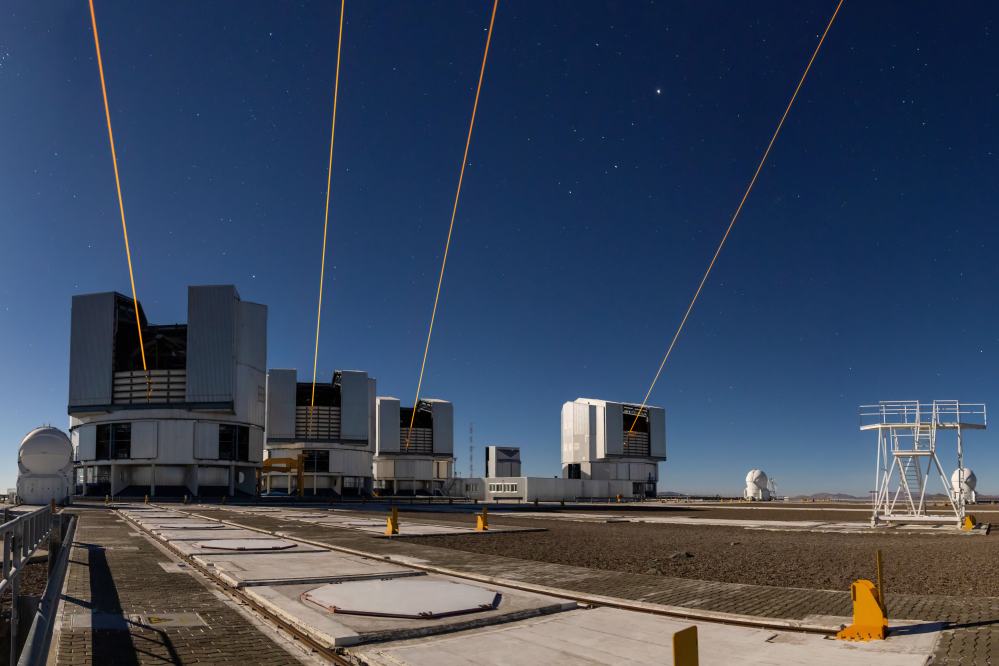
Gillessen and colleagues uncovered the star in data collected by the European Southern Observatory’s Very Large Telescope in Chile’s Atacama Desert. Their findings were published Wednesday in the journal Nature.
There are several hundred stars that closely orbit this giant black hole and are sensitive to its gravity. Scientists have mapped the orbits of around 50 of them. The new star is 10 times closer than the previous record holder, meaning that it also feels the effects of the black hole’s rotation.
There are supermassive black holes lurking in the center of almost every large galaxy. But nothing can escape them — not even light — so it’s notoriously difficult for scientists to figure out what’s going on inside.
Studying stars like this one could help scientists measure those mysterious properties, including how fast the supermassive black hole spins. Advanced telescopes are helping to pinpoint fainter stars that previously eluded detection, so there could be even speedier ones waiting to be found.
“This is just the tip of the iceberg,” said astronomer Tuan Do with the University of California, Los Angeles, who had no role in the study. “As we get fainter, there should be many more stars like this.”
___
The Associated Press Health and Science Department receives support from the Howard Hughes Medical Institute’s Department of Science Education and the Robert Wood Johnson Foundation. The AP is solely responsible for all content.