Rescuers use new tech to save caver trapped vertically in Alberta’s ‘Psych Squeeze’

Advertisement

Advertise with us

A caver has been rescued after being trapped underground at the Rat's Nest Cave in Canmore, Alta., in an operation that deployed volunteer-built underground radio technology for the first time.

Read this article for free:


or

Already have an account? Log in here »

To continue reading, please subscribe:

Subscribe and receive a limited-edition Free Press branded hat or tote.

Digital Subscription

One year of digital access for only $205*

  • Enjoy unlimited reading on winnipegfreepress.com
  • Read the E-Edition, our digital replica newspaper
  • Access News Break, our award-winning app
  • Play interactive puzzles

*First annual payment billed as $205.00 + GST for one year. This annual subscription will automatically renew at $233.00 + GST every 52 weeks (10% off the regular annual price of $259.35). Offer available to new and qualified returning subscribers only. Cancel any time.

To continue reading, please subscribe:

Add Free Press access to your Brandon Sun subscription for only an additional

$1 for the first 4 weeks*

  • Enjoy unlimited reading on winnipegfreepress.com
  • Read the E-Edition, our digital replica newspaper
  • Access News Break, our award-winning app
  • Play interactive puzzles
Start now

*Your next Brandon Sun subscription payment will increase by $1.00 and you will be charged $17.95 plus GST for four weeks. After four weeks, your payment will increase to $24.95 plus GST every four weeks.

A caver has been rescued after being trapped underground at the Rat’s Nest Cave in Canmore, Alta., in an operation that deployed volunteer-built underground radio technology for the first time.

Search and Rescue Alberta said the man became pinned in a tight spot known as the “Psych Squeeze” around 11:30 a.m. last Saturday.

The Alberta/BC Cave Rescue team was called in, and hammer drills were used to remove rock. The caver, who was trapped vertically, was eased out in a process measured in “inches per hour.”
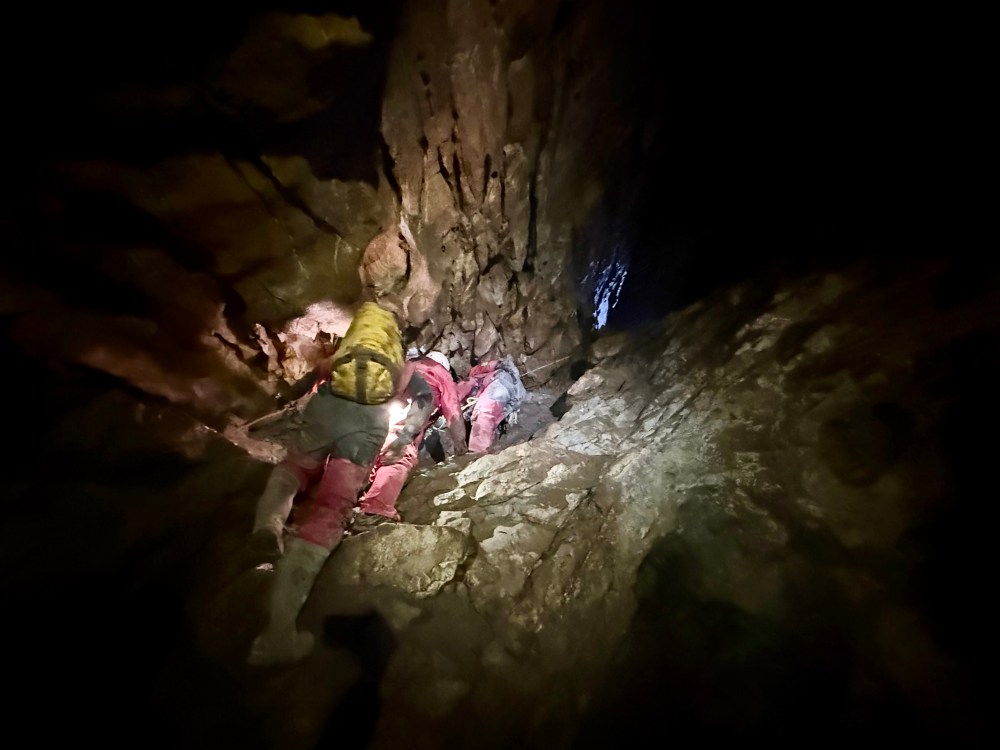
Search and Rescue Alberta and Alberta/BC Cave Rescue members along with Canmore Fire Rescue prepare to rescue a caver trapped in Rat's Nest Cave, in Canmore, Alta., in this Aug. 15, 2026 handout photo. THE CANADIAN PRESS/Handout - Search and Rescue Alberta (Mandatory Credit)

“Cave rescues are very rare and it’s even rarer to have to have someone stuck in a tight space and can’t free themselves,” said Christian Stenner, provincial coordinator with the Alberta/British Columbia Cave Rescue Service, in an interview Friday.

According to the Travel Alberta website, Rat’s Nest is Canada’s fourth-longest cave. The website says it is only accessible via a guided tour, and features “incredibly tight passageways” with names like The Laundry Chute. Another passageway has a 20-metre rappel.

“Both of these tours can be work, and are not for the out of shape. Expect bruises after your foray into the cave,” the website warns.

Stenner said the caver made his way a few hundred metres into the cave. He said it varies from an area where you can walk upright to spots which can require crawling on your hands and knees.

Stenner said he was wedged in the area about three metres down the cave, which was likely 30 to 40 metres from the actual surface of the ground. The man was freed around 10 p.m. and he finally emerged from the cave around midnight, after an operation involving 13 cave rescuers, 10 firefighters and two Kananaskis Mountain rescue members.

“I think he was pretty relieved. In the end he didn’t require to go to hospital or anything — it was just that physical entrapment. Once he was freed from that he was maybe a bit bruised, sore and tired because being trapped for many hours and trying to move exerts a lot of energy,” said Stenner.

“I don’t know if there was a cheer but certainly some relief and happiness.”

Stenner said a cave radio that transmits signals through rock was used in a live operation for the first time.

The technology was developed by members of Alberta/BC Cave Rescue, which is part of Search and Rescue Alberta, in response to the difficulty of using traditional communication methods like phones, radios or GPS underground.

“The ultra-low frequency radio wave is so wide it can penetrate through material like rock. It can go up to a half-kilometre … whereas the wave from a regular radio signal or a cellphone is such a narrow wave that when it hits material … it gets blocked,” he said.

It allows users to text through the dense rock and Stenner said if you compare the old way of doing things, this is much quicker.

“If you have to wait for a person to come out of the cave, tell the commander what the status is and then you have to send a person back into the cave to send the message or to get the resources that they need, it’s time consuming. So, to have the way to communicate almost instantaneously cuts down the time,” he said.

Work on the technology has been underway for years and this was its maiden voyage.

Stenner said that because cave rescues are rare, the radios had not actually been deployed on a live rescue. The latest version of the hardware was only recently finished.

“It worked perfectly. We couldn’t be happier,” Stenner said.

Stenner said the radio tech has already drawn interest from cave rescue groups around the world and it could have other useful applications in events including mine cave-ins.

John Alexander, the CEO of Search and Rescue Alberta, said the Rat’s Nest rescue “is a display of what can be achieved when multiple emergency response agencies come together in collaboration, and of the incredible innovation and initiative taken by our 1,500 volunteer search and rescue professionals who defy odds and overcome barriers every day, so others may live.”

This report by The Canadian Press was first published Aug. 21, 2026.

Report Error Submit a Tip

More Stories

Snowbird replacements ‘extremely manoeuverable, powerful,’ RCAF commander says

Kyle Duggan, The Canadian Press 4 minute read Preview

Snowbird replacements ‘extremely manoeuverable, powerful,’ RCAF commander says

Kyle Duggan, The Canadian Press 4 minute read Updated: 6:46 AM CDT

GATINEAU - The Royal Canadian Air Force welcomed on Thursday the first two of its new trainer aircraft, the CT-157 Siskin II — the same planes that will replace the old Tutor jets flown by the Snowbirds aerial demonstration team.

The turboprop planes will soon be headed to 15 Wing Moose Jaw, where the air force eventually will station 19 of them to serve as its main training fleet.

Acquiring the Siskin II, also known as the Pilatus PC-21, is part of the RCAF's plan to modernize its fleets and overhaul its training.

RCAF Commander Lt.-Gen. Jamie Speiser-Blanchet said the modern aircraft are well suited both to aerial acrobatics and to preparing pilots for the more advanced aircraft the air force is bringing online.

Read
Updated: 6:46 AM CDT

Canada-U.S. trade relationship is broken, but the damage can — and will — be repaired

Tom Brodbeck 5 minute read Preview

Canada-U.S. trade relationship is broken, but the damage can — and will — be repaired

Tom Brodbeck 5 minute read Yesterday at 1:35 PM CDT

Canada needs to get serious about diversifying its trade beyond the United States. But at the same time, Canadians should expect relations with the U.S. to normalize after Donald Trump is no longer in the White House.

For generations, Canada-U.S. trade was considered almost a fact of geography. The two countries share the world’s longest undefended border, deeply integrated supply chains and a century of commercial relationships.

Canadian manufacturers depend on American customers. American manufacturers depend on Canadian suppliers. Energy, agriculture, automotive production and countless other industries operate across the border as though it barely exists.

That isn’t going to change dramatically, even in the midst of a bitter trade war unleashed by the U.S. president.

Read
Yesterday at 1:35 PM CDT

Manitoba abandoning spring, fall clock changes

Carol Sanders 8 minute read Preview

Manitoba abandoning spring, fall clock changes

Carol Sanders 8 minute read Updated: Yesterday at 5:36 PM CDT

Time’s up for the time change in Manitoba.

Manitobans won’t be setting their clocks back an hour in November. The province has decided to permanently stay on daylight time after surveying residents on the twice annual clock adjustment.

“We heard from Manitobans loud and clear — no more changing the clocks in Manitoba,” Premier Wab Kinew said in a news release Thursday.

Most of the 72,000 votes submitted in an online EngageMB survey — 92 per cent — said they would like to see the practice end. The survey asked if they preferred earlier sunrises in winter with standard time or the later sunsets in summer with daylight time. More than half of survey participants (58 per cent) indicated a preference to stay on permanent daylight time; 34 per cent voted to eliminate the time change but stay on standard time.

Read
Updated: Yesterday at 5:36 PM CDT

Finding the balance on short-term rentals

Editorial 4 minute read Preview

Finding the balance on short-term rentals

Editorial 4 minute read 2:00 AM CDT

It’s fair to say the advent of Airbnb in 2008 changed the short-term rental market — it and its competitors gave hotels a run for their money, gave homeowners new ways to make an income and helped customers pay less for accommodations.

Read
2:00 AM CDT

Fiddling and a jig mark ceremony to rename Wolseley-area school

Maggie Macintosh 4 minute read Preview

Fiddling and a jig mark ceremony to rename Wolseley-area school

Maggie Macintosh 4 minute read 2:00 AM CDT

Beckoned by a fiddle, students broke out into a jig behind Little Bluestem School on Thursday evening to mark the end of a multi-year renaming process.

“I couldn’t help myself. I just had to dance,” eight-year-old Stevie Morrison said at a ribbon-cutting event to celebrate the new signage at 511 Clifton St., formerly known as Wolseley School.

Stevie and Fallon Lovelace Sharkey, 7, were out of breath after bouncing up and down to the beat, attempting to execute the Red River Métis dance moves they were taught at school.

There were cheers and tears as adults watched jigging on school grounds once named after a man who did not believe in Métis peoples’ right to self-determination.

Read
2:00 AM CDT

‘Parental rights’ issue resurfaces

Maggie Macintosh 5 minute read Preview

‘Parental rights’ issue resurfaces

Maggie Macintosh 5 minute read Yesterday at 2:00 AM CDT

Trustee campaign material that condemns rainbow flags is being met with outrage of all kinds, written complaints and, in one case, a cease-and-desist order.

“Parental rights,” including questions about classroom diversity, equity and inclusion policies, are resurfacing heading into school board elections across Manitoba.

“People are trying to advance their politics and their issues while simultaneously calling teachers ideologues and brainwashers,” said Shannon Moore, an associate professor at the University of Manitoba who studies sexual health education. “And I find that rich.”

Moore said parents have a right to choose independent school or homeschool, but they do not have a right to dictate curriculum that is currently developed using research and mainstream morals.

Read
Yesterday at 2:00 AM CDT