Scientists find a huge 10-sided wave pattern swirling in the clouds over Saturn’s south pole
Advertisement
Read this article for free:
or
Already have an account? Log in here »
To continue reading, please subscribe:
Digital Subscription
One year of digital access for only $1.44 a week*
- Enjoy unlimited reading on winnipegfreepress.com
- Read the E-Edition, our digital replica newspaper
- Access News Break, our award-winning app
- Play interactive puzzles
*Billed as $5.77 plus GST every four weeks. After 52 weeks, price increases to the regular rate of $19.95 plus GST every four weeks. Offer available to new and qualified returning subscribers only. Cancel any time.
To continue reading, please subscribe:
Add Free Press access to your Brandon Sun subscription for only an additional
$1 for the first 4 weeks*
- Enjoy unlimited reading on winnipegfreepress.com
- Read the E-Edition, our digital replica newspaper
- Access News Break, our award-winning app
- Play interactive puzzles
*Your next Brandon Sun subscription payment will increase by $1.00 and you will be charged $17.95 plus GST for four weeks. After four weeks, your payment will increase to $24.95 plus GST every four weeks.
Read unlimited articles for free today:
or
Already have an account? Log in here »
CAPE CANAVERAL, Fla. (AP) — Scientists have discovered an enormous 10-sided wave pattern in the icy ammonia clouds over Saturn’s south pole.
The spinning, meandering decagon appears to be even bigger and more unstable than the hexagon of clouds around Saturn’s north pole that was spied by NASA’s twin Voyagers in the 1980s, the Spanish-led team reported Wednesday.
This new jet stream formation popped up in the Hubble Space Telescope’s sights in 2023 after earlier observations came up empty. The researchers suspect the bizarre atmospheric phenomenon may have formed between 2017 and 2023, when Saturn’s south pole was tilted away from Earth and therefore out of view.
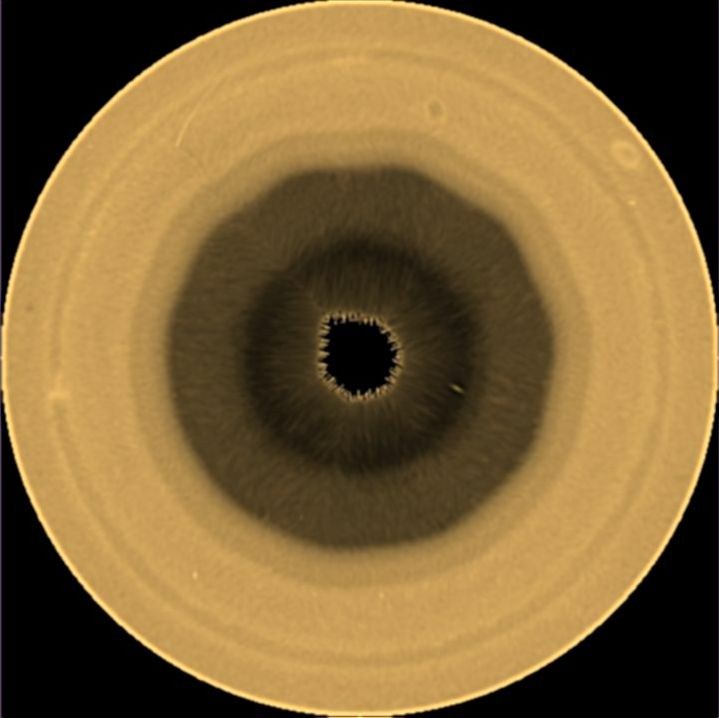
It could still be evolving, with a single side of the decagon already exceeding 10,000 miles (16,700 kilometers).
The findings are significant because it shows “the ‘unique’ hexagon is not as extraordinary as we thought,” lead author Agustin Sanchez-Lavega with the University of the Basque Country said in an email.
The findings were published in the journal Science Advances.
Although all of the solar system’s planets with atmospheres have wave-spawning disturbances, only Saturn churns them out looking like polygons, geometric shapes bounded by straight lines.
Both sit on jet streams, but the hexagon is practically stationary whereas the decagon migrates eastward at a tame 6 mph (10 kph).
“Saturn still has the ability to surprise us,” the University of Leicester’s Leigh Fletcher said in a statement. He measured the wind in the decagon as part of the study using the European Southern Observatory’s Very Large Telescope in Chile.
By comparing these two formations on opposite ends of Saturn, scientists can learn more about the weather patterns of giant gas planets, according to Sanchez-Lavega.
“This is a highly interesting phenomenon that appears to be unique to Saturn, and we want to know why,” he said.
Sanchez-Lavega wonders whether they might be related to the cyclones on Jupiter that are arranged in polygonal shapes. Improving views of Saturn’s southern hemisphere over the next several years should allow astronomers to capture more details of the decagon and perhaps solve “this intriguing atmospheric mystery,” he said.
It’s unclear whether the decagon will last as long as the hexagon, which has been visible by spacecraft for more than 40 years. That is longer than a Saturnian year, which is equivalent to 30 Earth years.
“For the time being, all I can confirm is that the decagon is still there,” Sanchez-Lavega said.
___
The Associated Press’ health and science coverage receives financial support from the AP Fund for Journalism and private foundations. AP is solely responsible for all content. Find AP’s standards for working with philanthropies, a list of supporters and funded coverage areas at AP.org.