Latvian citizens training with drones amid tensions with Russia
Advertisement
Read this article for free:
or
Already have an account? Log in here »
To continue reading, please subscribe:
Digital Subscription
One year of digital access for only $1.44 a week*
- Enjoy unlimited reading on winnipegfreepress.com
- Read the E-Edition, our digital replica newspaper
- Access News Break, our award-winning app
- Play interactive puzzles
*Billed as $5.77 plus GST every four weeks. After 52 weeks, price increases to the regular rate of $19.95 plus GST every four weeks. Offer available to new and qualified returning subscribers only. Cancel any time.
To continue reading, please subscribe:
Add Free Press access to your Brandon Sun subscription for only an additional
$1 for the first 4 weeks*
- Enjoy unlimited reading on winnipegfreepress.com
- Read the E-Edition, our digital replica newspaper
- Access News Break, our award-winning app
- Play interactive puzzles
*Your next Brandon Sun subscription payment will increase by $1.00 and you will be charged $17.95 plus GST for four weeks. After four weeks, your payment will increase to $24.95 plus GST every four weeks.
Read unlimited articles for free today:
or
Already have an account? Log in here »
RIGA – On a Thursday morning in August, about 20 executives from Latvia’s largest companies gathered in a former plywood factory.
The business leaders were not there to discuss market opportunities of market growth. Instead, they learned how to fly drones and familiarize themselves with the latest technology redefining modern warfare.
The old factory, in Latvia’s capital city of Riga, is now known as the Drone House.
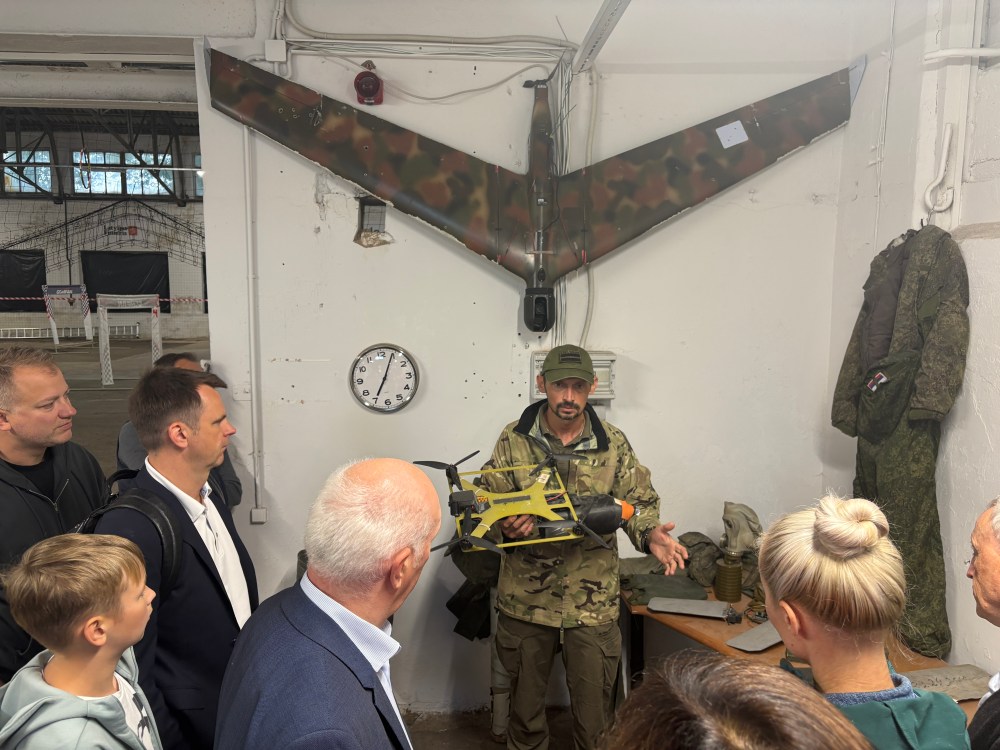
It provides a glimpse into local efforts by citizens organizing to strengthen their defences against growing threats from Russia in the context of a NATO mission that is led by Canada.
Local residents are learning how to fly and operate drones at the centre, which includes a 2,500-square-metre indoor hall and a 10,000-square-metere outdoor training area.
While taking a break from the training, businesswoman Laura Pica said she believes Latvians have a responsibility to defend their country.
“Look what we see in Ukraine, if civil citizens would not help, then probably Ukraine would be occupied,” she told The Canadian Press inside the training centre. “This is why we need to help our country to strengthen their forces.”
Being Russia’s neighbour is like standing next to “a monkey juggling with grenades,” she said.
“You can never know when it falls down,” she added.
Pica’s concerns are widespread in the Baltic country. NATO shot down a drone loaded with explosives in eastern Latvia three days prior.
Latvian authorities believe the drone was a Ukrainian aircraft that got diverted into Latvian airspace by Russian jamming.
“(Russia is) testing our limits and NATO limits,” said Maris Bruza, one of the four founders of the Drone House.
Testing those limits could include an operation to seize a portion of Latvian territory, just to see how NATO will react, he added.
The ambitious civilian project aims to train 50,000 citizens in the use of drones, including high school students who receive free training.
Even Ukrainian soldiers made their way to Drone House to provide training on the use of interceptor drones. The machines are designed to detect, track and neutralize enemy drones.
“At the moment, Ukrainians are the best in the world,” said Viesturs Silenieks, a co-founder of the Drone House. “No doubt that the best knowledge, expertise and practice comes from Ukraine.”
He explained that members of his team regularly travel to Ukraine, while Ukrainian military personnel frequently visit the Drone House to train and exchange information on the latest technologies developed on the front lines.
Among those training at the Drone House was Daiga Auzina, who has worked as a financial services manager for 20 years.
While she joked she does not have the skills to be a drone pilot, she stressed that investing in security and defence is crucial for Latvians.
“It’s on everybody’s mind today, it is our reality,” she said. “It’s not realistic to expect that governments will be able to help and cover every area.”
Auzina became emotional talking about the presence of Canadian soldiers, who have crossed the ocean to provide military support.
“I’m crying now because I think it’s just so great that Canadians are helping us,” she said.
Canada is leading a mission to “reassure, deter and defend” the Baltic states. But the situation is becoming increasingly complex.
With cyberattacks, armed drones, infrastructure sabotage, and disinformation campaigns, Latvia is facing threats that blur the line between war and peace.
Latvia’s new defence minister, Raivis Melnis, was appointed last May during a political crisis triggered by repeated drone attacks. The crisis led to the resignation of former prime minister Evika Silina.
Melnis, a former military officer, told The Canadian Press that Latvia is taking a proactive approach to the conflict that involves younger generations.
For example, the country reinstated conscription and added a mandatory national defence education course to school curriculums in 2024.
The 112-hour course, spread over two years, allows students to develop military skills and includes drone pilot training, according to the minister.
In Murjani, about 50 kilometres from Riga, volunteers aged 16 to 20 are preparing to participate in a drone-piloting competition using machines they assembled themselves.
The competition is the culmination of a two-week camp attended by members of the “Jaunsardzes,” the youth national guard.
Alesa Maza, 16, said it’s important to educate young people about drones “to demystify their intimidating aspect” and prevent panic when, for example, a drone enters the country’s airspace.
She said students are learning about the size of drones, their capabilities, what the aircraft can achieve and what to do when a drone is shot down.

After all, the teenager lucidly explained, drones are becoming an increasingly common part of Latvians’ lives, and “we’re going to be seeing them more so it’s just good to understand what it actually is.”
For many Latvians, defence is no longer just a matter for the military — it is everyone’s responsibility.
This report by The Canadian Press was first published Sept. 5, 2026.
—
This report was produced with a grant from the Fonds québécois en journalisme international.