What to know about Europe’s push to compete in space
Advertisement
Read this article for free:
or
Already have an account? Log in here »
To continue reading, please subscribe:
Digital Subscription
One year of digital access for only $1.44 a week*
- Enjoy unlimited reading on winnipegfreepress.com
- Read the E-Edition, our digital replica newspaper
- Access News Break, our award-winning app
- Play interactive puzzles
*Billed as $5.77 plus GST every four weeks. After 52 weeks, price increases to the regular rate of $19.95 plus GST every four weeks. Offer available to new and qualified returning subscribers only. Cancel any time.
To continue reading, please subscribe:
Add Free Press access to your Brandon Sun subscription for only an additional
$1 for the first 4 weeks*
- Enjoy unlimited reading on winnipegfreepress.com
- Read the E-Edition, our digital replica newspaper
- Access News Break, our award-winning app
- Play interactive puzzles
*Your next Brandon Sun subscription payment will increase by $1.00 and you will be charged $17.95 plus GST for four weeks. After four weeks, your payment will increase to $24.95 plus GST every four weeks.
Read unlimited articles for free today:
or
Already have an account? Log in here »
PARIS (AP) — Key figures from Europe’s space industry and other international players have converged on Paris to discuss how to advance the continent’s ambitions in a global market dominated by the United States.
The two-day International Space Summit that started Wednesday gathers officials, astronauts, researchers and industry leaders from about 120 countries to discuss the future of the space industry and pursue potential business deals.
“Europe is taking its destiny into its own hands, including in space,” French President Emmanuel Macron said in a message posted on X. He called for innovation and investment “to build a powerful Europe, independent even in space.”
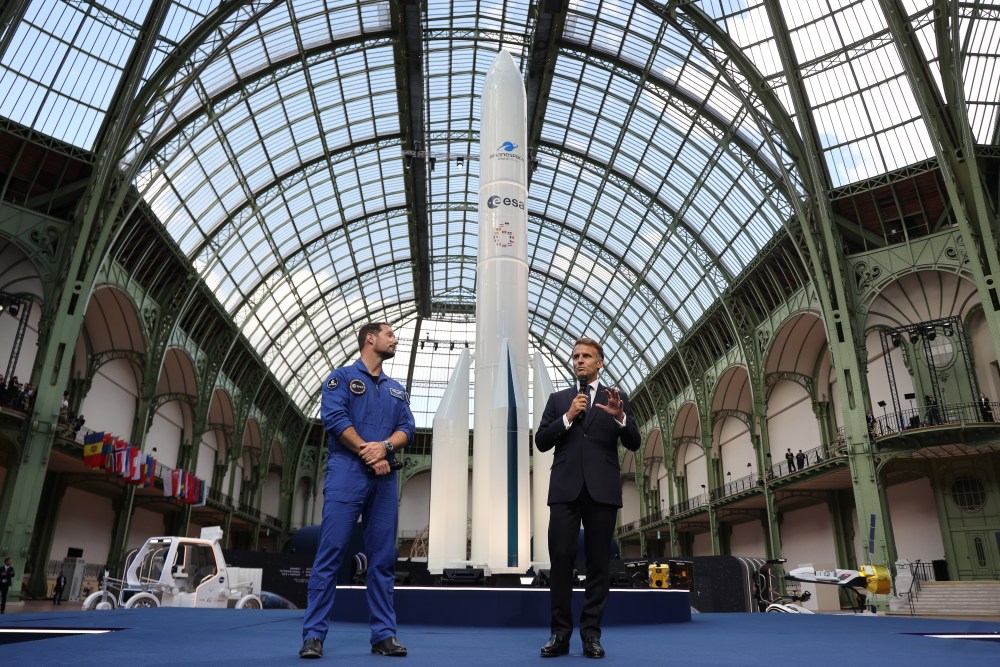
Here’s what to know about Europe’s efforts to compete in the global space race.
Europe seeks to build up sovereign space capabilities
Macron’s space summit underlines his push to reduce Europe’s reliance on the U.S. for vital tech services, which extends to space launches as well as satellites for communications and reconnaissance.
European nations have sought to build up their sovereign space capabilities since 2022 and Russia’s full-scale invasion of Ukraine, which highlighted how Elon Musk’s Starlink satellite communications service has become both a critical partner for Kyiv and a potential vulnerability.
Immediately after the war erupted, there were initial doubts about whether the billionaire would continue to fund Starlink services in Ukraine. Reports said Musk refused to let Starlink to be used to support an attack on a Russian naval base in 2022.
The European Union is working on a “sovereign satellite” constellation called Iris2 that is designed to rival Starlink by providing secure communications and connectivity to the 27-nation bloc’s citizens. However, it’s not expected to be fully operational until 2030.
Another inflection point came this year after the Iran war broke out and U.S. satellite imaging companies Planet Labs and Vantor started withholding images of the conflict region in the Middle East, apparently to prevent adversaries from attacking the U.S. and allies.
The Middle East conflict has fueled demand from countries for their own satellite imaging capabilities, said Emiliano Kargieman, CEO of Satellogic, which signed a deal earlier this year to supply Portugal with two high-resolution imaging satellites.
“For Europe there’s a lot at stake,” the director general of the European Space Agency (ESA), Josef Aschbacher said. “Satellites are really being utilized day in, day out. It’s what we call a critical infrastructure, therefore extremely important for every citizen.”
The United States is far ahead in the race
The United States remains the global leader in the space sector, with NASA conducting major exploration missions and overseeing the Artemis program, which aims to establish a human presence on the moon.
Musk’s rocket company, SpaceX, has transformed the commercial launch industry by making reusable rockets operational, lowering costs and increasing the frequency of launches.
Meanwhile, Amazon launched its first internet satellites in 2025. The company plans to deploy more than 3,200 satellites to provide broadband service around the world. Amazon’s founder Jeff Bezos also established the rocket company Blue Origin.
SpaceX and Blue Origin canceled plans to attend the Paris summit, the French government said. News outlet Politico reported that the White House had urged U.S. space companies not to attend because it could appear to support European Union policies.
“There can be tensions, as well as technological competition between major powers, particularly the United States and China,” a French presidential official said, speaking anonymously in keeping with the presidency’s customary practices. “We do have strengths, but we can see that things are accelerating and that much more money is needed.”
Ariane is the flagship of Europe’s rocket industry
The Ariane program allows Europe to launch satellites through missions including the Galileo navigation system, the Copernicus Earth-observation program and military and scientific satellites.
Ariane also operates commercial missions. Since the beginning of the year, the most powerful version of the rocket, Ariane 64, successfully put in orbit 100 Amazon Leo satellites in three launches as part of a contract for a total of 18 launches.
But Ariane, which relies on multiple European nations, requires complex logistics. The core stage of the rocket is assembled in France, while its upper stage is built in Germany with the support of hundreds of subcontractors across Europe.
Rocket components are transported by cargo ship across the Atlantic to Europe’s spaceport in Kourou, French Guiana, well-located for missions to geostationary orbit.
The rocket is also expendable, making it more expensive to operate than reusable competitors. There are only a handful of launches a year — in contrast to more than a hundred flights annually for SpaceX’s Falcon 9 rockets.
The continent needs more launch capabilities
European leaders are trying to build up domestic space launch capability so that the continent is less dependent on SpaceX rockets.
Musk has indicated that the company plans to “wind down” Falcon rockets and replace them with the bigger Starship, but space industry executives worry there could be a gap that could result in a “launch crunch” in a few years.
“Not being able to put your own satellite into orbit is a huge problem for Europe,” said Kargieman.
“China has its own launch capacity and Europe still doesn’t have a high-cadence, low-cost launch capacity, similar to SpaceX. This will undoubtedly be on everyone’s minds at the summit,” he said.
However, German startup Isar made a major breakthrough on Saturday in European efforts to catch up with SpaceX, when it successfully launched a rocket carrying satellites into space from Norway. It was the first such launch for a commercial European space company.

Aschbacher, the head of the ESA, said Europe should also build up its strength in space exploration. “One topic we discuss in particular is should Europe also build up astronaut flight capabilities?” he said. “That means bringing our own astronauts, with our own rockets or our own crew vehicle, to lower orbit and eventually beyond.”
___
Chan reported from London.
—-
This version removes the incorrect reference to Satellogic being based in Argentina.