Anthropic says its model Claude is helping to build the next version of itself
Advertisement
Read this article for free:
or
Already have an account? Log in here »
To continue reading, please subscribe:

Digital Subscription
One year of digital access for only $205*
- Enjoy unlimited reading on winnipegfreepress.com
- Read the E-Edition, our digital replica newspaper
- Access News Break, our award-winning app
- Play interactive puzzles
*First annual payment billed as $205.00 + GST for one year. This annual subscription will automatically renew at $233.00 + GST every 52 weeks (10% off the regular annual price of $259.35). Offer available to new and qualified returning subscribers only. Cancel any time.
To continue reading, please subscribe:
Add Free Press access to your Brandon Sun subscription for only an additional
$1 for the first 4 weeks*
- Enjoy unlimited reading on winnipegfreepress.com
- Read the E-Edition, our digital replica newspaper
- Access News Break, our award-winning app
- Play interactive puzzles
*Your next Brandon Sun subscription payment will increase by $1.00 and you will be charged $17.95 plus GST for four weeks. After four weeks, your payment will increase to $24.95 plus GST every four weeks.
Read unlimited articles for free today:
or
Already have an account? Log in here »
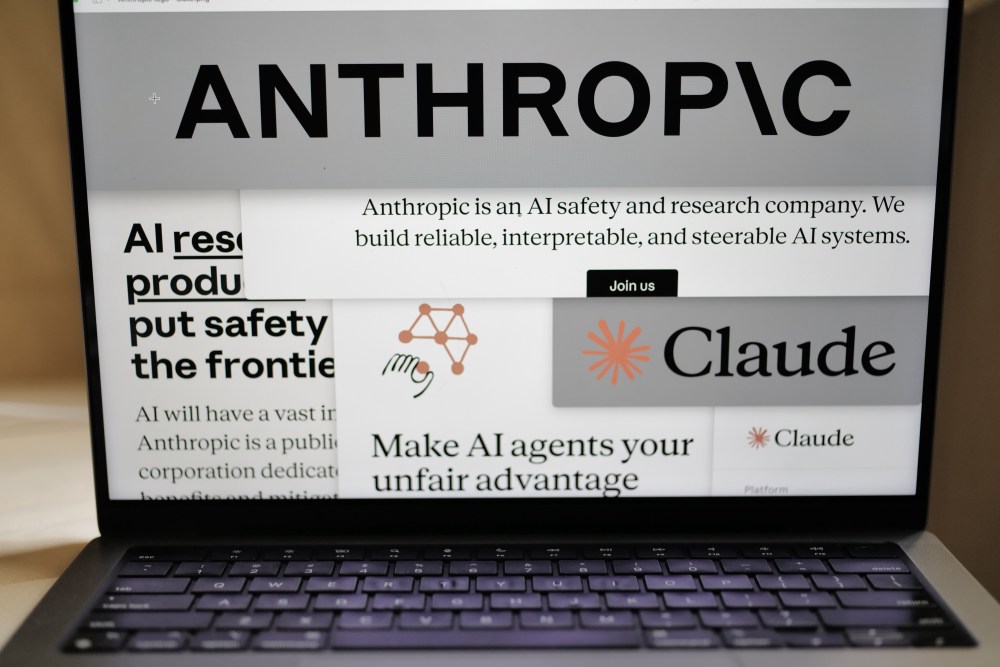
Anthropic’s Claude is helping the company develop the next, more intelligent version of the model, the artificial intelligence lab said in an announcement Thursday.
Claude is leading 26% of Anthropic’s model research and development, which the company said means it can complete most of a given task “end-to-end from a high-level prompt” while still being under human supervision. The model is not yet working completely autonomously.
Still, about 90% of the company’s research and development is done in “collaboration” with Claude, which Anthropic said means the model can do “large chunks of work under close human direction.”
The announcement came as some leading figures in AI, led in large part by Anthropic CEO Dario Amodei, are calling for a slowdown in the technology’s development over safety concerns.
As leaders consider pacing AI’s development, “we should do everything possible to minimize the gap between what frontier labs know and what the public knows,” the company said in a blog post. “This means better measuring the development of AI, reporting on it publicly, and giving society an opportunity to decide how to use this information.”
The company said that models accelerating their own development could make it “more challenging for humans to understand or control these systems.” It argued that sharing these metrics could lead to better understanding of how close leading AI labs are to reaching recursive self-improvement, or a model’s ability to autonomously build its successor.
Anthropic also urged other AI developers to share similar metrics on a regular basis, encouraging the use of a public methodology so the numbers could be compared over time, and potentially across labs.
It was unclear from Anthropic’s disclosure how close the company believes it is to achieving recursive self-improvement, but the pace at which Claude has increasingly contributed to research and development is notable. The portion of work Claude “leads,” or does in large part while remaining under human supervision, was none in February. Six months later, it was leading a quarter of research and development work, reaching that benchmark in August.
The company also shared details of agent oversight measures it has in place, noting that there were approximately 30,000 agents doing research and engineering work as of August. Oversight measures are crucial for seeing how often agent misbehavior is detected by monitoring systems, the company said. Anthropic recently committed to setting up external third-party evaluators who will be embedded within the company to monitor safety efforts.
An Anthropic researcher kicked off much of the recent dialogue around AI safety when he resigned last week with a dire warning about the threats the technology poses to humanity. Amodei, OpenAI CEO Sam Altman, Elon Musk and other tech leaders have since supported the idea of slowing down development, but other tech leaders and President Donald Trump have pushed back.