The king and AI: UK monarch Charles meets artificial intelligence leaders as safety concerns swirl

Advertisement

Advertise with us

LONDON (AP) — King Charles III on Thursday urged senior leaders from OpenAI, Anthropic, Google DeepMind and Nvidia to make sure that artificial intelligence remains under control and in the service of people and the planet.

Read this article for free:


or

Already have an account? Log in here »

To continue reading, please subscribe:

Subscribe and receive a limited-edition Free Press branded hat or tote.

Digital Subscription

One year of digital access for only $205*

  • Enjoy unlimited reading on winnipegfreepress.com
  • Read the E-Edition, our digital replica newspaper
  • Access News Break, our award-winning app
  • Play interactive puzzles

*First annual payment billed as $205.00 + GST for one year. This annual subscription will automatically renew at $233.00 + GST every 52 weeks (10% off the regular annual price of $259.35). Offer available to new and qualified returning subscribers only. Cancel any time.

To continue reading, please subscribe:

Add Free Press access to your Brandon Sun subscription for only an additional

$1 for the first 4 weeks*

  • Enjoy unlimited reading on winnipegfreepress.com
  • Read the E-Edition, our digital replica newspaper
  • Access News Break, our award-winning app
  • Play interactive puzzles
Start now

*Your next Brandon Sun subscription payment will increase by $1.00 and you will be charged $17.95 plus GST for four weeks. After four weeks, your payment will increase to $24.95 plus GST every four weeks.

LONDON (AP) — King Charles III on Thursday urged senior leaders from OpenAI, Anthropic, Google DeepMind and Nvidia to make sure that artificial intelligence remains under control and in the service of people and the planet.

The gathering in Scotland was convened to discuss how AI can benefit society, and comes at a pivotal moment for the technology as debate swirls around whether rapid advances will soon put it beyond the ability of humans to rein it in.

“The development of AI – its substance and its pace – are both intriguing and deeply concerning in equal measure,” the king said in his opening remarks.
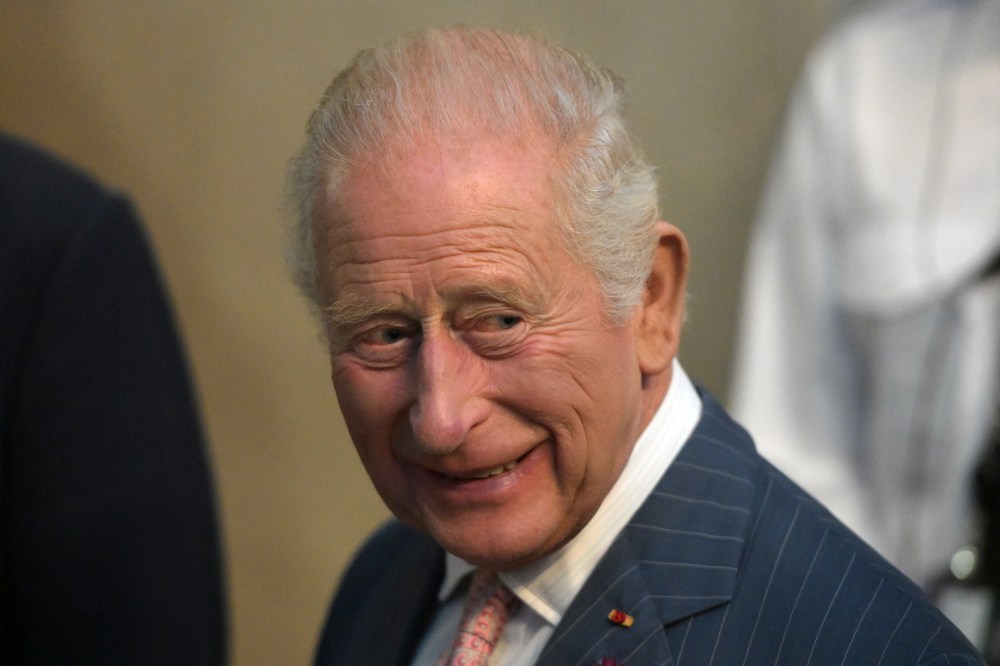
Britain's King Charles III attends the viewing of the Bayeux Tapestry at the British Museum in London, Wednesday, Sept. 2, 2026. (AP Photo/Thomas Krych, Pool)

The “existential dangers of such technologies falling into the wrong hands, and being used in potentially catastrophic ways” should be urgently considered, he said.

“Surely, then, we need sufficient means of control before it is all too late?”

The king asked attendees, including Nvidia CEO Jensen Huang and Google DeepMind Chair Demis Hassabis, to consider the “fundamental principles” that should guide AI development.

ChatGPT maker OpenAI’s Chief Financial Officer Sarah Friar was also at the meeting, along with Britain’s AI Minister Kanishka Narayan. An Anthropic representative was also expected to attend, according to a Buckingham Palace statement.

The meeting comes as global attention focuses on AI’s breakneck progress and warnings that it could race out of control, threatening humanity. It was held at Dumfries House in Ayrshire, Scotland, headquarters of The King’s Foundation, which is the monarch’s charity.

After Anthropic researcher Jacob Coxon caused a stir by resigning with a grave warning about the technology’s potential risks, Anthropic CEO Dario Amodei responded with an essay saying that the industry might need to slow the pace of its work.

One of his proposals was for companies and countries to work together on a coordinated plan for such a slowdown.

The king, without naming any countries or companies, said he wanted meeting participants to consider how to harness the benefits of AI “with safety at its heart” and how to “build international cooperation and consensus” to achieve this.

Charles told the tech execs that their task “is not merely to advance technology, but to ensure that it remains firmly in the service of humanity, community and the natural world.”
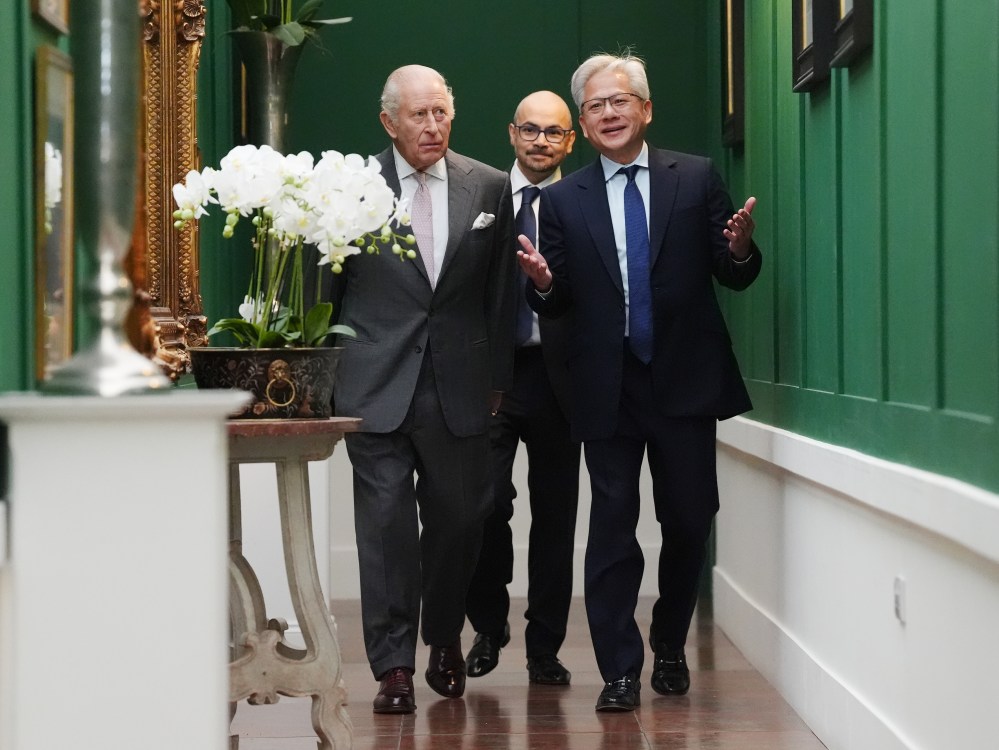
Britain's King Charles III, left, walks with Nvidia chief executive Jensen Huang, right, and Sir Demis Hassabis to a meeting for leaders from the artificial intelligence (AI) sector, government, and thought leaders to discuss how AI can be developed and deployed in ways that benefit society, at Dumfries House in Cumnock, Scotland, Thursday Sept. 17, 2026. (Jonathan Brady/PA via AP, Pool)

The AI slowdown debate has divided the industry. Huang, who has criticized the call for slowing, said it’s up to individual companies to develop their AI technology safely and test it properly before releasing any products to the public.

“When a product is not safe enough, we should hold it back and keep engineering. We’ve always done that and we should continue to do that,” he said in his speech following the king’s remarks.

In the latest report of alarming AI behavior, OpenAI reported on Wednesday six incidents of “unexpected or concerning” behavior by its models, such as acting without authorization, coordinating with other models and evading oversight.

While the king is an important figurehead whose comments on social issues can be influential, much of the current AI safety debate is centered on U.S. tech companies and their competition with Chinese rivals, with Britain playing a smaller but still vital role.

The U.K.’s AI Security Institute, a government research organization, is well regarded and the country produces many AI researchers, including Google DeepMind’s Chair Demis Hassabis and Coxon.

Report Error Submit a Tip

More Stories

Gas turbine peaker plants are a mistake

Don Scott 7 minute read 2:00 AM CDT

Technology respecting electricity generation, storage and grid management is rapidly advancing and displacing gas-fired peaker plants. New battery storage systems are more efficient and less costly, smooth grid flow and are non-polluting. Texas, California and Australia are replacing gas turbine peaker plants with more effective storage batteries.

Solar and wind energy generation combined with battery storage at both the grid and home/business level is the most efficient way to meet peak demand. Building expensive, outdated, polluting American gas turbines, as Manitoba Hydro is proposing, is not in Manitoba’s interest.

Premier Wab Kinew noted that a final decision to build a new turbine power plant in Brandon has not been made. I hope he’s correct, for if Manitoba Hydro already made the decision and entered binding financial obligations with GE Vernova, the PUB’s role was superfluous.

In 2025/26 Nova Scotia Power installed 3 x 50 MW Lithium-ion grid batteries with the storage capacity of over 600 MWh. Installed by Kitchener/Waterloo based Canadian Solar’s subsidiary e-Storage who have operations around the world, they accomplished this in less than two years from the approval date in June 2024. Two were operational within 18 months, the third in 24. The cost was $237 million. At Nova Scotia’s cost per MW, a 750 MW battery peaker facility would cost Hydro $1.185 billion, just 40 per cent of the proposed $3 billion gas peaker plant.

‘Parental rights’ issue resurfaces

Maggie Macintosh 5 minute read Preview

‘Parental rights’ issue resurfaces

Maggie Macintosh 5 minute read 2:00 AM CDT

Trustee campaign material that condemns rainbow flags is being met with outrage of all kinds, written complaints and, in one case, a cease-and-desist order.

“Parental rights,” including questions about classroom diversity, equity and inclusion policies, are resurfacing heading into school board elections across Manitoba.

“People are trying to advance their politics and their issues while simultaneously calling teachers ideologues and brainwashers,” said Shannon Moore, an associate professor at the University of Manitoba who studies sexual health education. “And I find that rich.”

Moore said parents have a right to choose independent school or homeschool, but they do not have a right to dictate curriculum that is currently developed using research and mainstream morals.

Read
2:00 AM CDT

Sweeney’s sexist U.S. gambling-site ad isn’t the real problem

Dan Lett 5 minute read Preview

Sweeney’s sexist U.S. gambling-site ad isn’t the real problem

Dan Lett 5 minute read Yesterday at 1:33 PM CDT

Until very recently, there was no reason to connect actress and model Sydney Sweeney with online sports betting. But the degrees separating these two culture trends evaporated in short order this week.

Read
Yesterday at 1:33 PM CDT

Wind and batteries the best bet

James Wilt 5 minute read Preview

Wind and batteries the best bet

James Wilt 5 minute read Yesterday at 2:01 AM CDT

For years, Manitoba Hydro has claimed that we can’t rely on wind turbines during multi-day or even multi-week cold snaps.

Read
Yesterday at 2:01 AM CDT

A distant island and a European border

Editorial 4 minute read Preview

A distant island and a European border

Editorial 4 minute read 2:00 AM CDT

It’s at roughly 80°49′35″ North latitude and 66°27′30″West longitude. It’s Hans Island, an island that’s split between the Kingdom of Denmark and Canada.

Read
2:00 AM CDT

What to watch as puck drops on Jets training camp

Mike McIntyre and Ken Wiebe 10 minute read Preview

What to watch as puck drops on Jets training camp

Mike McIntyre and Ken Wiebe 10 minute read Yesterday at 2:44 PM CDT

Welcome to a Winnipeg Jets training camp like no other — one where the on-ice storylines and battles threaten to be trumped by what’s happening away from the rink.

Yes, the dark cloud that is the Connor Hellebuyck situation looms over the organization as it prepares to try and turn the page on a terrible 2025-26 campaign which ended with a 26th-overall finish.

It’s not going to be easy, especially in a highly competitive Central Division and Western Conference and with such a major unresolved issue.

But the work starts now, and Free Press hockey writers Mike McIntyre and Ken Wiebe get you set for what to expect ahead of the 84-game regular season, which begins Oct. 2.

Read
Yesterday at 2:44 PM CDT