Private spacecraft falls back to Earth after failing to rescue aging NASA telescope
Advertisement
Read this article for free:
or
Already have an account? Log in here »
To continue reading, please subscribe:

Digital Subscription
One year of digital access for only $205*
- Enjoy unlimited reading on winnipegfreepress.com
- Read the E-Edition, our digital replica newspaper
- Access News Break, our award-winning app
- Play interactive puzzles
*First annual payment billed as $205.00 + GST for one year. This annual subscription will automatically renew at $233.00 + GST every 52 weeks (10% off the regular annual price of $259.35). Offer available to new and qualified returning subscribers only. Cancel any time.
To continue reading, please subscribe:
Add Free Press access to your Brandon Sun subscription for only an additional
$1 for the first 4 weeks*
- Enjoy unlimited reading on winnipegfreepress.com
- Read the E-Edition, our digital replica newspaper
- Access News Break, our award-winning app
- Play interactive puzzles
*Your next Brandon Sun subscription payment will increase by $1.00 and you will be charged $17.95 plus GST for four weeks. After four weeks, your payment will increase to $24.95 plus GST every four weeks.
Read unlimited articles for free today:
or
Already have an account? Log in here »
CAPE CANAVERAL, Fla. (AP) — The robotic spacecraft that failed to rescue an aging NASA telescope plunged back to Earth on Friday less than three months after launching on the bold mission.
Katalyst Space Technologies announced the demise of its three-armed spacecraft named Link. It reentered the atmosphere overnight, bringing the $30 million, NASA-sponsored salvage effort of the Swift Observatory to a close.
Swift is expected to follow in early November as its orbit steadily sinks.
“While we’ll be sad to see Swift’s mission come to a close, we knew this boost effort would be worthwhile either way,” NASA’s Shawn Domagal-Goldman said in a statement.
It provided valuable practice for future satellite-rescue missions and pushed teams to rush against the clock like never before, Domagal-Goldman added.
Thrown together in under a year, Link was supposed to capture the 22-year-old Swift and then boost it to a higher, longer-lasting orbit so it could keep observing some of the biggest explosions in the universe. The sun’s intense flare-ups had put the telescope on a downward spiral faster than engineers anticipated.
To buy time, NASA suspended observations early this year and repositioned Swift to minimize the atmosphere’s downward drag. Otherwise, the telescope would have come down before help could arrive, according to managers.
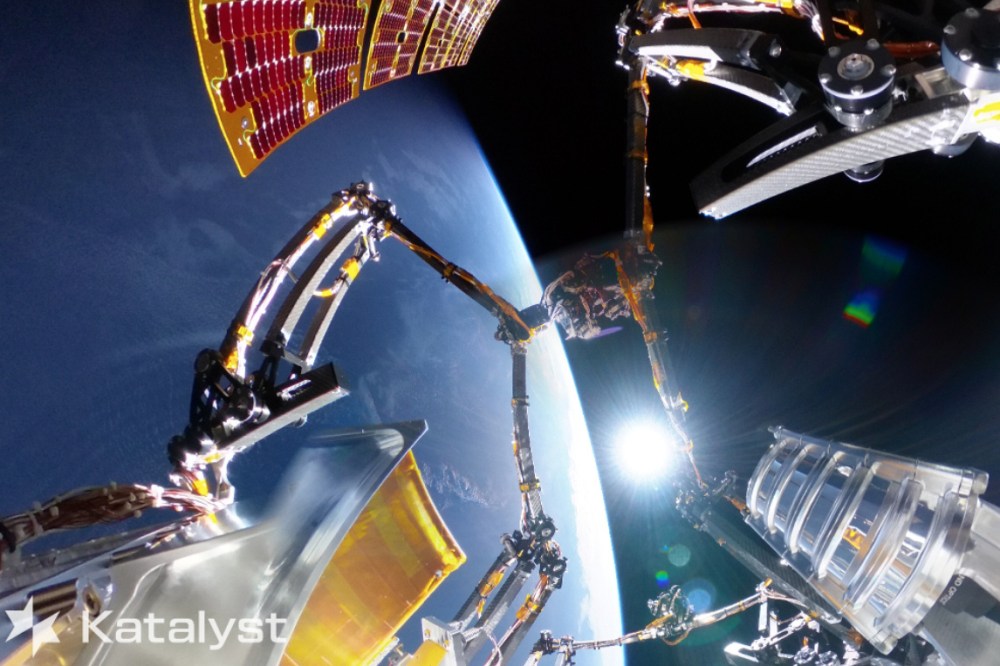
Link launched on July 3, but quickly ran into electronic problems that took out two of the three reaction wheels needed to turn the spacecraft. Then a bad valve sent the satellite into a fast spin that disrupted communication. Engineers regained control, but Link didn’t have enough fuel left to carry out its job and the rescue effort was called off in August.
Katalyst used the few weeks remaining to practice moving Link’s robot arms, each about 3 feet (1 meter) in length with a handlike gripper on the end. Flight controllers even managed to guide the spacecraft to within 7 miles to 9 miles (12 kilometers to 15 kilometers) of Swift, close enough to snap pictures.
“We knew from the beginning that this was an ambitious mission on an aggressive timeline,” Katalyst CEO Ghonhee Lee said in a statement.
Lee said the company will carry all the lessons learned to its future satellite-recovery endeavors. “This is a foundation we can build on,” he added.
Swift is back to scanning the universe in the month or so that it has left.
Launched in 2004, the $364 million observatory is designed to pivot quickly — as its name suggests — to capture gamma ray bursts, exploding stars and other fast-breaking cosmic action. That ability allows Swift to serve as a lookout or first responder for other telescopes that can follow its lead. NASA is scrambling to see how it now will fill that gap.
___
The Associated Press’ health and science coverage receives financial support from the AP Fund for Journalism and private foundations. AP is solely responsible for all content. Find AP’s standards for working with philanthropies, a list of supporters and funded coverage areas at AP.org.