Covert U.S. effort led to Canada’s acceptance of dubious postwar immigrants: study

Advertisement

Advertise with us

OTTAWA - Newly released passages from a landmark 1986 study say at least 35 people with apparently suspect backgrounds came to Canada after the Second World War through a covert program set up by U.S. intelligence agencies.

Read this article for free:


or

Already have an account? Log in here »

To continue reading, please subscribe:

Subscribe and receive a limited-edition Free Press branded hat or tote.

Digital Subscription

One year of digital access for only $205*

  • Enjoy unlimited reading on winnipegfreepress.com
  • Read the E-Edition, our digital replica newspaper
  • Access News Break, our award-winning app
  • Play interactive puzzles

*First annual payment billed as $205.00 + GST for one year. This annual subscription will automatically renew at $233.00 + GST every 52 weeks (10% off the regular annual price of $259.35). Offer available to new and qualified returning subscribers only. Cancel any time.

To continue reading, please subscribe:

Add Free Press access to your Brandon Sun subscription for only an additional

$1 for the first 4 weeks*

  • Enjoy unlimited reading on winnipegfreepress.com
  • Read the E-Edition, our digital replica newspaper
  • Access News Break, our award-winning app
  • Play interactive puzzles
Start now

*Your next Brandon Sun subscription payment will increase by $1.00 and you will be charged $17.95 plus GST for four weeks. After four weeks, your payment will increase to $24.95 plus GST every four weeks.

OTTAWA – Newly released passages from a landmark 1986 study say at least 35 people with apparently suspect backgrounds came to Canada after the Second World War through a covert program set up by U.S. intelligence agencies.

The previously secret details appear in a recently released version of a study on the resettlement of alleged Nazi war criminals in Canada during the Cold War era.

B’nai Brith Canada fought for years to see more of the report by researcher Alti Rodal, which was conducted for Canada’s inquiry on war criminals led by Jules Deschenes in the 1980s.
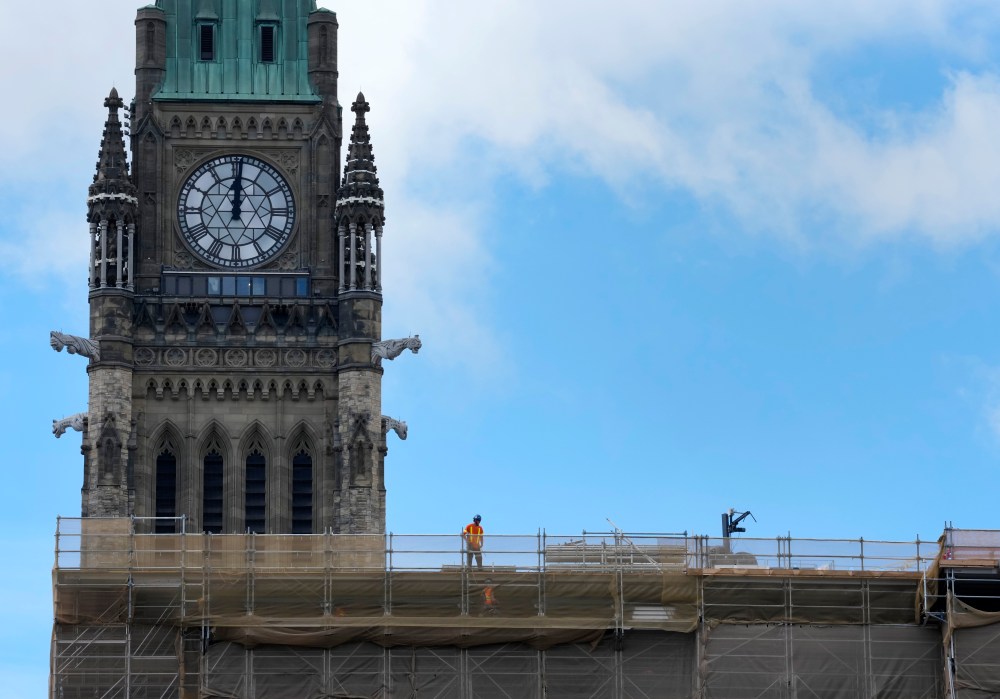
A worker stands on top of the Centre Block buildings below the Peace Tower on Parliament Hill in Ottawa on Tuesday, Sept. 8, 2026. THE CANADIAN PRESS/Adrian Wyld

In a ruling last month, the Federal Court ordered the release of some long-concealed portions of Rodal’s study.

The Canadian Heritage Department did not appeal the decision and Library and Archives of Canada provided B’nai Brith with the latest public version of the Rodal report.

Simon Wolle, B’nai Brith Canada’s chief executive officer, called the release a historic outcome. In a statement, he added the organization is pleased the information has been made available to the public, historians, survivors of the Holocaust and their descendants.

The study says in 1954, Canadian officials discovered the existence of an “active and organized program” run by the Research and Resettlement Branch of the U.S. army.

The program, known as USAREUR, was a cover for the U.S. Central Intelligence Agency and other American intelligence agencies engaged in the resettlement of persons who had “rendered them services,” Rodal writes.

The study says a USAREUR official confided to Canada that the U.S. agency’s aim was to resettle in other safe countries defectors from Communism and former agents who had worked for the Americans.

The study says that, according to that U.S. official, a number of these people had criminal records, some arising from cases involving “moral turpitude” — a category in which Nazi collaborators were included.

The USAREUR official provided the Canadians with a list of 35 people who had already gone to Canada with the assistance of the agency, the study says. It adds that subsequent RCMP checks led to the conclusion that nearly all of these individuals would have been “rejectable” on security grounds.

Rodal said the USAREUR episode suggests that in the years following the war — and particularly during the period before the RCMP’s discovery of irregularities in USAREUR’s activities — “American Intelligence personnel could well have assisted persons with war criminal background to immigrate to Canada.”

“They were in a position to provide such persons with false documentation and to report to Canadian Visa Control Officers in the course of their routine checks that there was nothing adverse about these prospective immigrants,” the study says.

Rodal concluded it would appear that large numbers of former agents were being resettled by the Americans, “and it was perhaps the less desirable ones, for whatever reason, whom they would have wished to resettle in another country, such as Canada.”

This report by The Canadian Press was first published Oct. 8, 2026.

Report Error Submit a Tip

More Stories

Collaros turns back the clock in crucial win over Stamps

Taylor Allen 7 minute read Preview

Collaros turns back the clock in crucial win over Stamps

Taylor Allen 7 minute read Sunday, Oct. 11, 2026

It was around this time seven years ago that the Winnipeg Blue Bombers officially became Zach Collaros’s team.

Making his first start in blue and gold after being acquired via trade, Collaros ran backwards to escape a collapsing pocket before rolling to his right and firing a perfect pass to Darvin Adams in the back corner of the south end zone during a home game against the Calgary Stampeders.

The play marked the beginning of the Collaros era in Winnipeg.

And a similar play Saturday night, once again against the Stampeders, served as a reminder that the 38-year-old pivot isn’t done just yet.

Read
Sunday, Oct. 11, 2026

Woman accused of pulling handgun on taxi driver

1 minute read Yesterday at 10:39 AM CDT

A 45-year-old woman accused of pulling a handgun on a Winnipeg taxi driver is facing multiple firearms-related charges.

It happened Sunday afternoon, at about 2:30 p.m., near the intersection of Concordia Avenue and Louelda Street. Officers learned a woman got into a cab in the Munroe East neighbourhood and pulled out a handgun, asking the driver to take her to a specific location, the Winnipeg Police Service stated in a news release.

The taxi driver activated the taxi's emergency beacon, exited the vehicle, and contacted police.

The woman got into the driver's seat of the taxi, but the keys had been removed, and she fled on foot. A suspect was arrested shortly afterward in the 1000 block of Concordia Avenue. Police seized a .22-calibre handgun during the arrest.

Manitoba e-scooter legislation changes set to impose speed limit, age restrictions, sidewalk ban

Matthew Frank 5 minute read Preview

Manitoba e-scooter legislation changes set to impose speed limit, age restrictions, sidewalk ban

Matthew Frank 5 minute read Sunday, Oct. 11, 2026

People riding e-scooters and other personal electric vehicles in Manitoba will have to strap on a helmet, stay off sidewalks and follow new age limits once new provincial rules for the devices take effect next year.

The vehicles, which also include electric skateboards, hoverboards and unicycles, will fall under The Highway Traffic Act starting in 2027, according to the province’s website. E-bikes are excluded from the new rules, according to the province’s frequently-asked-questions page.

All riders must be at least 16 years old and wear properly fitting helmets — that goes for passengers, too, the province said.

The proposed new legislation sets a speed limit of 25 km/h and would prohibit personal electric vehicles from sidewalks unless signs specifically allow sidewalk use. Riders would be using shared paths or roads with speed limits of 50 km/hr or less. They won’t be allowed to operate the vehicles under the influence of alcohol or drugs and they must use hand signals and obey traffic signs.

Read
Sunday, Oct. 11, 2026

Jets encouraged by play through first five games

Mike McIntyre 6 minute read Preview

Jets encouraged by play through first five games

Mike McIntyre 6 minute read Saturday, Oct. 10, 2026

Turkey. Stuffing. And a heaping helping of rest and recovery.

The Winnipeg Jets have plenty to be thankful for this holiday weekend, including a solid 3-1-1 start to the NHL campaign. Players and coaches are also counting their blessings at finally getting a breather after a busy stretch of five games in eight days.

“We don’t have another (break like this) until a week before Christmas. So we’re going to take advantage of it,” head coach Scott Arniel said following the club’s first regulation loss, a 5-1 stinker on Friday night against the visiting Anaheim Ducks.

To borrow a funny old Thanksgiving-related phrase from former defenceman Nate Schmidt, the hockey club was “leaking gravy.” They looked like a group that could use a timeout — which they’ll get since they don’t play again until hosting the Minnesota Wild on Tuesday night.

Read
Saturday, Oct. 10, 2026

‘People count on this place’: Pembina Hwy. Giant Tiger latest location slated to close

By Matthew Frank 3 minute read Preview

‘People count on this place’: Pembina Hwy. Giant Tiger latest location slated to close

By Matthew Frank 3 minute read Yesterday at 4:34 PM CDT

Another Giant Tiger store in Winnipeg will shutter next year, leaving some area residents concerned about a lack of affordable groceries in the neighbourhood.

Red papers taped to the front doors of the Canadian retail chain’s location at Pembina Highway and Southpark Drive indicate it will close Feb. 27.

Doreen Yanchuk, a self-described bargain hunter, shook her head when she saw the signs Monday. The 67-year-old said she’s a regular customer at the location because it’s a five-minute drive from her home.

“They have very good sales here, which draws people to the shop because everything is expensive,” Yanchuk said.

Read
Yesterday at 4:34 PM CDT

Riding the Unity Bus to rally support for Canada in Alberta

Melissa Martin 8 minute read Preview

Riding the Unity Bus to rally support for Canada in Alberta

Melissa Martin 8 minute read Updated: Yesterday at 9:57 PM CDT

WAINWRIGHT, Alta. — The Unity Bus arrives right on time, pulling into a parking lot on the edge of this town of about 6,600 people close to the Alberta-Saskatchewan border. As the vehicle slows to a halt, resplendent in its patriotic red-and-white paint, a small group of supporters stand waiting, decked in their own maple leaf garb.

The Unity Bus’s doors open and former Alberta deputy premier Thomas Lukaszuk bounds to the ground. The supporters, volunteers with Lukaszuk’s Forever Canadian campaign, welcome him with applause; he greets them with open arms. He knows many by name, having been to Wainwright four times; some of them fondly call him “the boss.”

“Do you need some stickers?” he asks. “Do you need some swag to give away?”

It’s a chilly Thanksgiving Monday morning on the eastern edge of Alberta. A sharp wind nips at exposed skin and drab grey clouds hang low in the sky. Such weather does not encourage high spirits, but Lukaszuk and these volunteers can’t afford to let theirs falter: in just one week, on Oct. 19, Albertans will vote on a historic question on whether to remain in Canada.

Read
Updated: Yesterday at 9:57 PM CDT