From ‘hands-free’ to ‘eyes-off’: how General Motors is simulating its way to autonomous driving
Advertisement
Read this article for free:
or
Already have an account? Log in here »
To continue reading, please subscribe:

Digital Subscription
One year of digital access for only $205*
- Enjoy unlimited reading on winnipegfreepress.com
- Read the E-Edition, our digital replica newspaper
- Access News Break, our award-winning app
- Play interactive puzzles
*First annual payment billed as $205.00 + GST for one year. This annual subscription will automatically renew at $233.00 + GST every 52 weeks (10% off the regular annual price of $259.35). Offer available to new and qualified returning subscribers only. Cancel any time.
To continue reading, please subscribe:
Add Free Press access to your Brandon Sun subscription for only an additional
$1 for the first 4 weeks*
- Enjoy unlimited reading on winnipegfreepress.com
- Read the E-Edition, our digital replica newspaper
- Access News Break, our award-winning app
- Play interactive puzzles
*Your next Brandon Sun subscription payment will increase by $1.00 and you will be charged $17.95 plus GST for four weeks. After four weeks, your payment will increase to $24.95 plus GST every four weeks.
Read unlimited articles for free today:
or
Already have an account? Log in here »
WARREN, Mich. (AP) — At the General Motors Global Technical Center in Warren, Michigan, in suburban Detroit, hundreds of volunteer, real-world drivers have hopped inside a Cadillac Lyriq electric vehicle or other popular GM models and experienced all sorts of things while in the car: regular roadway driving, driving up and down hills, construction, rain, nearby traffic and other scenarios.
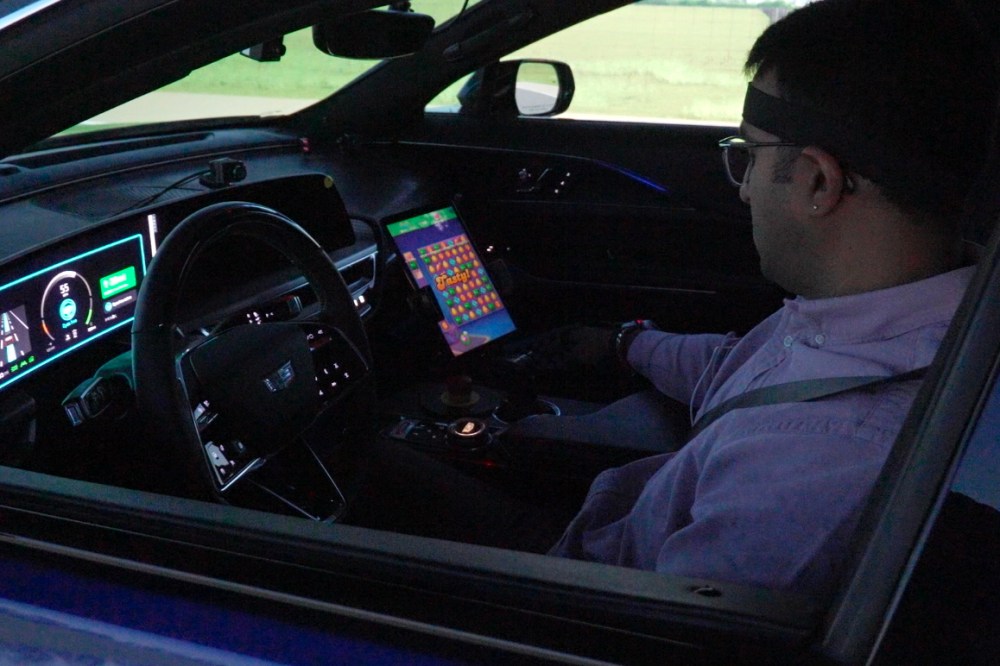
But while the vehicle is real, the world that the drivers are experiencing is not. Instead, they’re inside a simulator; a 360-degree, immersive environment where their every eye movement, heart stress, sweating and other reactions are measured against countless driving tests. Here, GM is testing a human driver’s response in vehicles just as much as it’s testing the vehicle tech itself.
That simulation is how GM — and other automakers — are testing future iterations of their advanced driver assistance systems. Also called ADAS, this technology so far allows for well-known vehicle features such as automatic emergency braking, blind spot warnings, lane departure warnings, lane-centering assist, surround-view cameras, driver attention monitors and many more.
These features let drivers go “hands-free” at certain times, particularly while on the highway.
Automakers anticipate that these systems will eventually grow so advanced that drivers will be allowed to safely take their hands off the wheel, and their eyes off the road. But the race is not only about the technology itself, but the payoff, which is a big one. Automakers with the best tech will get more consumers to subscribe to those capabilities, making automated driving a lucrative play for the industry.
“Going eyes off is really the turning point where consumers will be more willing to pay for this feature, because when you go eyes off, now you’re really potentially giving the driver back some time, because they don’t have to be paying attention to the road,” said Sam Abuelsamid, vice president of market research at firm Telemetry. “That’s where they see the real value proposition.”
GM says its version will be possible by 2028, when it’s launching the next Super Cruise on the Cadillac Escalade IQ luxury electric sport utility vehicle. Others are on their heels.
“2028 is the broad timeline when there’s a whole group of companies that are all targeting launching systems like this that can operate at highway speeds,” Abuelsamid added, “on a wider variety of roads than what we see with a lot of the systems today.”
GM’s tech evolving from ‘hands-free’ to ‘eyes-off’
Since 2017, GM has sold vehicles with Super Cruise, a hands-free, assisted driving system — notably not self-driving — that’s available to use on over 630,000 roads in the U.S. and Canada, and more around the world.
“You can take your hands off the wheel and keep your eyes on the roads, but safely enjoy a de-stressed drive on those roads in your normal, everyday commutes,” said Tyson Becker, GM executive director for autonomous vehicle strategy and product.
There are now more than 20 different GM models across its four brands — Cadillac, GMC, Buick and Chevrolet — equipped with the technology. The automaker plans to expand the number of models available with Super Cruise in the coming years with the ultimate goal of launching the next generation of Super Cruise, technology that allows for safe, “eyes-off” driving.
“What we’re talking about is truly a technology that is so safe that it allows you to take your eyes off the road while it’s active, and do other things in the cabin, whether that is looking at your phone, looking at your laptop, taking a meeting, watching a movie,” Becker added.
Simulation is part of what makes that future possible
One of the most challenging aspects of developing autonomous technology is predicting, and getting a vehicle to respond to countless, unexpected scenarios while on the road.
That could mean a dog, deer, or even a child, sprinting onto a road; a detour unforeseen on a navigation app or a suddenly active construction zone. A driver — or in this case, the technology — needs to be able to recognize that the immediate environment has changed, and to respond in a safe way.
That’s largely where simulation, combined with data collection and artificial intelligence, comes in.
In GM simulations, drivers of all experience levels take the wheel and face a multitude of computer-generated scenarios on highways or urban landscapes replete with other “humans” and roadway signage.
“We want to really be able to take anything that our customers could experience out on the road,” said Maureen August, senior manager at GM Research & Development.
The ultimate GM challenge for drivers … Candy Crush
As participants drive in the simulator, GM looks at key data points, like heart rate, stress, where the driver’s eyes are going, how long they are looking at one part of the road or another and how they are attending to the road, all from a nearby control room.
One of the best ways to test driver attention these days: inviting drivers to play Candy Crush.
“We found it’s very effective for getting people involved and wanting to get the highest score,” August said. “It’s a great way for us to get you engaged and then have to pull you away from a task.”
After participants drive, they’re asked how they felt, how they understood the system, and whether it was intuitive. Other factors GM looks at include comfort, how convenient certain features are to use, whether a driver feels the system is trustworthy and how many seconds are required for a driver to take full control of a moving vehicle.
“We want to make sure that you’re responding effectively and that we’ve given you the alert far enough ahead that you can take over if needed,” August said. “But we also want to be sure that if you feel comfortable and the vehicle is capable, that you don’t take over, that you let the vehicle do what it’s capable of doing.”
Other automakers racing to advanced technology
Hands-off technology is being deployed by many automakers today; Ford’s BlueCruise is among the more notable examples.
BlueCruise is available in equipped Ford vehicles for use on more than 130,000 miles of certain North American roads.
Tesla lists technology used in its cars as “Full Self-Driving,” but it still requires human oversight.
As for more advanced systems, there aren’t any passenger vehicles in production with eyes-off technology now — some tech companies, however, offer autonomous commercial robotaxi services in select cities.
Far smaller rollouts of sophisticated light-duty driving systems from various auto companies have been available in limited markets in recent years, but have been discontinued.
In addition to the technology challenges, there are regulatory hurdles, experts say.
“There isn’t really much in the way of real regulation that governs these systems today,” Telemetry’s Abuelsamid said. “And so, the automakers are basically going state by state to get approvals for where they can operate these systems.”

Because of that, he said, “it remains to be seen where GM will be able to offer their eyes off system come 2028.”
Ultimately, automakers are racing toward more advanced tech, not only to make their vehicles more enticing, but also to leverage subscription fees customers will pay to have the technology onboard.
The name of the game, Abuelsamid said, is “to provide enough convenience and safety, the consumers will be willing to pay a recurring fee to use it … so drivers can do things like watch a video, read a book, text — without having to watch the road all the time.”
___
Alexa St. John is an Associated Press climate reporter. Follow her on X: @alexa_stjohn. Reach her at ast.john@ap.org.