The not-so-secret vulnerability in Ukraine’s drone arsenal? Chinese technology
Advertisement
Read this article for free:
or
Already have an account? Log in here »
To continue reading, please subscribe:

Digital Subscription
One year of digital access for only $205*
- Enjoy unlimited reading on winnipegfreepress.com
- Read the E-Edition, our digital replica newspaper
- Access News Break, our award-winning app
- Play interactive puzzles
*First annual payment billed as $205.00 + GST for one year. This annual subscription will automatically renew at $233.00 + GST every 52 weeks (10% off the regular annual price of $259.35). Offer available to new and qualified returning subscribers only. Cancel any time.
To continue reading, please subscribe:
Add Free Press access to your Brandon Sun subscription for only an additional
$1 for the first 4 weeks*
- Enjoy unlimited reading on winnipegfreepress.com
- Read the E-Edition, our digital replica newspaper
- Access News Break, our award-winning app
- Play interactive puzzles
*Your next Brandon Sun subscription payment will increase by $1.00 and you will be charged $17.95 plus GST for four weeks. After four weeks, your payment will increase to $24.95 plus GST every four weeks.
Read unlimited articles for free today:
or
Already have an account? Log in here »
KYIV, Ukraine (AP) — Since Russia invaded more than four years ago, Ukraine has become a global leader in military drone innovation, enabling its forces to grind a much larger enemy to a stalemate.
But this technological force multiplier has come with an unsettling vulnerability: Ukrainian drone makers are highly dependent on electronics made by China, a key Russian ally.
Ukraine’s greatest fear is that the Chinese government could severely restrict its access to these critical parts. It also worries that Russian defense companies that need these same supplies could be given preferential treatment by Chinese factories.
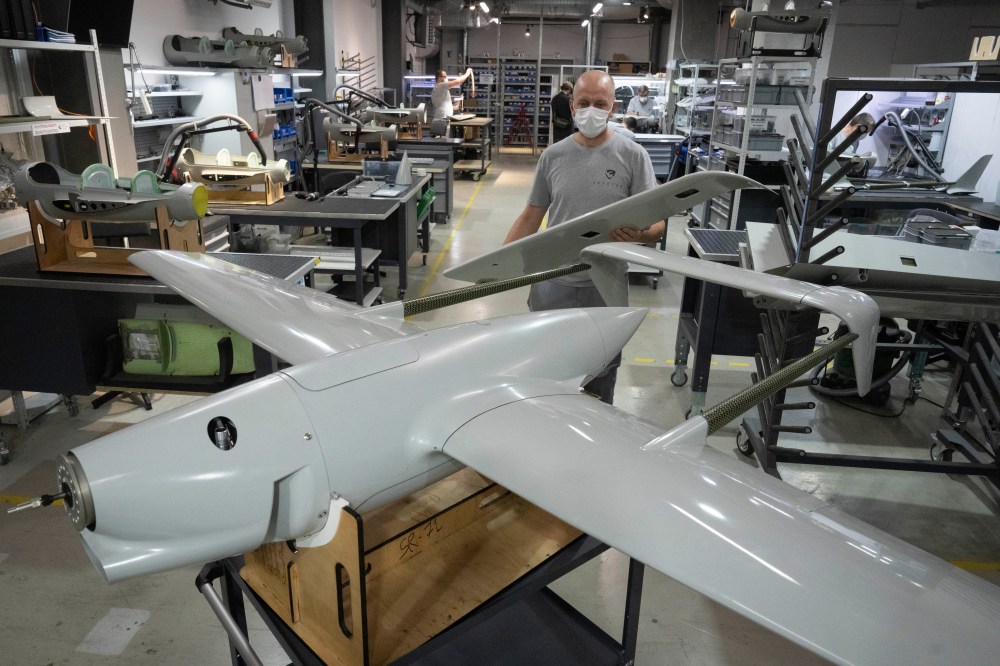
Over the past two years, Ukraine has sought to break its dependence on China by expanding domestic manufacturing and importing more supplies from Taiwan, Europe and the U.S. That has minimized its need for Chinese-made electric motors, flight controllers and other parts.
Yet Ukraine cannot entirely break free from China, whose lower costs and vastly greater production capacity cannot be matched by allied suppliers.
“If China stops their production to us … we are blinded,” said Andrii Taganskyi, an executive at Odd Systems, a Ukrainian weapons manufacturer that develops cameras for drones. “This is the scariest part.”
China has tightened controls on exports of drones and related equipment for several years, citing concerns about prolonging the war in Ukraine. While the restrictions have not stopped the flow of Chinese components to Ukraine, they have caused delays and driven up costs, pushing Ukrainian companies toward intermediaries in third countries.
“China has leverage,” said Robert Tallost, a researcher at the think tank RUSI. “They could direct more material to Russia while restricting supplies to the West.”
China’s Foreign Ministry said Beijing takes a “prudent and responsible” approach to military exports. It said it opposes the use of civilian drones for military purposes, and urged all sides to find a political settlement of the war.
Switching away from China would be expensive
Ukraine has earned worldwide recognition for its cutting-edge drone industry, designing and assembling systems that have changed modern warfare. Yet many of the materials and components that go into Ukrainian drones cannot be localized anytime soon.
Magnets, motors, chips, thermal sensors, battery cells and more still largely come from China, a dozen Ukrainian manufacturers said.
Switching entirely to Western alternatives could raise costs by as much as 60% and cut production by a similar amount, said Oleksandr Yakovenko of TAF Industries, a major Ukrainian defense company. That is not a viable tradeoff, Yakovenko and other executives said.
Still, Ukrainian drone makers have begun to wean themselves off of China.
Three years ago, the Ukrainian drone maker Vyriy relied upon China for nearly 90% of the components in its attack drones. “Today, about 70% to 80% of our components are made in Ukraine,” said Vyriy’s founder, Oleksii Babenko.
This increasing self-reliance has an extra benefit in the midst of a grueling war. Drones and drone components made domestically can be redesigned in a matter of days to meet urgent demands on the battlefield, whereas it can take months for such changes to filter through foreign supply chains, said Artur Savchii, an analyst at the Kyiv-based think tank Serpens Center for International Security.
At the beginning of 2024, nearly 90% of Ukraine’s imported drone parts came directly from China. In the first eight months of 2026, it was just 28%, according to Ukraine Customs data.
But the drop may not be as dramatic as it seems. Many components recorded as coming from Poland and the Czech Republic, for example, very likely were manufactured in China and routed through those countries.
Thermal cameras show why China is hard to replace
Ukraine can assemble batteries but must import the cells inside them. Motors require imported magnets and copper. And while Ukraine can manufacture some electronics, Chinese companies can produce them at far greater scale and roughly half the cost.
Thermal cameras show just how difficult it is for Ukraine to break its dependence.
Ukrainian companies design the cameras themselves but still rely on imported sensors, which detect infrared radiation, and lenses that cannot be made domestically, manufacturers said. One of the key raw materials is germanium, an element which China has in abundance, making Chinese lenses far cheaper than European alternatives.
Although the U.S. and Europe also make sensors, most of them are used domestically.
Ukraine could build thermal cameras entirely from European components, Taganskyi said, but capacity and cost are barriers: Europe produces about 600,000 thermal sensors a year, versus Ukraine’s estimated need for 4 million, he said.
For now, some Chinese components remain essential.
“Without this 5%, there is no camera,” Taganskyi said.
Ukraine competes with Russia for Chinese components
To be sure, Russia is even more dependent on China than Ukraine, experts say – in part because of Western sanctions that restrict its access to other markets. The difference is that Moscow doesn’t face the risk of its allies in Beijing tipping the scales in favor of Ukraine.
Ukrainian President Volodymyr Zelenskyy addressed Russia’s advantage vis-a-vis its relationship with China during a recent interview.
“They are slightly on Russia’s side. And by ‘slightly,’ I mean not direct weapons supplies, but a greater openness to them, a greater willingness to help them rather than us – and for a country as large as China, ‘slightly’ means a lot,” Zelenskyy said.
Competing with Russia for the attention of the same Chinese factories carries another risk for Ukraine: revealing its needs to the enemy.
The risk is clear to Babenko. A Russian drone recovered by the Ukrainian army on the front line was equipped with highly sophisticated antennas useful for long-range reconnaissance and guidance, and Babenko’s company traced the technology to a Chinese supplier. When the Ukrainians reached out to buy several hundred, the supplier initially refused, then agreed on the condition that they keep the deal private because the technology had been developed for Russia, Babenko said.
The episode underscored why domestic production is a matter of strategic security, Babenko said. “We should be ready for that situation when China will fully choose the Russian position,” he said.
Ukraine finds ways around Chinese restrictions
China has tightened export controls on drones and related components several times since 2023. The restrictions have made it impossible for Ukrainian companies to purchase some long-range civilian drones, motors, cameras and infrared imaging equipment directly from Chinese companies.
The restrictions, which were tightened further this summer, have forced Ukrainian defense companies to adapt by using intermediaries in third countries to keep Chinese-made drones and parts moving. Many said they suffered disruptions and higher costs.
“We just need to have partner companies which purchase it in other countries, then a third, then to Ukraine,” said one Ukrainian drone executive. “It’s like a special operation.”
Another executive said companies also get around export controls by altering product descriptions on government paperwork. “Sometimes you have to be creative,” he said. Both executives spoke anonymously to avoid revealing their tactics.
For now, Chinese factories’ willingness to do business with Ukrainian buyers, and the ease of routing goods through third countries, makes the trade difficult to shut down, said Joseph Webster, a senior fellow at the Atlantic Council.
“This dependence is not going to go away in a war where both sides are burning through equipment at a horrifying scale,” said Samuel Bendett, an analyst of military robotics. “Where domestic industry cannot keep up, China can.”