Ukraine’s strikes on Russian data centers disrupt key services and derail AI research
Advertisement
Read this article for free:
or
Already have an account? Log in here »
To continue reading, please subscribe:
Digital Subscription
One year of digital access for only $1.44 a week*
- Enjoy unlimited reading on winnipegfreepress.com
- Read the E-Edition, our digital replica newspaper
- Access News Break, our award-winning app
- Play interactive puzzles
*Billed as $5.77 plus GST every four weeks. After 52 weeks, price increases to the regular rate of $19.95 plus GST every four weeks. Offer available to new and qualified returning subscribers only. Cancel any time.
To continue reading, please subscribe:
Add Free Press access to your Brandon Sun subscription for only an additional
$1 for the first 4 weeks*
- Enjoy unlimited reading on winnipegfreepress.com
- Read the E-Edition, our digital replica newspaper
- Access News Break, our award-winning app
- Play interactive puzzles
*Your next Brandon Sun subscription payment will increase by $1.00 and you will be charged $17.95 plus GST for four weeks. After four weeks, your payment will increase to $24.95 plus GST every four weeks.
Read unlimited articles for free today:
or
Already have an account? Log in here »
Russia prides itself on its digital advances — from an extensive e-commerce services sector to ambitious plans for developing artificial intelligence.
But now, some of the key data centers at the heart of its technical prowess have been knocked out by Ukrainian drone attacks in the 4 1/2-year-old full-scale invasion, suffering damage that could take a long time to repair.
Ukraine this month hit three main data centers belonging to tech giant Yandex, one for Russia’s biggest bank, Sberbank, and one for social media platform VKontakte, the country’s equivalent to Facebook.

While Yandex, Sberbank and VKontakte are coy about the damage, people and businesses across Russia have reported widespread interruptions to cloud services. Banking, e-commerce, geolocation and ride-hailing services, as well as Alisa, Yandex’s virtual assistant, and multimodal AI chatbots all have suffered lasting disruptions.
The fallout even spread to Russia’s judicial system, reportedly forcing arbitration courts to cancel or postpone sessions and cutting database access.
Most experts predict repairing the damage could take months, if not years. Some warn that Moscow’s aspirations to become a leader in AI development could be significantly set back.
“This effectively sets Russia far behind in the AI race,” said Mikhail Klimarev, head of the Internet Protection Society activist group.
Data centers have been hit by both sides in the war
Data centers are the latest targets of aerial campaigns waged by both sides against each other’s vital infrastructure.
Russian missiles and drones have pummeled Ukraine’s power grid and other key sites, part of Kremlin efforts to weaken morale and resistance. Moscow stepped up those attacks as winter approaches, taking advantage of a shortage of U.S.-supplied Patriot interceptors, whose stockpiles have been drained by Washington’s war with Iran.
Ukraine retaliated with waves of drone attacks against Russian oil refineries, triggering a massive fuel crisis and bringing the war home to millions of civilians.
U.S. President Donald Trump has blamed the attacks for higher global oil prices, which have escalated largely due to the U.S. war in Iran. Earlier this month, Trump struck a deal with President Vladimir Putin to import diesel oil, shocking Ukraine and its allies.
Ukraine also hit huge warehouses for Russia’s top online retailers, Wildberries and Ozon.
Kyiv’s attacks on Russian data centers closely followed Moscow’s recent strikes on data centers in Ukraine, which disrupted the internet and TV broadcasts.
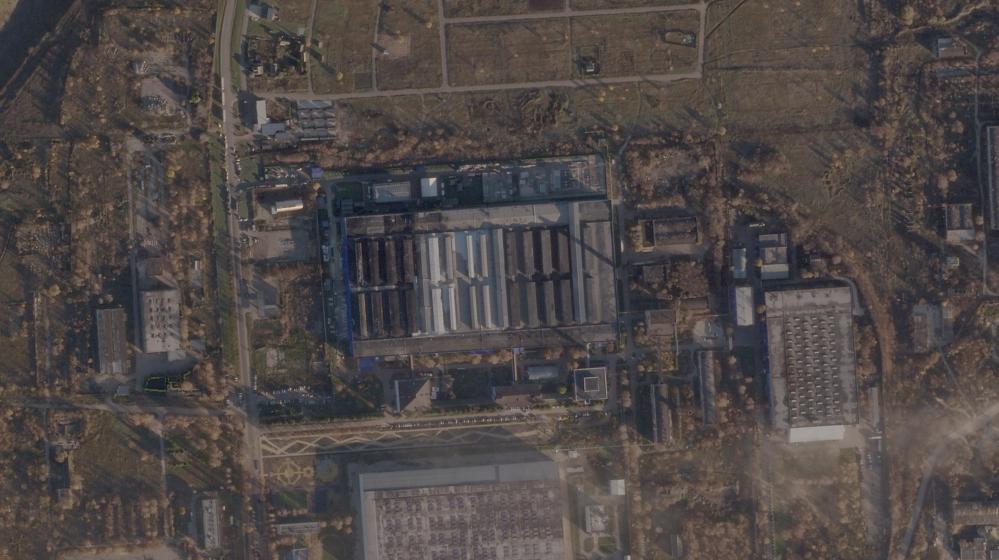
On Oct. 8, Ukrainian drones hit a Yandex data center in Sasovo in the Ryazan region that houses two of the company’s three supercomputers. A data center in Kaluga was hit a day later and the one in Vladimir was struck Oct. 11.
The data center and AI hub for Sberbank was hit Oct. 14 in Balakovo in the Saratov region, and four days later, Kyiv struck a data center in St. Petersburg serving VKontakte.
Data centers are vulnerable
While oil refineries and warehouses are easy prey, data centers are even softer targets — massive buildings packed with servers and supporting power and cooling infrastructure. Lasting damage can result from a drone carrying a relatively light load of explosives.
The vulnerability of data centers was exposed by Iran, whose drones hit two Amazon Web Services data centers in the United Arab Emirates and one in Bahrain. AWS said last month it was unable to restore access to the resources and data hosted at two of them.
Yandex has run drills for an accident that could incapacitate one of its six data centers, but it was caught unprepared when its three key facilities were hit over four days. It wasn’t immediately clear why air defenses near the sites had failed.
“The problem in Russia is that they’ve got to cover a big country with air defense and they don’t have enough,” said Nick Reiners, senior geotechnology analyst at Eurasia Group.
Russia’s efforts to build a ‘sovereign internet’ backfire
Ukraine has stored critical data on servers in allied European countries, helping limit the damage from Russian attacks. But Moscow’s strict digital sovereignty policy requires all data storage at home, making it extremely vulnerable.
“Because all the infrastructure and all the data is located inside Russia, it’s relatively easier to take down,” Reiners said.
Klimarev predicted the data center attacks could encourage many top Russian companies to move data abroad, while the authorities could ease their efforts to tighten internet controls to minimize the damage.
“Paradoxically, the strikes on data centers have saved the Russian internet from isolation, as they will now have to move computing assets, most likely, to Europe,” Klimarev said. “It’s quite likely that many Russian businesses are now roaming the European market to rent computing assets.”
Russians are vexed by service disruptions
Yandex dominates digital life in Russia and many former Soviet nations. It provides a wide variety of functions, including a search engine, cloud storage, payment apps, geolocation and ride-hailing services, and e-commerce platforms.
“Yandex is kind of like Uber and Amazon and Google and everything rolled into one,” with everything “concentrated in just a few data centers,” Reiners said. “From a strategic perspective, they’re an excellent target.”
The attacks on Yandex caused unprecedented disruptions, paralyzing payments, online orders, taxi rides and access to personal data.
Moscow resident Igor Mann said he couldn’t collect an order he placed with Yandex Market, an e-commerce platform. He said he tried using a virtual private network, but “nothing worked.”
Taxi driver Pavel Belyavskiy, who gets orders via Yandex’s ride-hailing app, couldn’t connect with passengers.
“On several orders already, I’ve ended up waiting for a long time and had to cancel the ride because I couldn’t even get in touch with the passenger,” he said.
The attacks also caused temporary disruptions at some major companies and banks that rely on Yandex cloud services.
“It’s not just about convenience — it’s also about work … tied to everyday life,” said another Moscow resident, Eduard Malyavko.
A blow to Russia’s AI ambitions
Yandex said it restored most key cloud services in the following days as it turned to other data centers in Russia. But the damage to the company’s AI development efforts is widely seen as massive and longer-lasting.
Yandex has invested in huge data centers as the global AI boom fuels demand for computing power. The company’s three supercomputers used to develop models are ranked among the top 500 in the world. Its most powerful computer — at the Sasovo data center — was ranked 19th.
Yandex didn’t disclose the extent of the strikes’ consequences, but satellite images indicated its data centers sustained serious damage. Some observers noted that fires triggered by the attacks probably seriously damaged high-end chips and other key equipment.
“With this kind of hit, it’s hard to expect that at least something was left intact — the data centers’ equipment is fragile, demanding and expensive,” Klimarev said. “Soot from the fire is bad for electronics.”
While Russia already lagged years behind the U.S. and China, “Ukraine’s drone strikes will likely still set back Russian AI efforts further,” said Connor Martin, an expert with the Council on Foreign Relations.

He said in a commentary that Russia likely will struggle to quickly replace the U.S.-designed Nvidia A100 chips powering Yandex’s supercomputers.
Klimarev also said the global deficit of high-end chips, combined with the sanctions on their delivery to Russia, will make repairs long and costly.
“I’m not sure it can be done in half a year, a year, or even at all,” he said.
___
Kelvin Chan in London and M Reo in Washington contributed.