Scientists finally crack code to create test-tube puppies

Canine IVF will impact wildlife conservation

Advertisement

Advertise with us

Last summer, seven 250-gram mutts from six parents tumbled out of the womb of a single mother.

Read this article for free:


or

Already have an account? Log in here »

To continue reading, please subscribe:

Subscribe and receive a limited-edition Free Press branded hat or tote.

Digital Subscription

One year of digital access for only $205*

  • Enjoy unlimited reading on winnipegfreepress.com
  • Read the E-Edition, our digital replica newspaper
  • Access News Break, our award-winning app
  • Play interactive puzzles

*First annual payment billed as $205.00 + GST for one year. This annual subscription will automatically renew at $233.00 + GST every 52 weeks (10% off the regular annual price of $259.35). Offer available to new and qualified returning subscribers only. Cancel any time.

To continue reading, please subscribe:

Add Free Press access to your Brandon Sun subscription for only an additional

$1 for the first 4 weeks*

  • Enjoy unlimited reading on winnipegfreepress.com
  • Read the E-Edition, our digital replica newspaper
  • Access News Break, our award-winning app
  • Play interactive puzzles
Start now

*Your next Brandon Sun subscription payment will increase by $1.00 and you will be charged $17.95 plus GST for four weeks. After four weeks, your payment will increase to $24.95 plus GST every four weeks.

Hey there, time traveller!
This article was published 15/12/2015 (3931 days ago), so information in it may no longer be current.

Last summer, seven 250-gram mutts from six parents tumbled out of the womb of a single mother.

This isn’t a math problem — it’s biology. And it has been solved for the first time by in vitro fertilization for dogs.

The technique of fertilizing an egg in a test tube and then implanting the embryo in a woman’s womb has been used to help human couples have children since the late 1970s, but scientists have struggled to do the same for canines. The birds and the bees, it would seem, work a little differently in dogs.

Michael Carroll / Cornell University College of Veterinary Medicine
Seven-week-old puppies born by in vitro fertilization. Canine IVF will help research into human health.
Michael Carroll / Cornell University College of Veterinary Medicine Seven-week-old puppies born by in vitro fertilization. Canine IVF will help research into human health.

But a team of researchers at Cornell University’s College of Veterinary Medicine, working in conjunction with the Smithsonian Institution, managed to tweak the IVF procedure enough to produce the seven healthy IVF puppies — the first in the world, they say.

The dogs, born July 10, are a mix of beagle, Labrador and cocker spaniel, according to The Associated Press.

“We each took a puppy and rubbed it with a little towel and when it started to squiggle and cry, we knew we had success,” Alexander Travis, who runs the lab at Cornell, told the AP. “Their eyes were closed. They were just adorable, cute, with smooshed-in faces. We checked them to make sure they looked normal and were all breathing.”

The birth of the puppies was a reward for years of research into making IVF work for dogs.

The problem, the scientists say, is that the canine reproductive cycle differs from that of humans and other mammals. When the female dogs’ eggs were extracted at the same stage of their menstrual cycle as is done for humans, the eggs weren’t yet ready to be fertilized.

According to a Cornell veterinary college press release, the team “found that if they left the egg in the oviduct one extra day, the eggs reached the stage where fertilization was most likely to occur.”

Altering the cell culture where the egg was fertilized also helped, they wrote.

The researchers tout the achievement as having significant implications for wildlife conservation.

“We can freeze and bank sperm to conserve the genetics of endangered species,” said co-author Alex Travis, a Cornell professor of reproductive biology.

The method can also be employed to preserve rare breeds both of show and working dogs.

But it’s also likely to have consequences for human health. Dogs and humans share some 350 inherited diseases, including cancer and diabetes. Using IVF will allow researchers to more closely examine how the traits that lead to those illnesses are passed down through dog — and ultimately, human — DNA.

Plus, who doesn’t like a scientific study that ends with seven adorable puppies?

— Washington Post
Report Error Submit a Tip

More Stories

Canada must not accept another Iranian autocracy

David Matas 5 minute read 2:01 AM CDT

Iran is a state run by a radical government victimizing its citizens and its neighbours. How do we change that? Any regime change that repeats the mistakes of the past is not a solution.

What went wrong in the past which led to the current regime? One answer is the U.K. and American aided coup which led to the ouster in 1953 of a democratically elected government headed at the time by Mohammad Mossadegh and its replacement with an American friendly autocrat, the Shah of Iran, Mohammad Reza Pahlavi.

The Shah imposed his rule through the Iranian National Intelligence and Security Organization — SAVAK, the acronym of its Persian name. SAVAK systematically inflicted torture, arbitrary killings and extra-judicial killings on perceived opponents of the regime. It was only a matter of time before repression of a regime directed to serving foreign interests would be overthrown.

What replaced the regime of the Shah, in 1979, the current regime of the mullahs, is a regime as intolerant and violent as the regime of the Shah and then some. That was not inevitable. But neither was it surprising. The vicious nature of the current regime, following the example set by the Shah, and its hatred for the United States, reacting to the U.S. aided imposition of the Shah, both echoes and reacts to the past. In 1979, the U.S. reaped what it sowed in 1953.

A quick look at where provinces and territories stand on time changes

The Canadian Press 2 minute read Preview

A quick look at where provinces and territories stand on time changes

The Canadian Press 2 minute read Updated: Yesterday at 6:28 AM CDT

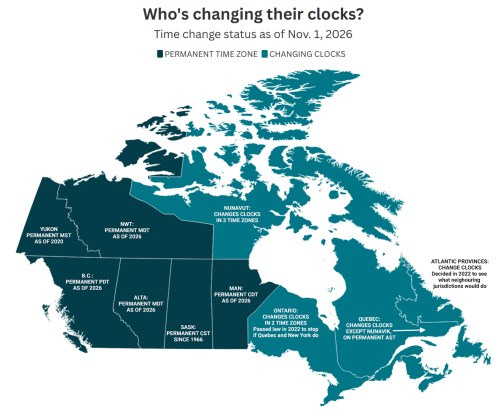
WINNIPEG - Manitoba's government said Thursday the province will be sticking with daylight time year-round, making it the latest jurisdiction to move away from twice-annual time changes. Here's a look at where things stand across Canada:

British Columbia said in March that it was moving to permanent Pacific daylight time. The change also means that parts of northeastern B.C., which have been on mountain standard time year round, are now in alignment with the rest of the province.

Alberta also switched to permanent daylight time this year in what it calls Alberta time. The change means it now has the same time as Saskatchewan year round.

Saskatchewan has been on permanent central standard time since 1966.

Read
Updated: Yesterday at 6:28 AM CDT

Klein launches mayoral campaign with pledge to make Winnipeg safest city in Canada

Joyanne Pursaga 5 minute read Preview

Klein launches mayoral campaign with pledge to make Winnipeg safest city in Canada

Joyanne Pursaga 5 minute read Updated: Yesterday at 7:48 PM CDT

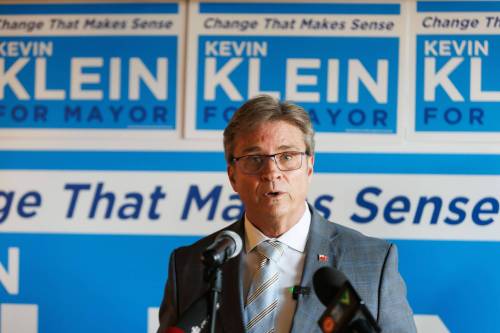
Mayoral candidate Kevin Klein says he would make Winnipeg the safest city in Canada by the end of his four-year term, if elected.

“Crime is happening all over the city and we have to take steps to address it,” Klein said at his first campaign announcement Friday morning.

The candidate said crime is “getting out of control,” noting his grandchild’s car seat was recently stolen from a vehicle parked in a typically quiet neighbourhood.

He promised to hire 100 to 110 more police officers, which he believes would cost between $9 million and $11 million.

Read
Updated: Yesterday at 7:48 PM CDT

Not falling back means time loop remains unclosed

Jen Zoratti 4 minute read 2:01 AM CDT

I demand restitution. Where’s my hour?

In the traditional fall-back, spring-forward time change set up — you know, ol’ trusty that’s been effect for lo these 63 years — we lost an hour in the spring that we got back in the fall.

That was the social contract: you commit to feeling like you’re on cold medication for a week in March because you know a glorious extra hour of sleep will be returned to you in November. (Unless, of course, you have little kids, but look: we all make our choices.)

Well, that transaction, flawed as it was, isn’t happening this year. That hour you sacrificed to the sun gods in the spring? Gone. Not coming back. We’ve sprung forward and we shan’t be falling back — not in November, and (possibly) not ever. The scale shall remain unbalanced and the loop shall remain unclosed as Manitoba has adopted permanent daylight time.

Gillingham in lead with decided voters

Nicole Buffie 6 minute read Preview

Gillingham in lead with decided voters

Nicole Buffie 6 minute read Yesterday at 6:55 PM CDT

A cloud of uncertainty is hanging over Winnipeg as October’s municipal election nears.

Three months after a poll showed more than 40 per cent of Winnipeggers wanted to see someone other than current mayor Scott Gillingham elected, a new Abacus Data poll indicates more than half of Winnipeg voters are undecided heading into next month’s civic election.

Of decided voters, 55 per cent favour Gillingham compared to 23 per cent for former councillor and provincial cabinet minister Kevin Klein and 11 per cent for funeral director Mike Vogiatzakis.

Of all respondents, just over 50 per cent said they were unsure while 13 per cent said they will not vote.

Read
Yesterday at 6:55 PM CDT

Canada-U.S. trade relationship is broken, but the damage can — and will — be repaired

Tom Brodbeck 5 minute read Preview

Canada-U.S. trade relationship is broken, but the damage can — and will — be repaired

Tom Brodbeck 5 minute read Thursday, Sep. 17, 2026

Canada needs to get serious about diversifying its trade beyond the United States. But at the same time, Canadians should expect relations with the U.S. to normalize after Donald Trump is no longer in the White House.

For generations, Canada-U.S. trade was considered almost a fact of geography. The two countries share the world’s longest undefended border, deeply integrated supply chains and a century of commercial relationships.

Canadian manufacturers depend on American customers. American manufacturers depend on Canadian suppliers. Energy, agriculture, automotive production and countless other industries operate across the border as though it barely exists.

That isn’t going to change dramatically, even in the midst of a bitter trade war unleashed by the U.S. president.

Read
Thursday, Sep. 17, 2026