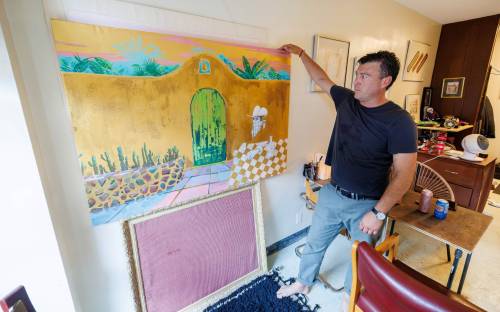
Sentimental items are hard to replace
Advertisement
Read this article for free:
or
Already have an account? Log in here »
To continue reading, please subscribe:

Digital Subscription
One year of digital access for only $205*
- Enjoy unlimited reading on winnipegfreepress.com
- Read the E-Edition, our digital replica newspaper
- Access News Break, our award-winning app
- Play interactive puzzles
*First annual payment billed as $205.00 + GST for one year. This annual subscription will automatically renew at $233.00 + GST every 52 weeks (10% off the regular annual price of $259.35). Offer available to new and qualified returning subscribers only. Cancel any time.
To continue reading, please subscribe:
Add Free Press access to your Brandon Sun subscription for only an additional
$1 for the first 4 weeks*
- Enjoy unlimited reading on winnipegfreepress.com
- Read the E-Edition, our digital replica newspaper
- Access News Break, our award-winning app
- Play interactive puzzles
*Your next Brandon Sun subscription payment will increase by $1.00 and you will be charged $17.95 plus GST for four weeks. After four weeks, your payment will increase to $24.95 plus GST every four weeks.
Read unlimited articles for free today:
or
Already have an account? Log in here »
Hey there, time traveller!
This article was published 16/02/2019 (2717 days ago), so information in it may no longer be current.
SO you’ve tossed a bunch of stuff after watching a series of episodes from Marie Kondo’s Netflix special.
Those extra shirts, the duplicated kitchen appliances, that blue wig you’re not sure why you had in the first place.
But it’s possible that a few short weeks later, the regret is already starting to kick in.
We could think of many of our own examples of throwing things out we later wish we’d kept — letters from an ex-boyfriend, a part to an Instant Pot unrecognized as being a part to an Instant Pot, maps from travels we could’ve framed. And yes, one of our children wanted to wear that blue wig for crazy hair day.
Perhaps lost in the conversation of the amount of joy sparked by decluttering is the very real regret many people feel after losing items forever.
The regret of tossing things is just as much an emotion as sparked joy, said Joseph Ferrari, a professor of general psychology and community psychology at DePaul University.
“Regret focuses on a variety of domains — jobs I didn’t take, relationships I had, things I got rid of,” he said. “Regret is also an emotion. It’s more of a depressive.”
We build relationships with items, he said, and when we get rid of them too quickly, it can result in negative or depressive feelings like regret.
For this reason, he suggests not immediately purging. Instead, stop and think about what you have.
“Don’t jump in and get rid of it right away,” he said. “Sort, strategize and then purge.”
Ferrari said the recommendations of decluttering experts he has worked with are not necessarily what Kondo suggests. For example, she says to hold the object and see if it sparks joy.
But he suggests the opposite. Don’t hold items, because touching something makes you want to keep it. “There’s this attachment of the fond memories,” he said. “Get a friend to come and hold the items, to say, ‘Do you want this?”
And consider the following: Could you buy it again? That pair of pants likely exists elsewhere, in a worst-case scenario of clothing regret. As far as more personal items, he said, many decluttering experts feel kindly toward keeping them.
“If it is sentimental, then hold on to it,” he said.
For items like appliances — or that part of the Instant Pot — those are likely things you can purchase again. The sentimental ones — the letters, the vacation mementoes — are things that might be harder to replace.
Consider donating an item, so it goes to a good cause.
Or give it to a family member who might appreciate it. Plus, you’ll still have access to the item. “Give it to a relative that might be happy with it, and you’ll be able to see their joy,” he said.
— Chicago Tribune