

Serta-fied success
North End recycling firm reaches significant milestone, diverting 50,000 mattresses from the landfill

Advertisement
Read this article for free:
or
Already have an account? Log in here »
To continue reading, please subscribe:
Monthly Digital Subscription
$1 per week for 24 weeks*
- Enjoy unlimited reading on winnipegfreepress.com
- Read the E-Edition, our digital replica newspaper
- Access News Break, our award-winning app
- Play interactive puzzles
*Billed as $4.00 plus GST every four weeks. After 24 weeks, price increases to the regular rate of $19.95 plus GST every four weeks. Offer available to new and qualified returning subscribers only. Cancel any time.
Monthly Digital Subscription
$4.99/week*
- Enjoy unlimited reading on winnipegfreepress.com
- Read the E-Edition, our digital replica newspaper
- Access News Break, our award-winning app
- Play interactive puzzles
*Billed as $19.95 plus GST every four weeks. Cancel any time.
To continue reading, please subscribe:
Add Free Press access to your Brandon Sun subscription for only an additional
$1 for the first 4 weeks*
*Your next subscription payment will increase by $1.00 and you will be charged $16.99 plus GST for four weeks. After four weeks, your payment will increase to $23.99 plus GST every four weeks.
Read unlimited articles for free today:
or
Already have an account? Log in here »
Hey there, time traveller!
This article was published 07/06/2021 (1772 days ago), so information in it may no longer be current.
The landfill is where mattresses go to die a slow, destructive death. Mother Earth Recycling is where they go to be resuscitated and reborn, a new lease on life for fabric, foam and springs.
In Winnipeg, about 35,000 coily, cushiony kings, queens and twins are buried — mattress to mattress, fluff to fluff — in mounds of garbage each year; that’s enough to fill the Manitoba Hydro building from the street level on Portage Avenue to its tippy top, 115 metres up, says Jessica Floresco, Mother Earth’s general manager.
Factor in surrounding rural municipalities and Winnipeg’s annual tower of mattress detritus would be the tallest building in town, with apologies to the newest high-rise under construction at 300 Main St.

Since 2015, Mother Earth, a North End firm that is 100 per cent Indigenous-owned and operated, has taken it upon itself to shorten that leaning tower of Sealys, Sertas and Caspers, diverting them from a destiny of rot while salvaging the reusable materials to send them to a better place.
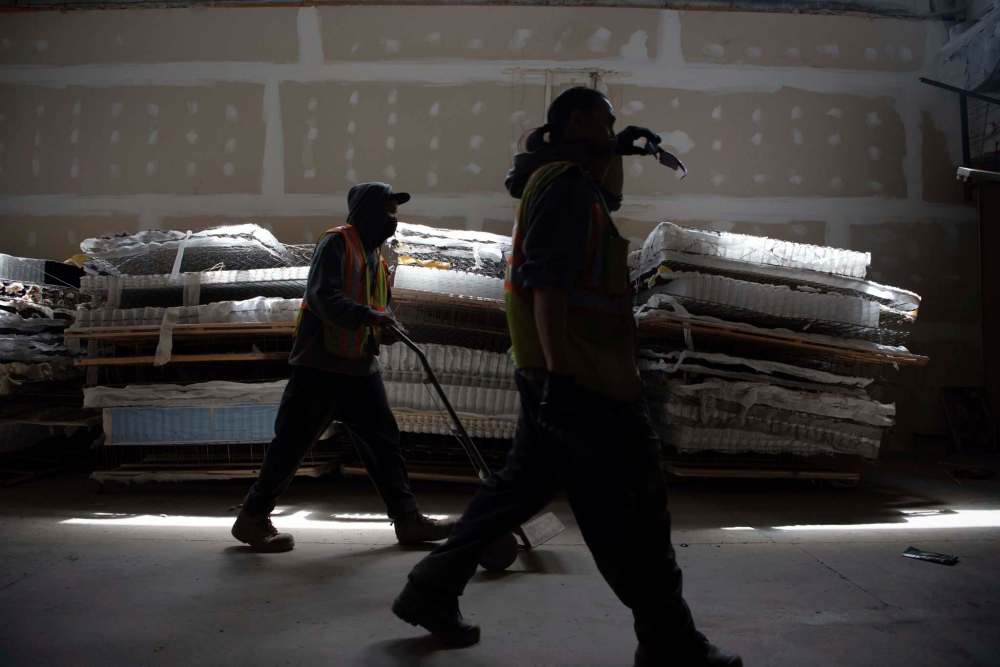
On April 26, just an average Tuesday, the staff hummed along, disassembling and baling, when Floresco told them they’d just reached a comfortable plateau. “I said, ‘Hey guys, you just unloaded the 50,000th mattress,’” she says.
Put that 50,000 into perspective: it’s equivalent to about 1,660,148 kilograms of waste that otherwise would have been rotting away, with mattresses taking almost 120 years to break down in a landfill. (That’s right: shreds of your great-great-grandmother’s bed may still be lying around somewhere.)
The staff separate the individual components, and each is sent somewhere else to become something else: the wood goes to Transcona’s Greensite Recycling where it is converted to biofuels; the springs stay in the local scrap market and are sent to the foundry in Selkirk; the foam is sent to a Madison, Wis., firm called Reynolds Urethane Recycling. A small percentage of each mattress cannot be recycled, so is baled tightly on site and ends up in the landfill, but the fraction pales in comparison to the volume recycled: In all, about 98 per cent of the total volume of mattresses that come into Mother Earth’s warehouse avoid a funeral in the Brady Landfill.
It should also be said that these mattresses are beat up, ruined, destroyed beyond safe reuse, the kind of mattresses that might usually be found in a back lane, soggy, moulding and stained with god knows what. There are organizations that accept donations of usable mattresses; Mother Earth is focused on beds on their deathbed.
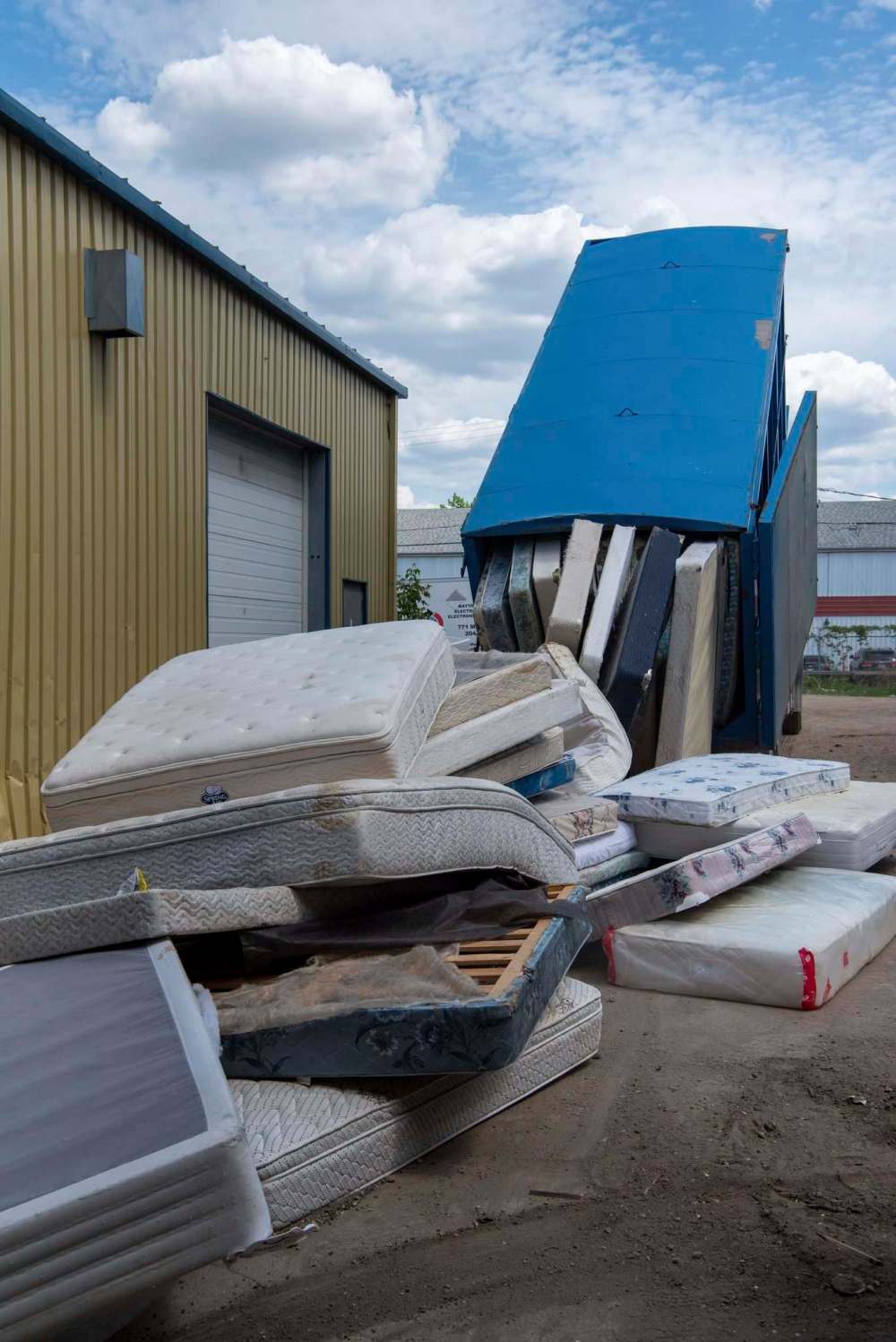
“It feels like just yesterday we reached 30,000 mattresses,” Floresco says. Maybe not yesterday, but in reality, it’s been just a year: that milestone was reached in May 2020. By October, Mother Earth reached 40,000, and throughout the winter, traditionally the slowest season in the mattress recycling game, 10,000 more came through.
In just 12 months, Mother Earth recycled nearly 66 per cent of its total mattress count from the preceding five years. There’s hardly been time to rest; on some days, more than 300 mattresses arrive.
Floresco says a major reason for the rapidly growing volume is the social enterprise’s partnership with the City of Winnipeg, which began as a pilot project last March; that pilot project alone contributed 10,000 mattresses in its first year.
The first partnership the firm had was with IKEA, in 2015, a $250,000 deal brokered with the previous NDP government and Take Pride Winnipeg that also helped establish an employment training program to help Mother Earth staff up. This deal happened after research into a similar operation in Duluth, Minn., and soon, municipalities enlisted the Winnipeg enterprise to help them wish their beddies bye.
The RM of Norfolk was the first, then came the SWAMP landfill, which serves Winkler, Morden and the RM of Stanley. Fifteen rural municipalities have now partnered with Mother Earth to contribute mattresses, as well as retailers, hotels, care homes and the general public. In addition to mattresses, Mother Earth operates an e-waste refurbishment shop, and with funding from the province, started a pilot project recycling car seats last fall.
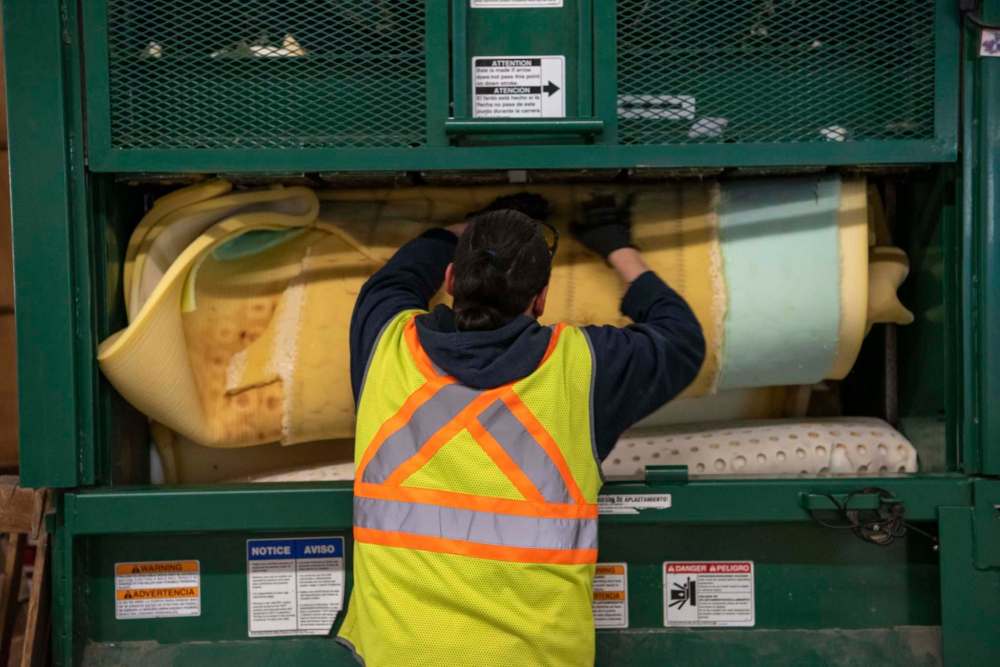
Floresco says the organization operates on a triple bottom line, prioritizing social, environmental and economic gain simultaneously. The social aspect is centred on not just the green ideals, but its federally supported employment model, which over the past three years enabled 40 trainees to gain training in six-month cohorts.
Each trainee experiences some barriers to employment, such as addiction or lack of traditional education, and are all Indigenous, Floresco said. The majority of trainees had never had a full-time job before.
That training includes classroom lessons, first aid, food handler’s certification, in case they should require it for future work, budgeting and financial lessons, floor training, and soft skills. Fourteen of the trainees are employed full-time at Mother Earth, with each paid a starting living wage of $13 per hour, along with paid time off and other benefits. Nearly 80 per cent of participants found full-time employment there or elsewhere.
And it’s definitely skilled labour: by the time employees in the warehouse get the hang of it, they can take apart a mattress in 15 minutes flat.
The enterprise does operate for-profit, charging $14.29 plus tax per mattress, $30 per mattress with box springs, and $50 for pickup, with drop-off options available. It costs an average of $13.50 for the organization to take apart each mattress when factoring in labour and other costs, leaving 79 cents of profit on the table.
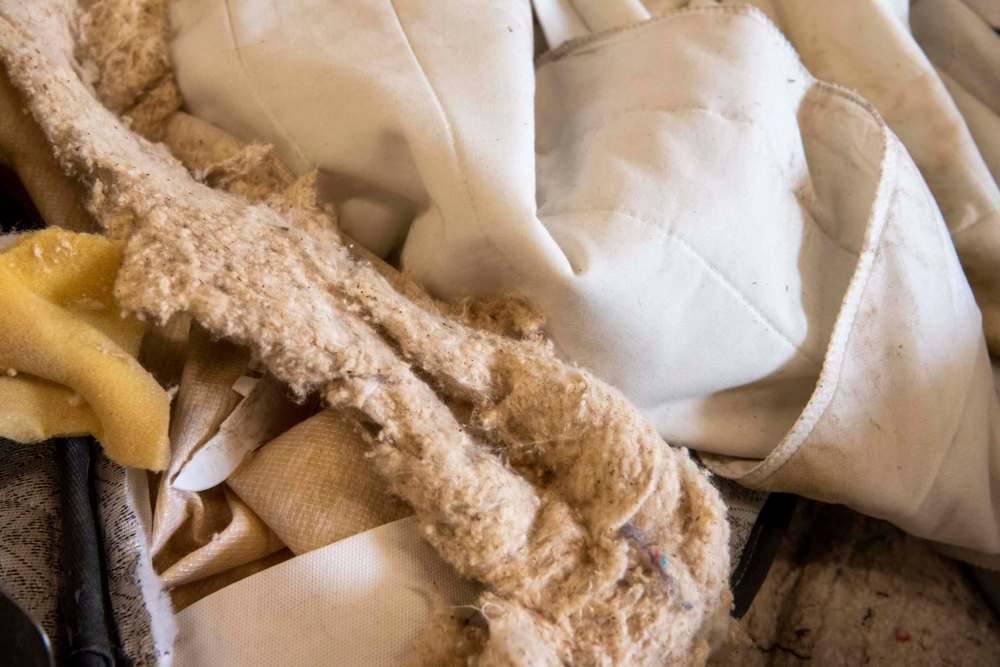
“But we don’t like saying profit,” she says. “We say excess revenues, and having that allows us to keep our staff on and keep paying them fair wages.”
Most years, Mother Earth has to issue seasonal layoffs during the winter, but thanks to growing partnerships, this last frigid season was the first in the organization’s history when no layoffs were necessary. That’s been great news for Floresco, who worried when the pandemic started that her longtime employees might’ve been without work.

Instead, each staffer has stayed on, with each receiving their first dose and many their second of the COVID-19 vaccine, and Mother Earth, rather than contracting its operations, is actually expanding them: this month, the firm took over a neighbouring warehouse, growing its footprint from 11,000 to 18,000 square-feet.
Because of pandemic restrictions, the number of people inside the warehouse is strictly capped, but Floresco hopes as soon as it’s safe, training can commence to add more staff to the ever-larger fold.
As a social enterprise, Floresco says Mother Earth views its operations differently than traditional businesses, which may prioritize profits above all else. “The idea that employees are just there to make you money is a very outdated way of thinking,” she says. “People want to know they’re valued and important to you, and that what they’re doing makes a difference.”
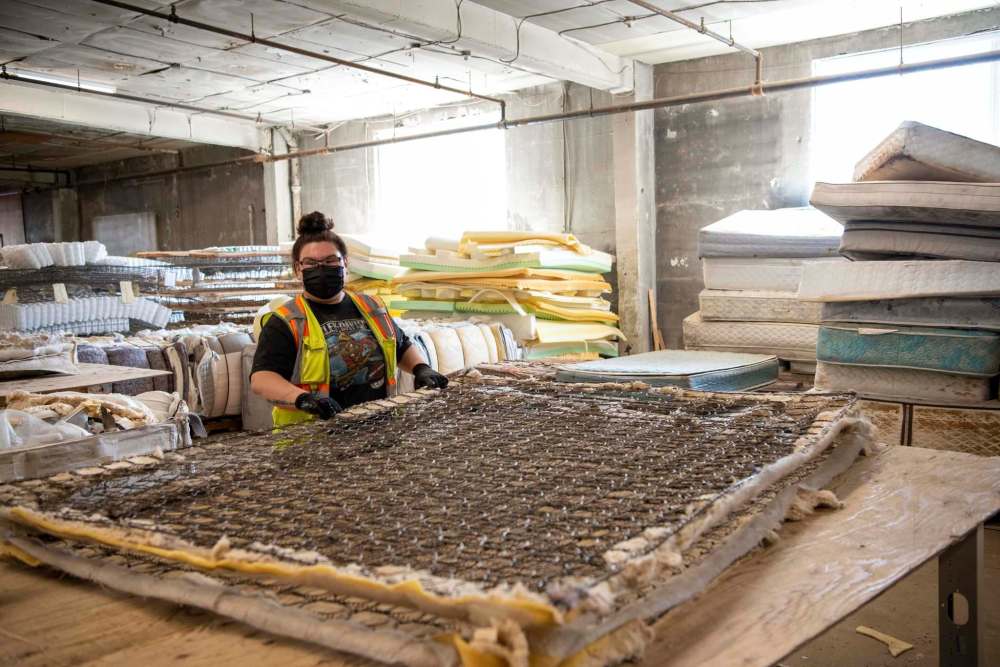
The employees there can rest easily knowing they do just that. Jessica Floresco tries to get about eight hours of sleep each night.
ben.waldman@freepress.mb.ca
Ben Waldman is a National Newspaper Award-nominated reporter on the Arts & Life desk at the Free Press. Born and raised in Winnipeg, Ben completed three internships with the Free Press while earning his degree at Ryerson University’s (now Toronto Metropolitan University’s) School of Journalism before joining the newsroom full-time in 2019. Read more about Ben.
Every piece of reporting Ben produces is reviewed by an editing team before it is posted online or published in print — part of the Free Press‘s tradition, since 1872, of producing reliable independent journalism. Read more about Free Press’s history and mandate, and learn how our newsroom operates.
Our newsroom depends on a growing audience of readers to power our journalism. If you are not a paid reader, please consider becoming a subscriber.
Our newsroom depends on its audience of readers to power our journalism. Thank you for your support.
Ben Waldman is a National Newspaper Award-nominated reporter on the Arts & Life desk at the Free Press. Born and raised in Winnipeg, Ben completed three internships with the Free Press while earning his degree at Ryerson University’s (now Toronto Metropolitan University’s) School of Journalism before joining the newsroom full-time in 2019. Read more about Ben.
Every piece of reporting Ben produces is reviewed by an editing team before it is posted online or published in print — part of the Free Press‘s tradition, since 1872, of producing reliable independent journalism. Read more about Free Press’s history and mandate, and learn how our newsroom operates.
Our newsroom depends on a growing audience of readers to power our journalism. If you are not a paid reader, please consider becoming a subscriber.
Our newsroom depends on its audience of readers to power our journalism. Thank you for your support.
Advertisement Advertise With Us
Advertisement Advertise With Us