Shaking up Christmas
Because it wouldn't be the holidays without upside-down trees, buckets of chicken, poop and big goats
Advertisement
Read this article for free:
or
Already have an account? Log in here »
To continue reading, please subscribe:

Digital Subscription
One year of digital access for only $205*
- Enjoy unlimited reading on winnipegfreepress.com
- Read the E-Edition, our digital replica newspaper
- Access News Break, our award-winning app
- Play interactive puzzles
*First annual payment billed as $205.00 + GST for one year. This annual subscription will automatically renew at $233.00 + GST every 52 weeks (10% off the regular annual price of $259.35). Offer available to new and qualified returning subscribers only. Cancel any time.
To continue reading, please subscribe:
Add Free Press access to your Brandon Sun subscription for only an additional
$1 for the first 4 weeks*
- Enjoy unlimited reading on winnipegfreepress.com
- Read the E-Edition, our digital replica newspaper
- Access News Break, our award-winning app
- Play interactive puzzles
*Your next Brandon Sun subscription payment will increase by $1.00 and you will be charged $17.95 plus GST for four weeks. After four weeks, your payment will increase to $24.95 plus GST every four weeks.
Read unlimited articles for free today:
or
Already have an account? Log in here »
Hey there, time traveller!
This article was published 09/12/2017 (3141 days ago), so information in it may no longer be current.
It goes without saying Christmas is a time for traditions, a time for engaging in annual customs and rituals because of the comfort they provide in a topsy-turvy world.
But this season, some festive folks are throwing caution to the wind and turning one of the most popular Christmas traditions on its end — and we mean that quite literally.
According to a host of news reports, one of the hottest holiday trends decking the halls this year is the upside-down Christmas tree, a flipped fir, if you will.
A story earlier this week in the Minneapolis Star Tribune revealed major retailers such as Home Depot, Target, Walmart, Wayfair and many more are selling inverted trees, with prices ranging from around $100 to close to $1,000.
“An upside-down Christmas tree may hang from a bracket on the ceiling like a chandelier, set upside-down on a stand, or be mounted on a wall for stability,” the Star Tribune explained.
It seems the notion of hanging fir trees upside down dates back to the Middle Ages, where it was common among many Slavic groups as a symbol of Christianity.
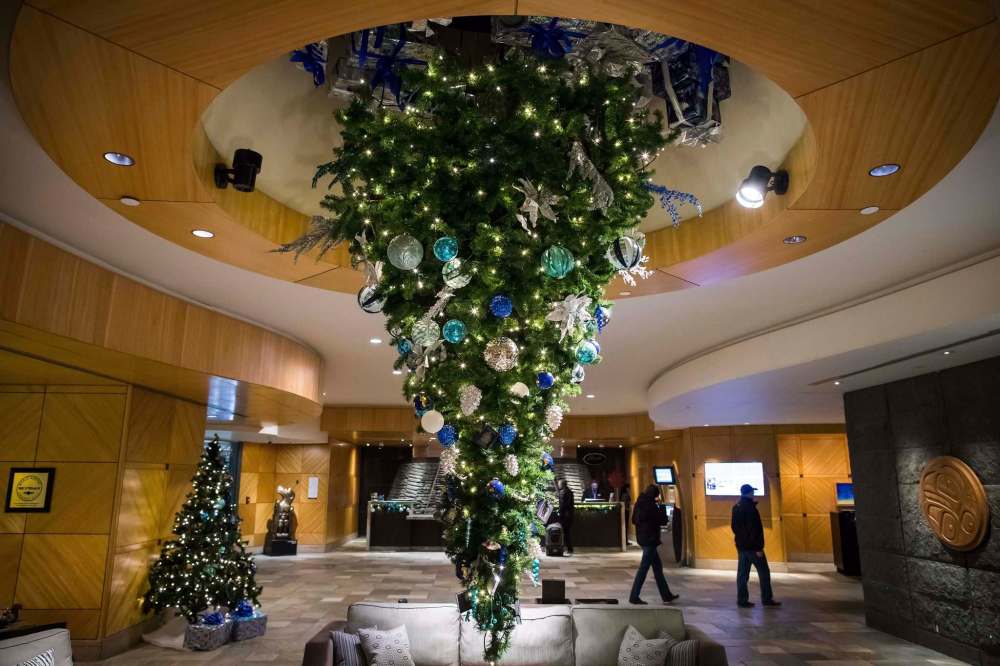
In Canada, a nine-foot Christmas tree hangs upside-down in the hotel lobby of the Fairmont Vancouver Airport, where it’s a hit with guests and passersby. Surprisingly, upside-down trees are far from the quirkiest festive trend, as we see from today’s bell-ringing list of Five of the Strangest Christmas Traditions of All Time:
5) The country: Japan
The crazy custom: Kentucky Fried Christmas
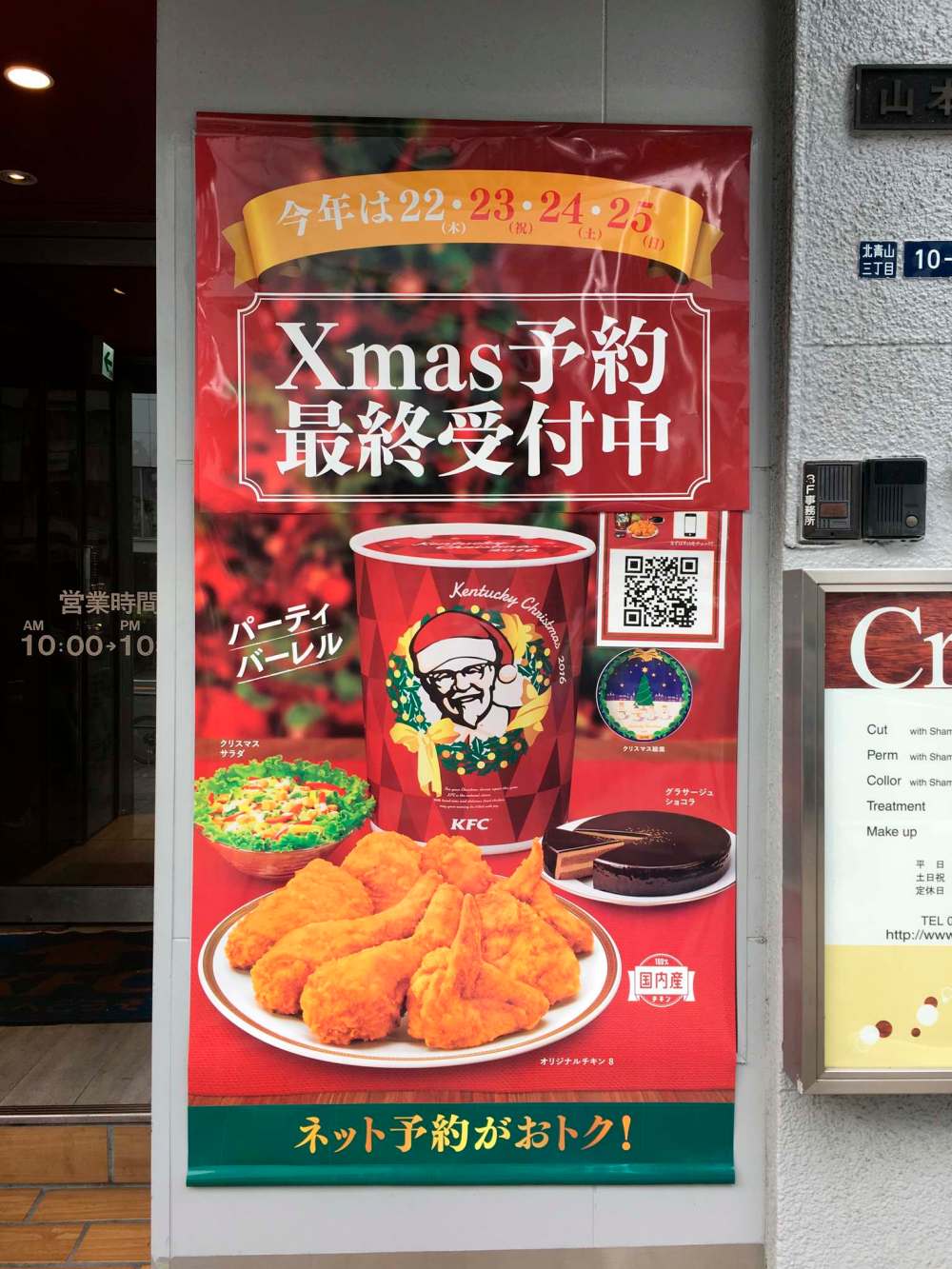
The festive facts: In Japan, Christmas dinner has become finger-licking good. That’s because the festive food of choice at the most wonderful time of year isn’t turkey — it’s Kentucky Fried Chicken.
According to the BBC, an estimated 3.6 million Japanese families tuck into a special bucket of KFC from the American fast-food chain during the Christmas season, with millions of hungry fans enduring long lines to order fried chicken weeks in advance to keep the tradition alive.
“December is a busy month for KFC in Japan — daily sales at some restaurants during the Christmas period can be 10 times their usual take,” the BBC reported in 2016. “Getting the KFC special Christmas dinner often requires ordering it weeks in advance, and those who didn’t will wait in line, sometimes for hours.”
KFC Japan says it all began in 1970 when Takeshi Okawara opened the first KFC in the country and woke up one midnight with an idea that came in a dream — a “party barrel” to be sold at Christmas. It seems Okawara overhead a couple of foreigners lamenting how they missed having turkey for Christmas, and he hoped fried chicken could take its place, so he started pushing his party barrel.
In 1974, KFC took the plan national, calling it “Kurisumasu ni wa Kentakkii,” or Kentucky for Christmas. The campaign took off, as did the career of Okawara, who served as CEO of KFC Japan from 1984 to 2002. The party barrel for Christmas became a national phenomenon, with ads showing happy Japanese families crowding around buckets of chicken, and stores dressing up the company mascot, white-suited Colonel Sanders, in Santa outfits.
“When I was a kid, I saw the TV commercial. So when it comes to Christmas, we Japanese think of KFC chicken,” Yoko Ogata told the CBC in 2016. We hate to be judgmental, but just bring us some figgy pudding.
4) The countries: Germany and the United States
The crazy custom: Hiding the pickle
The festive facts: We’ve all heard this Christmas tall tale, haven’t we?
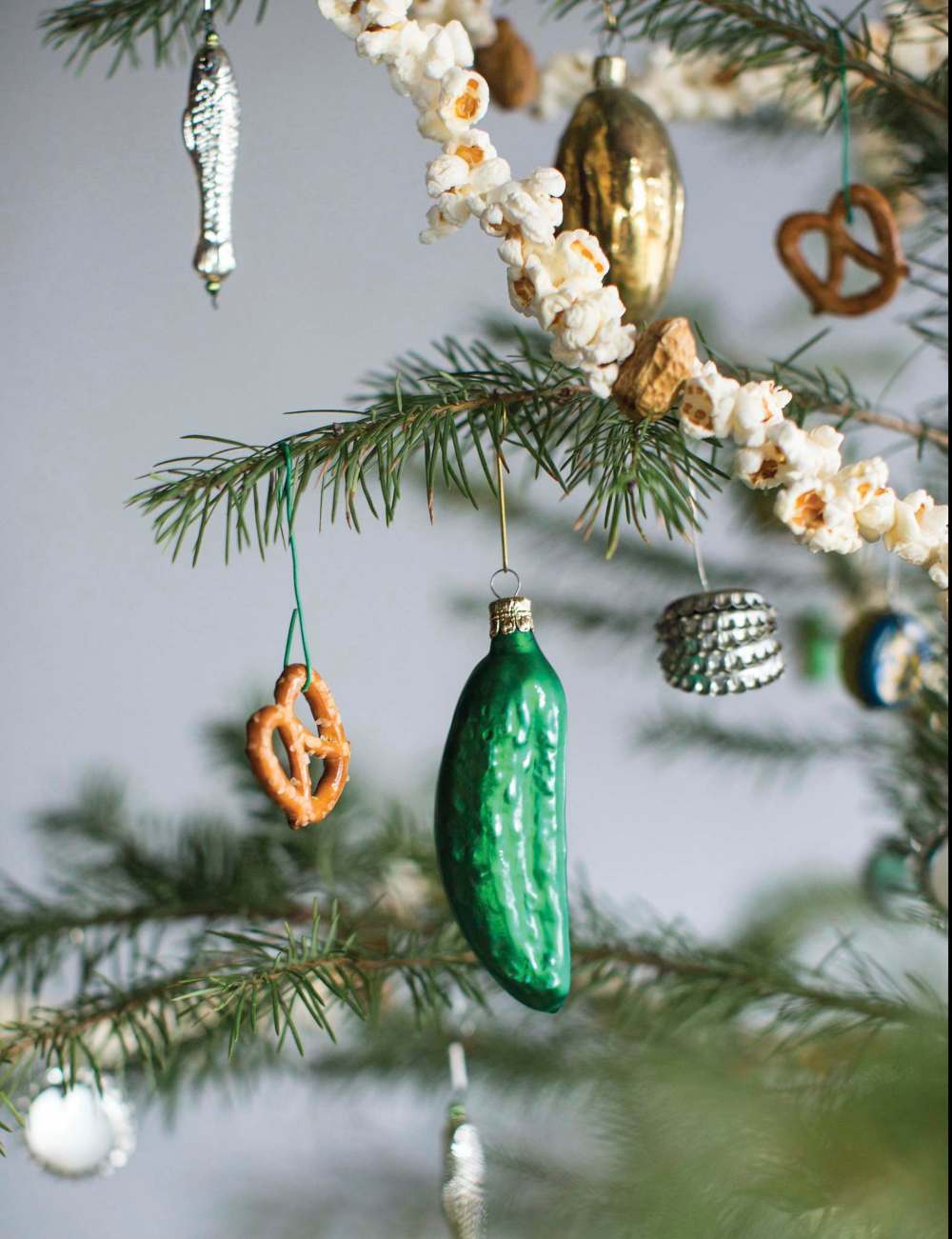
According to the story, a longtime German Christmas tradition involves hiding an ornament in the shape of a pickle on the Christmas tree on Christmas Eve — and the first child to discover it in the morning receives a small gift.
These ornaments are so pervasive now that even this columnist hides one on his tree, though it is merely decorative and no bonus gifts are awarded to the finder.
The website WhyChristmas.com notes there are two extremely far-fetched stories about the origin of the pickle ornament. The first Victorian-era story states that a soldier in the American Civil War — who was born in Bavaria — was being held prisoner and, because he was starving, begged a guard for one last pickle before he died. “The guard took pity on him and gave a pickle to him,” the website says. “The pickle gave him the mental and physical strength to go live on.”
As much as we like that story, it’s not as compelling as the medieval tale of two Spanish boys who were travelling home from a boarding school for the holidays. “When they stopped at an inn for the night, the evil innkeeper killed the boys and put them in a pickle barrel,” WhyChristmas.com says. “That evening, St. Nicholas stopped at the same inn, and found the boys in the barrel and miraculously brought them back to life.”
Being revived after a death-by-pickle incident is a bit hard too swallow, no matter how you slice it. What seems more likely is that the story arose around 1890 in the U.S. to coincide with the importation of glass Christmas tree decorations, in the shape of fruits and vegetables, from Germany and France.
Declares WhyChristmas.com: “So it’s most likely that an ornament salesman, with a lot of spare pickles to sell, invented the legend of the Christmas Pickle.” It’s a dilly of a story — please forgive us for that — but the festive truth is we hate someone gherkin us around at this time of year.
3) The country: South Africa
The crazy custom: Killing for Cookies
The festive facts: Want to hear a Christmas story even more disquieting than the one about the two boys who were killed by being stuffed inside a pickle barrel by an evil innkeeper? Well, you’re in luck. From South Africa comes a terrifying holiday tale that is told at this festive time of year to teach hungry youngsters to keep their greasy mitts away from the family stash of cookies in the wee hours of the night.
The story tells the fate of Danny, a fictitious boy (at least we hope he was fictitious) who angered his grandmother by eating the cookies that had been left for Santa. In her rage, the grandmother supposedly (why not?) killed Danny for his cookie-snitching ways.
“It’s said that the ghost of Danny haunts the homes of naughty children in South Africa during the holidays,” the website DestinationAmerica.com notes. “If that doesn’t scare you into laying off the sweets, nothing will. Yikes.”
We’ve always assumed that too much holiday baking wasn’t good for you, but we never thought it could be lethal. So if you are spending the holidays in South Africa, you’ll want to skip the cookies and tuck into a big feed of one of the more popular local delicacies — on Christmas Day, locals reportedly feast on deep-fried caterpillars of the Emperor Moth.
“For some in South Africa, Christmas is the perfect time to eat deep-fried caterpillars from the Emperor Moth,” notes HuffingtonPost.ca. “It’s a little unclear why it’s a tradition, but research shows that the grub is highly nutritious.”
Gushes Mother Nature Network: “Whereas the iron content of beef is 6 mg per 100 grams of dry weight… caterpillars pack a whopping 31 mg of iron per 100 grams.” Sounds great. But, again, we’ll stick with the figgy pudding and sugar plums.
2) The country: The Catalan region of Spain
The crazy custom: Tio de Nadal “the pooping log”
The festive facts: Before we go any further, we just want to say we are not judging anyone’s traditions, we are just sharing them. For instance, in the restive region of Catalan — where the parliament declared independence in October following an unrecognized referendum on independence from Spain — a popular tradition is Tio de Nadal, essentially a hollow yule log, roughly 30 centimetres long, decorated with stick legs, a smiley face, a stick nose and a floppy red sock hat.
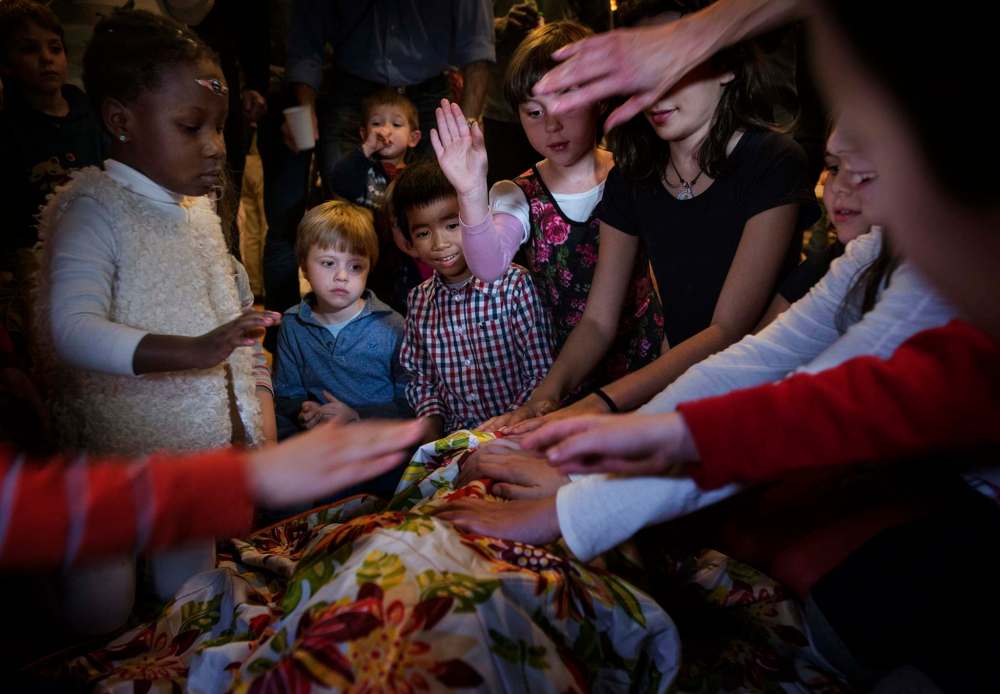
Tio, perhaps better known as “the pooping log,” is kind of a scatological Santa, if you catch our drift. On Dec. 8 each year — the Feast of the Immaculate Conception — families bring out the happy little log every night until Dec. 24 and children are tasked with “feeding” the log by offering him nuts, dried fruit and water. The kids are also expected to cover Tio de Nadal with a blanket to ensure he stays warm and comfortable.
On Christmas Eve, or Christmas Day, families put Tio partly into the fireplace and the children order him to poop out presents while whacking the smiling log with sticks. They also sing a little Tio de Nadal song, but we are not about to share the lyrics because this is a family newspaper.
“Then comes the miracle: the kids look under Tio de Nadal’s blanket and discover that the dear log has pooped out a pile of candies and presents,” explains slate.com. “(The end of the defecation session is signalled by the presence of a stinky herring.)
When everyone has collected their gifts from Tio de Nadal, the family burns him for warmth.” We just have enough space to mention another defecation-based Catalonian tradition — placing a porcelain figure of a pooping man, known as the “Caganer,” into nativity scenes. The little guy wears the traditional Catalan red cap and is shown with a bare backside and defecating.
“Caganer is not meant to be sacrilegious — his fertilization of the holy ground heralds a prosperous harvest in the new year,” slate.com notes.
1) The country: Sweden
The crazy custom: Torching the Giant Straw Yule Goat
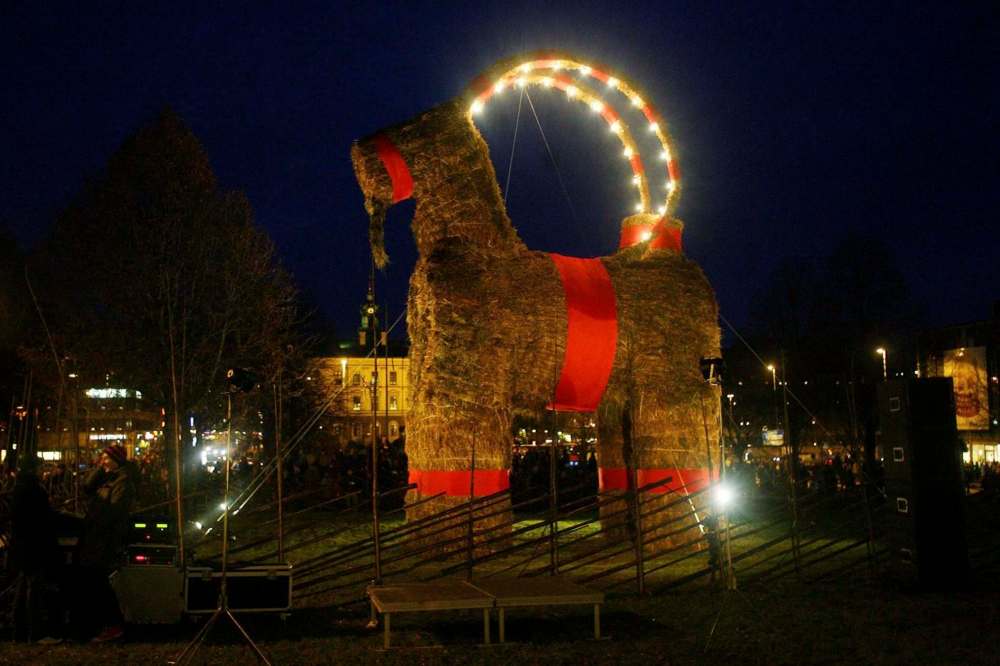
The festive facts: Before we begin, we will point out that we are not making fun of Sweden, because our boss’s wife is Swedish and, if we are good, she will be preparing our favourite food, Swedish meatballs, this Christmas. That said, every year in Sweden, the town of Gavle (pronounced: “Yeah-vleh”) celebrates the start of the Christmas season by erecting a giant 13-metre-tall straw statue of a goat.
Why a goat? Well, in northern Europe, one of the traditions is that sometimes Santa rides a goat instead of his sleigh, so small straw goats became one of the most popular festive decorations.
In 1966, Gavle decided to put up its first giant straw goat. That goat made it all the way to New Year’s Eve before being burned down. But goat statues in other years haven’t been so lucky. The Gavle goat has been destroyed or damaged about 37 times in the past 50 years. Along with erecting the goat, the town’s other main Christmas tradition is betting on whether the straw statue will make it to Christmas.
“The town has tried lots of different ways to protect their goat,” CBC.ca notes. “They’ve had guards stationed, security cameras put up, fences raised, and the goat itself has been sprayed with water and flameproof chemicals. Some years the goat even survives the whole holiday season. But most years… it doesn’t.”
In 2005, for instance, a group dressed as Santa and some gingerbread men reportedly fired flaming arrows into the goat, while in 2009, hackers disabled the security cameras, then sneaked in and set the goat ablaze.
“An American tourist was arrested for burning down the goat in 2001, but he said he’d been told by his Swedish friends that burning the goat was OK — he ended up spending two weeks in jail,” the CBC says.
This year’s version of the goat was erected last Sunday and, when we last looked, was still standing. The town has put new security measures in place to protect the goat from arsonists. What are they? “It’s secret,” spokesperson Maria Wallberg told TheLocal.se. Hopefully, this is the year no one gets their goat. And we’re definitely not kidding.
doug.speirs@freepress.mb.ca