She’s fluent in cat, dog, gets by in possum
Real-life Dr. Doolittle 'translates'for animals
Advertisement
Read this article for free:
or
Already have an account? Log in here »
To continue reading, please subscribe:

Digital Subscription
One year of digital access for only $205*
- Enjoy unlimited reading on winnipegfreepress.com
- Read the E-Edition, our digital replica newspaper
- Access News Break, our award-winning app
- Play interactive puzzles
*First annual payment billed as $205.00 + GST for one year. This annual subscription will automatically renew at $233.00 + GST every 52 weeks (10% off the regular annual price of $259.35). Offer available to new and qualified returning subscribers only. Cancel any time.
To continue reading, please subscribe:
Add Free Press access to your Brandon Sun subscription for only an additional
$1 for the first 4 weeks*
- Enjoy unlimited reading on winnipegfreepress.com
- Read the E-Edition, our digital replica newspaper
- Access News Break, our award-winning app
- Play interactive puzzles
*Your next Brandon Sun subscription payment will increase by $1.00 and you will be charged $17.95 plus GST for four weeks. After four weeks, your payment will increase to $24.95 plus GST every four weeks.
Read unlimited articles for free today:
or
Already have an account? Log in here »
Hey there, time traveller!
This article was published 01/03/2016 (3806 days ago), so information in it may no longer be current.
WINTER PARK, Fla. — In the cacophony of a county animal shelter — incessant barking bouncing off bare concrete — a woman with slow, deliberate steps and gently sweeping arms makes her way down an aisle.
At first, the dogs grow louder and more insistent. But as the woman pauses beside each kennel, her breathing long and deep, one by one the animals turn quiet and calm. Their ears relax. They lie down. Some yawn.
It’s as if Jo Maldonado, the woman walking among them, has cast a spell.
“Animals are very sensitive to our energy,” she says.
“If we are calm, they intuitively feel safe to relax.”
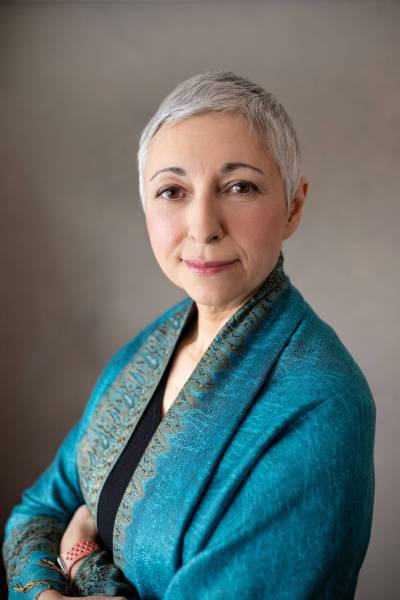
A former public-relations executive, Maldonado, 63, now serves as a translator of sorts for the animal kingdom. While studies show 99 per cent of pet owners talk to their animals, Maldonado is one of the few who listens to the response.
Maldonado calls herself an animal communicator, a skill that is as much art as science. She has worked with horses, dogs, cats, leopards — even an opossum. Now she’s teaching her skills to fellow humans.
At the Wild Horse Rescue Center in Mims, Fla., at an exotic animal sanctuary in Apopka, Fla., and at Seminole County Animal Services (where she did the shelter walk), Maldonado is an odd but effective presence, admirers say. She has done sessions with everything from hogs, horses and leopards to calicos and chihuahuas.
Her clients have included a 16-year-old cat who wanted a few more walks in the garden with his owner before he died, a Jack Russell terrier who didn’t like the rain and a show horse stressed out by his owner’s nervous energy before competitions.
Skeptics may snicker, but Maldonado has no shortage of humans willing to pay for her services. And last fall she began teaching her animal communication skills at the Rollins College Center for Lifelong Learning, where her month-long courses have quickly reached their 25-student limit.
“The first class, I kind of thought, ‘Well, this might work for her, but I won’t be able to do it,’” says Denise Fisher, an Orlando insurance executive. “To be honest, it seemed a little voodoo-ish. But I’ve seen from the exercises we do in class how much our posture and tone can affect the animals… I’m a convert.”
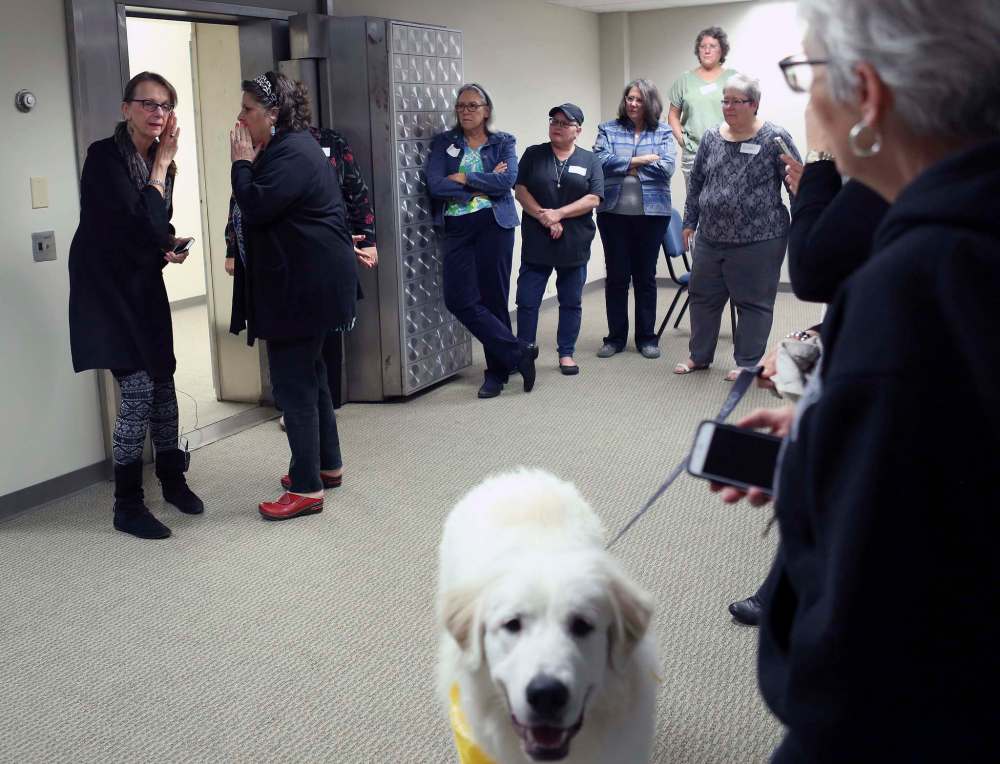
On a recent night, Maldonado brings in a pack of five Italian greyhounds and a pair of Great Pyrenees to demonstrate how they react to varying human postures. The breeds are nearly polar opposites: one is small, smooth and high-strung; the other huge, hairy and mellow. A student assuming a Wonder Woman-like “power pose” — hands on hips, head and shoulders back, feet straight and firmly planted — elicits a confrontational yapping from the boldest of the little dogs, while a 65-kilogram Great Pyrenees tries to skulk out of the room timidly.
“You can see how much your body language makes a difference,” says student Janice Buczkowski of Heathrow, Fla., who works at the Audubon Center for Birds of Prey. “I’m trying to I use it in how I approach the birds. It seems to help.”
Maldonado wasn’t always an animal whisperer. But a decade ago, while convalescing from hip surgery, she began reading on the subject, which had always fascinated her. That eventually led to the opening of her Center for Animal Therapies, which hosted local practitioners lecturing on subjects from animal first aid to biofeedback to Qigong — a Chinese practice that melds medicine, meditation and martial arts for healing.
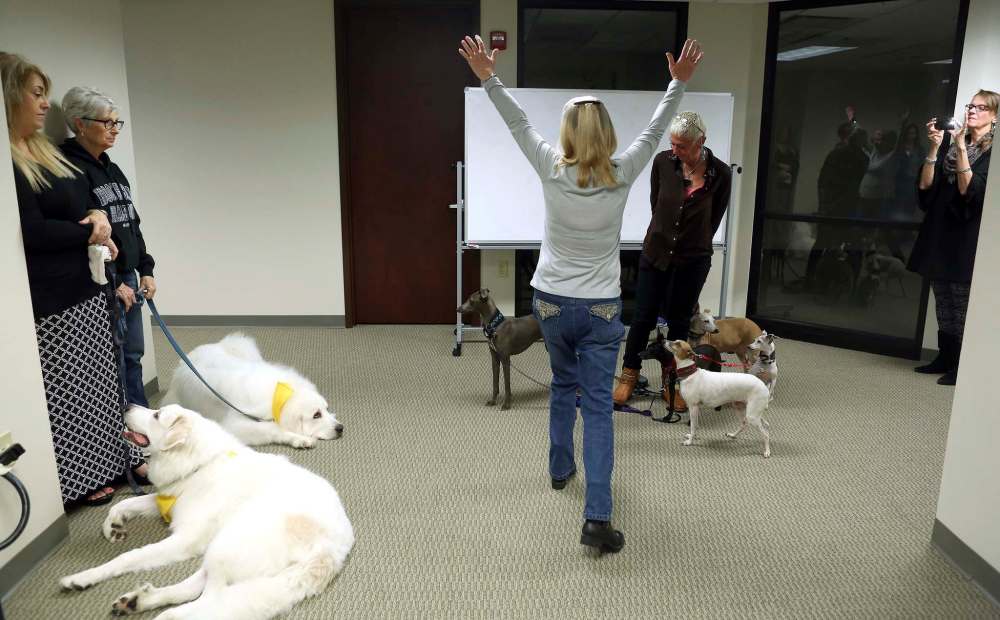
Maldonado took all the classes herself. Then she began trying out some of what she’d learned to lower stress in rescued animals before opening a practice with private clients.
“She just kind of bends down sideways and does some breath work, and it seems to be very calming,” says Diane Gagliano, program co-ordinator for Seminole County Animal Services. “I believe in it. I think the animals sense this quiet energy she has.”
Judy Sarullo, founder of the nonprofit Pet Rescue by Judy in Sanford, concurs. “It’s amazing, what she does,” she says. “She’ll spend time with our animals and then tell us what they want.”

One case, a few years ago, involved an abandoned white poodle named Jack, who would growl, snarl and try to bite anyone who came near.
“Jo meets with him and tells me, ‘His whole life, all he’s ever heard is that he’s a nasty little dog. You need to tell him how much you love him and build up his confidence,’” Sarullo says.
“I felt ridiculous, but every day I would tell Jack how great he was and that I loved him — and he ended up being the most wonderful little dog, and the lady who adopted him treats him like a king.”
Sarullo admits some of her staff volunteers have been skeptical, despite small miracles of transformation. “They’ll tell me it’s bull—-,” she says. “I tell them, ‘Bull—- or not, do what she says because it works.’”
— Orlando Sentinel