Stop paying your children for chores
Experts argue allowances should be educational and not connected to housework
Advertisement
Read this article for free:
or
Already have an account? Log in here »
To continue reading, please subscribe:

Digital Subscription
One year of digital access for only $205*
- Enjoy unlimited reading on winnipegfreepress.com
- Read the E-Edition, our digital replica newspaper
- Access News Break, our award-winning app
- Play interactive puzzles
*First annual payment billed as $205.00 + GST for one year. This annual subscription will automatically renew at $233.00 + GST every 52 weeks (10% off the regular annual price of $259.35). Offer available to new and qualified returning subscribers only. Cancel any time.
To continue reading, please subscribe:
Add Free Press access to your Brandon Sun subscription for only an additional
$1 for the first 4 weeks*
- Enjoy unlimited reading on winnipegfreepress.com
- Read the E-Edition, our digital replica newspaper
- Access News Break, our award-winning app
- Play interactive puzzles
*Your next Brandon Sun subscription payment will increase by $1.00 and you will be charged $17.95 plus GST for four weeks. After four weeks, your payment will increase to $24.95 plus GST every four weeks.
Read unlimited articles for free today:
or
Already have an account? Log in here »
Hey there, time traveller!
This article was published 12/10/2017 (3200 days ago), so information in it may no longer be current.
Eighty-three per cent of parents who give their kids an allowance believe they should earn it by doing chores, according to an annual T. Rowe Price survey. Those parents are getting it wrong, if you believe a pile of parenting books going back a couple of decades that say an allowance should be for learning — not for earning.
For a recent book, Ron Lieber’s The Opposite of Spoiled argues that we shouldn’t give allowances in exchange for chores because one day our kids will decide they don’t need the money and refuse to do the work.
“So allowance ought to stand on its own, not as a wage but as a teaching tool,” Lieber writes.
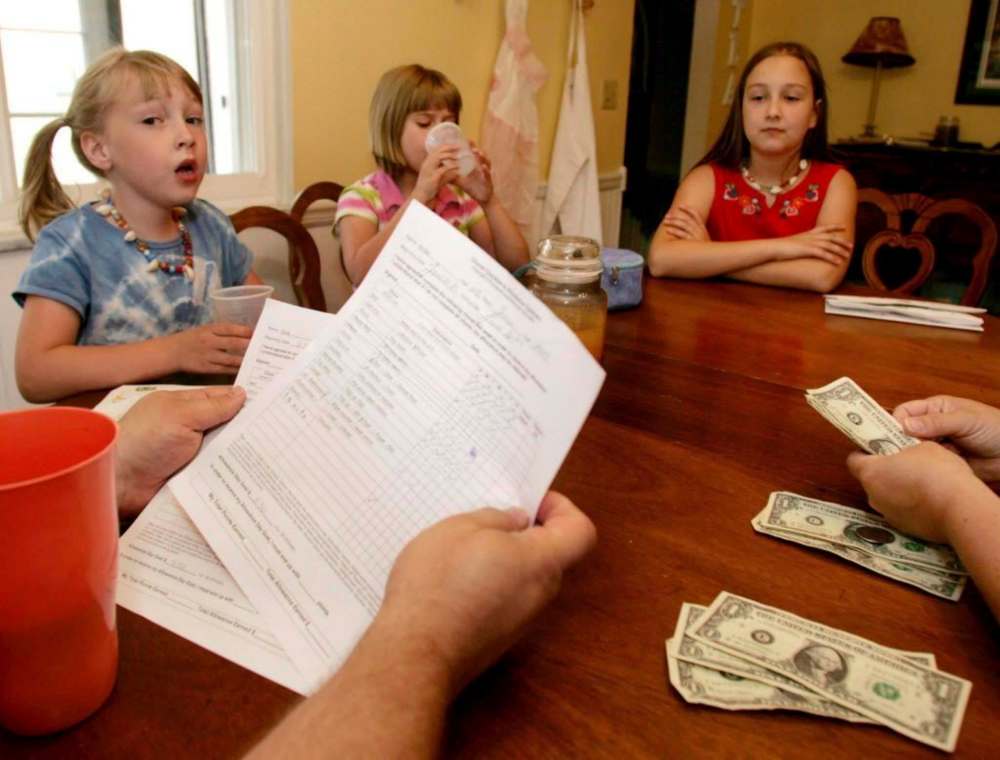
Then there’s Positive Discipline A-Z, the classic by Jane Nelsen. Nelsen, too, argues that allowances should be educational: “Chores are a separate issue and should not be connected to an allowance.”
Even the venerable Dr. Spock’s Baby and Childcare, first published in 1945, had come around by the eighth edition and proclaimed: “An allowance is a way for children to learn about handling money… An allowance shouldn’t be used as payment for routine chores.”
So does this mean our kids shouldn’t do routine chores? No. It just means that they shouldn’t get paid for them.
These parenting experts — and more — argue that children should help out around the house because it’s the right thing to do, not because they make money. Many suggest that if you want to pay your children to do extra work around the house — your own work — that’s perfectly fine. Some parents encourage their kids to look for jobs that need to be done and name a price, as a way of encouraging entrepreneurship.
The T. Rowe Price survey also found that 34 per cent of parents don’t give their children an allowance at all, and these experts would say that’s another mistake. After all, to learn to ride a bike, you need a bike. To learn to play the violin, you need a violin. So, to learn how to manage money, you need money. Even in households where money is tight, parents can move a little bit of the money they spend on their children into an allowance for the children to spend on themselves.
So that’s the “why” of allowance. But what about the when, where, how much and how often?
When
In the T. Rowe Price survey, 20 per cent of parents who give an allowance started it when their kids were six; that was followed by ages seven and eight, each with 19 per cent. So there is no one “right” age. The consensus among experts is that you should give your child an allowance as soon as they begin noticing and asking about money. Lieber gives the practical suggestion to start an allowance soon after the tooth fairy first comes, as this will certainly make your child take a sudden interest in money!
How often
Once you start an allowance, how often do you dole it out? The majority of parents give their children this money on a weekly basis, and the experts say that’s fine for little kids. However, for teenagers, some suggest a larger, monthly allowance to give them practice making their funds stretch over time.
Where
Similarly, you could change your method of payment as your kids grow up. For example, kids in the single digits are learning to count and like visual and tactile stimulation, so giving them cash and coins is a learning experience. Some parents have their children divide that money into separate jars or multi-compartment piggy banks, allocated for “spending,” “saving” and “donating.”
You may be able to reach screen-obsessed tweens by giving them their money via various apps that allow you to deposit money and allow them to group that money into virtual jars, instead of real jars. Some even enable them to make purchases straight from the app. For older teens, money and parenting experts suggest a bank account with a debit card to give them practice for the real world that’s just around the corner.
How much
There’s one final, fraught category to tackle: how much. Eden Burgess easily deals with multimillion-dollar paintings in her role as an art and antiquities lawyer for Cultural Heritage Partners, but when it came to negotiating her growing daughter’s allowance, she needed help. “I asked some parent friends who said that a good rule of thumb is half the child’s age,” Burgess said. “So we started at four dollars per week when my daughter was eight.”
Burgess chose to give her daughter half her age; others say to pay kids their full age. There are advantages to using an age-based formula when your kids are young: It avoids arguments about the initial amount, provides a methodology for raises and justifies different amounts given to older and younger siblings.

Formula or not, there is no “right” number. The amount of allowance you give depends, in part, on your financial circumstances. But experts do agree on a broad strategy: give enough allowance so that your children can buy small things they want but will have to save up for bigger things — great practice for real life.
“We like to think it was our decision to raise her allowance when her 10th birthday came around,” Burgess said. “We did stick with the half-age rule, but she is a daughter of two lawyers and is always pressing for more of something — including allowance!”
Raising your children’s allowance as they grow is a good idea — as long as you raise their responsibilities as well.
Depending on their maturity level, you could pick age 13 or 16 to turn over much of the money you spend on your child to your child. I’m not talking about grocery money, because that’s a collective family expense. The idea is to give your teens a heftier allowance to cover clothing, cellphone bills and other personal expenses. “As our daughter gets older, we may shift to the ‘higher allowance/more responsibility’ approach so she can keep learning to budget and make financial choices,” Burgess said. If you try it, you should let your older child sink or swim with that money — better to practise when they’re 13 than when they’re 23.
— Washington Post