WEATHER ALERT

Study: Safe to transplant hepatitis C-infected hearts, lungs

Advertisement

Advertise with us

WASHINGTON - Doctors can safely transplant hepatitis C-infected lungs and hearts into people desperate for a new organ, say researchers who may have found a way to protect those patients from getting the risky virus.

Read this article for free:

or

Already have an account? Log in here »

To continue reading, please subscribe:

Subscribe and receive a limited-edition Free Press branded hat or tote.

Digital Subscription

One year of digital access for only $205*

  • Enjoy unlimited reading on winnipegfreepress.com
  • Read the E-Edition, our digital replica newspaper
  • Access News Break, our award-winning app
  • Play interactive puzzles

*First annual payment billed as $205.00 + GST for one year. This annual subscription will automatically renew at $233.00 + GST every 52 weeks (10% off the regular annual price of $259.35). Offer available to new and qualified returning subscribers only. Cancel any time.

To continue reading, please subscribe:

Add Free Press access to your Brandon Sun subscription for only an additional

$1 for the first 4 weeks*

  • Enjoy unlimited reading on winnipegfreepress.com
  • Read the E-Edition, our digital replica newspaper
  • Access News Break, our award-winning app
  • Play interactive puzzles
Start now

*Your next Brandon Sun subscription payment will increase by $1.00 and you will be charged $17.95 plus GST for four weeks. After four weeks, your payment will increase to $24.95 plus GST every four weeks.

Hey there, time traveller!
This article was published 03/04/2019 (2673 days ago), so information in it may no longer be current.

WASHINGTON – Doctors can safely transplant hepatitis C-infected lungs and hearts into people desperate for a new organ, say researchers who may have found a way to protect those patients from getting the risky virus.

The experiment, reported Wednesday, is the latest attempt to put a dent in the nation’s long transplant waiting list by using organs that otherwise would be wasted, often ones from victims of the opioid epidemic.

The new twist: Instead of trying to cure hepatitis C after it took hold in transplant recipients, researchers at Boston’s Brigham and Women’s Hospital say a faster, cheaper treatment seems to prevent infection in the first place.
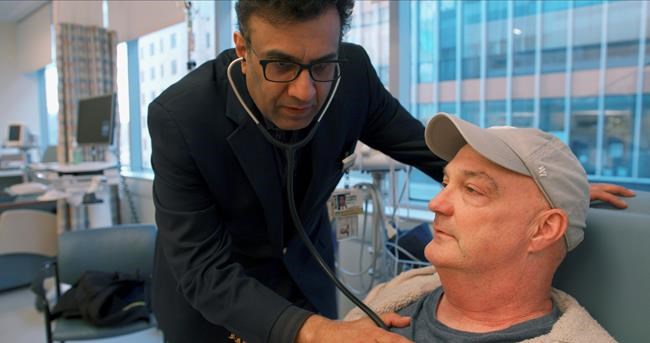
In this February 2019 photo provided by Brigham and Women's Hospital, Dr. Mandeep Mehra, executive director of Brigham’s Center for Advanced Heart Disease, checks on patient James Sullivon at the hospital in Boston. Sullivon, who received a hepatitis C-positive heart transplant, was given antiviral medicine shortly after the procedure in hopes of blocking hepatitis C infection rather than having to treat it. (Adam Knee/Brigham and Women's Hospital via AP)

“This is about not discarding organs that are medically suitable,” said Dr. Ann Woolley, a Brigham infectious disease specialist who co-authored the study in the New England Journal of Medicine.

Transplanting organs that could infect someone with a liver-damaging virus sounds drastic, but the organ shortage has more hospitals giving it a try. More than 113,000 people are on the national waiting list for a transplant; just 36,529 people got one last year. For heart or lung transplants, about 1,000 people a year die waiting.

“I knew that time was getting shorter for me,” said Rexford Kelley, 71, of Searsport, Maine. So he sought out the Brigham study in hopes that accepting a lung infected with hepatitis C would mean a speedier transplant. “I’m thankful I got the lung,” said the retired state trooper, who now breathes easy enough to get back on the golf course.

Until recently, doctors tended to transplant hepatitis C-infected organs only into patients who already had that virus.

But in 2016, spurred by powerful new drugs that promised to cure hepatitis C, surgeons began experimenting with so-called mismatched transplants — giving infected kidneys to hepatitis-free recipients. If those patients showed signs of infection, they got three months of medicine to beat it back. Last year, small studies at the University of Pennsylvania and Johns Hopkins University showed not only were patients cured of their hepatitis, the new kidney worked fine.

It was time to test more scarce transplants of lungs or hearts. Among the questions: Would hepatitis C make it harder to transplant those more fragile organs? And because the hepatitis medicine costs tens of thousands of dollars, could patients fare as well with a shorter — and cheaper — course of treatment?

In February, Penn researchers reported the standard three-month treatment cured 10 recipients of a hepatitis C-infected heart. One eventually died of organ rejection but the others were faring well.

Brigham researchers took a different approach. Within hours of either a heart or lung transplant, participants started taking medicine for a month in hopes of blocking hepatitis C infection rather than having to treat it.

The study detailed how about half of the 69 transplant recipients so far are faring. Six months after transplant, none showed signs of hepatitis C and their organs were functioning well. One died eight months after transplant from a bacterial infection unrelated to the hepatitis but 15 are doing well a year later.

Woolley said researchers might test even shorter treatment, noting the virus was undetectable at two weeks.

It might work “because maybe the virus hasn’t had the chance to establish itself,” said Dr. Peter Reese, a Penn kidney specialist who helped pioneer hepatitis C mismatch transplants but wasn’t involved in the latest research. But, “if the short course doesn’t work, it’s incumbent to be up front with patients about what they would do.”
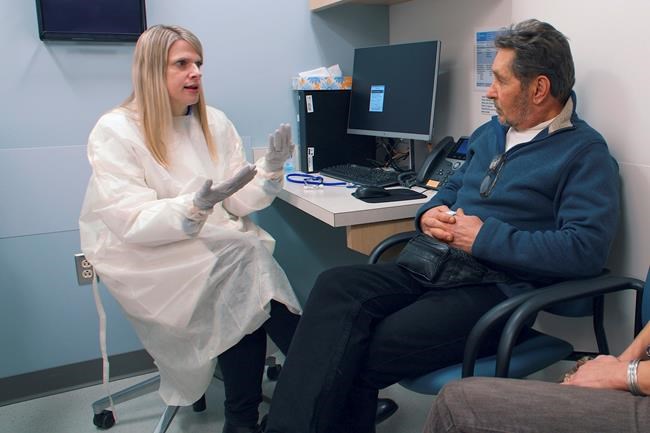
In this February 2019 photo provided by Brigham and Women's Hospital, Dr. Ann Woolley, an infectious disease specialist, speaks with patient Mark Natichinoi at the hospital in Boston. Natichinoi, who received a hepatitis C-positive lung transplant, was given antiviral medicine shortly after the procedure in hopes of blocking hepatitis C infection rather than having to treat it. (Adam Knee/Brigham and Women's Hospital via AP)

Larger and longer studies are key for all hepatitis C-infected transplants, Reese added.

Many hospitals aren’t waiting for more evidence. Last year, there were 1,274 hepatitis C-infected transplants in people without the virus compared to several hundred the year before, according to the United Network for Organ Sharing, which oversees the nation’s transplant system.

“It’s not established that cure rates are 100 per cent,” cautioned UNOS chief medical officer Dr. David Klassen. “To believe they would be, would be a little naive.”

But one Penn heart recipient said patients should know this option could cut their waiting time. Tom Giangiulio Jr., 59, of Waterford Township, New Jersey, was steadily deteriorating after two years awaiting a transplant when doctors asked if he’d be their study’s first volunteer. He was transplanted in June 2017.

“My first thought was saving my life,” he recalled. “My next thought was, ‘I’m the front-runner here. What I’m doing could open up a tremendous number of hearts to other recipients.'”

___

The Associated Press Health & Science Department receives support from the Howard Hughes Medical Institute’s Department of Science Education. The AP is solely responsible for all content.
Report Error Submit a Tip

More Stories

City has plenty of frozen dessert oases to discover

AV Kitching 6 minute read Preview

City has plenty of frozen dessert oases to discover

AV Kitching 6 minute read Updated: 10:42 AM CDT

No matter the weather, ice cream is always a welcome addition to the day.

It’s a rite of passage as, at the slightest hint of a thaw, Winnipeggers descend in droves, heeding the siren call of institutions such as Sargent Sundae (2053 Portage Ave.) and Bridge Drive-In (766 Jubilee Ave. and 1680 Main St.) that slide open their shutters any time from late March to early April, ready to welcome dedicated connoisseurs seeking their first taste of the season.

We’re blessed with an abundance of ice-cream joints in this city, ranging from brick-and-mortar storefronts to mobile carts and pop-up stalls, all serving generous scoops of childhood faves alongside rather more innovative flavours.

With so many dairy bars and frozen dessert parlours dotted around, there’s no need to choose just one spot to satisfy your sweet tooth.

Read
Updated: 10:42 AM CDT

Landlord asks city to work with him over homeless camp after appeal option turfed

Scott Billeck 4 minute read Preview

Landlord asks city to work with him over homeless camp after appeal option turfed

Scott Billeck 4 minute read Yesterday at 5:44 PM CDT

A West Broadway landlord says the City of Winnipeg has rejected his attempt to appeal an order that requires him to clear a homeless encampment from his riverfront property.

Marvin Sharp, CEO of Astroid Management Ltd., which operates the Pen-Eve Apartments at 35 Balmoral St., said Monday the decision is absurd since his firm was given almost no time to respond to the order.

The city denied his request for an appeal hearing because he failed to respond before the July 18 compliance deadline.

Sharp contends that was impossible because the compliance order, dated July 10, did not arrive at his office until July 17, leaving him just one day to file an appeal. The city clerk’s office is closed on weekends.

Read
Yesterday at 5:44 PM CDT

CMHR ‘fans flames of antisemitism,’ Asper says, ending support from family that led effort to create it

Carol Sanders 7 minute read Preview

CMHR ‘fans flames of antisemitism,’ Asper says, ending support from family that led effort to create it

Carol Sanders 7 minute read Updated: Yesterday at 8:49 PM CDT

The Winnipeg family that led the effort to build the Canadian Museum for Human Rights will not provide support going forward, philanthropist and honorary board member Gail Asper says.

Read
Updated: Yesterday at 8:49 PM CDT

Anishinaabe Days teepee poles vandalized

Nicole Buffie 4 minute read Preview

Anishinaabe Days teepee poles vandalized

Nicole Buffie 4 minute read Sunday, Jul. 26, 2026

An act of vandalism to a teepee at the Treaty One Development Corp’s Anishinaabe Days did not stop the celebrations from continuing over the weekend.

Someone deliberately cut the poles used to erect the site’s teepee before the event began, Treaty One executive director Jason Whitford said Sunday.

The family responsible for overseeing the teepee and its construction at the site, Naawi-Oodena  on Kenaston Boulevard, went to the site on Friday to erect the teepee when they noticed someone had taken a saw and cut all 15 of its poles in half.

“They were stored in a safe place, and they were stored properly as per protocol,” Whitford said. “They were in an area where there was no construction so they were isolated from any activity.”

Read
Sunday, Jul. 26, 2026

Cyclists shown Winnipeg’s warmer side

Tiago Resko 4 minute read Preview

Cyclists shown Winnipeg’s warmer side

Tiago Resko 4 minute read Yesterday at 5:57 PM CDT

Fundraising cyclists from New Brunswick who had their bikes stolen in Winnipeg got to see a completely different side of the city over the weekend.

Read
Yesterday at 5:57 PM CDT

Progress, yes — but there’s still much to do

Editorial 4 minute read Preview

Progress, yes — but there’s still much to do

Editorial 4 minute read 2:00 AM CDT

There is no shortage of reasons to be cynical about Winnipeg’s homelessness crisis. The numbers are daunting. End Homelessness Winnipeg estimated that 8,248 people were homeless in March, including 4,463 who were chronically homeless.

Read
2:00 AM CDT