Systemic change needed to address suicide among physicians in Canada: doctors

Advertisement

Advertise with us

VANCOUVER - Dr. Sarah Tulk remembers feeling hopeless while training as a resident, her energy sapped by the demands of a job that had her working 24 hours and more straight, until the depression that set in had her thinking she'd kill herself.

Read this article for free:

or

Already have an account? Log in here »

To continue reading, please subscribe:

Subscribe and receive a limited-edition Free Press branded hat or tote.

Digital Subscription

One year of digital access for only $205*

  • Enjoy unlimited reading on winnipegfreepress.com
  • Read the E-Edition, our digital replica newspaper
  • Access News Break, our award-winning app
  • Play interactive puzzles

*First annual payment billed as $205.00 + GST for one year. This annual subscription will automatically renew at $233.00 + GST every 52 weeks (10% off the regular annual price of $259.35). Offer available to new and qualified returning subscribers only. Cancel any time.

To continue reading, please subscribe:

Add Free Press access to your Brandon Sun subscription for only an additional

$1 for the first 4 weeks*

  • Enjoy unlimited reading on winnipegfreepress.com
  • Read the E-Edition, our digital replica newspaper
  • Access News Break, our award-winning app
  • Play interactive puzzles
Start now

*Your next Brandon Sun subscription payment will increase by $1.00 and you will be charged $17.95 plus GST for four weeks. After four weeks, your payment will increase to $24.95 plus GST every four weeks.

Hey there, time traveller!
This article was published 05/05/2019 (2645 days ago), so information in it may no longer be current.

VANCOUVER – Dr. Sarah Tulk remembers feeling hopeless while training as a resident, her energy sapped by the demands of a job that had her working 24 hours and more straight, until the depression that set in had her thinking she’d kill herself.

“I did feel suicidal,” she said. “That’s what sparked my interest and desire to talk about it.”

Tulk, who completed her residency in family medicine at McMaster University in Hamilton saw a system that was failing resilient people wired to succeed through hard work and a competitive drive — before they became victims of burnout.
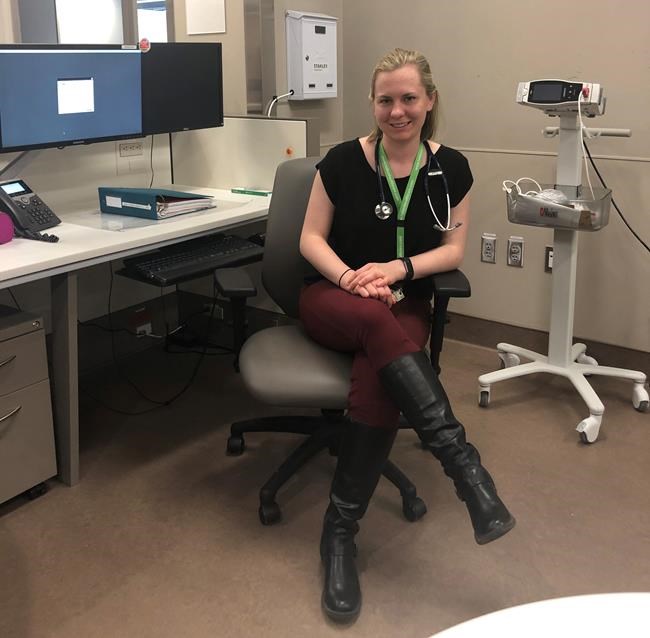
Dr. Sarah Tulk, a family doctor in Milton, Ont., shown on Thursday, May 2, 2019, is drawing attention to the need for more awareness about high rates of suicide among physicians after her own issues with depression while she was in training. THE CANADIAN PRESS/HO-Sarah Tulk MANDATORY CREDIT

“A lot of people do a pretty good job of hiding it,” she said of the high rate of depression among medical students, residents and doctors. She said they stay silent because they worry about their careers if they expose what they consider a weakness.

Tulk, who reached out for help in 2016 through a physician health program, is working to raise awareness and create change after hearing about too many doctors taking their own lives.

“I’m doing really well and I want people to know that recovery is certainly possible,” said Tulk, now a family doctor in Milton, Ont.

Tulk has joined psychiatrist Joy Albuquerque, medical director of the Ontario Medical Association’s physician health program, in outlining five key points about physician suicide in Monday’s publication of the Canadian Medical Association Journal.

They write that suicide is an occupational hazard in their profession, with a rate for male doctors nearly double compared with the general public, and two and a half times higher for female physicians.

Access to drugs and expertise in their use means doctors know just how much they need to hasten death by poisoning, sometimes with benzodiazepines or with other methods, including firearms.

Thoughts of suicide can begin in medical school and are later associated with patients’ complaints to regulatory bodies, Tulk and Albuquerque say, adding doctors face unique barriers to care compared with the general public.

While stigma is generally pervasive, physicians have the extra burden of little time to access care and face concerns about confidentiality as they fear discrimination in licensing and applications for work at hospitals, the commentary says.

In a SoundCloud podcast on the topic, Albuquerque says their colleagues also tend to self-stigmatize because they are accustomed to being care providers, not those who receive care.

Self care is an important component of dealing with the challenges of the job and it’s starting to be part of the learning environment at medical schools but there’s a long way to go, said Tulk, who teaches undergraduate programs at McMaster University.

Dr. Stephanie Smith, who will be starting a two-year family practice residency at the University of Calgary in July, said that as a medical student, she was working at a hospital for up to 27 “dangerous” hours at a time.

“The majority of my class was burned out by the end of medical school,” she said of the pressure of the 14-month program without any breaks to recover mentally.

“After 27 hours I’m just not processing things the same way anymore. It adds a very complex layer of stress and anxiety and guilt” to the heavy workload of a medical student, she said.

Smith, who has been in the Canadian Armed Forces for 18 years and worked as a nurse in the military between 2004 and 2016, said medical students often end up taking on extra responsibility for patients when fewer regular health-care staff are working during evenings, raising concerns about safety.

“I have a lot of critical experience as a nurse and I worry when I’m so tired at four or five in the morning and I have not slept since the day before. But the person who is signing off on things, the resident, is also tired.”

Dr. Gigi Osler, president of the Canadian Medical Association, said the well-being of physicians is a high priority and her organization is working with medical students, residents and provincial associations to create change for the sake of a healthy workforce.

“We’re in this position, sitting at those tables, where we are going to continue to try to be that catalyst and that connector to say we need to have change,” Osler said after meeting in Vancouver with her British Columbia counterparts, who she said shared their concerns about health and wellness among physicians.

The CMA hired a clinical psychiatrist in January to take the lead on that issue, and Dr. Caroline Gerin-Lajoie’s role will be to survey the needs of the health professionals across the country as stigma surrounding suicide is also addressed, Osler said.

“I can tell you, anecdotally, that there have been physician deaths that I’m almost 100 per cent certain have been suicides but nobody’s talking about it because the family doesn’t want to talk about it, colleagues don’t want to talk about it.”

— Follow @CamilleBains1 on Twitter.
Report Error Submit a Tip

More Stories

Woman, 23, charged with fatal stabbing outside Portage Place

Tyler Searle and Erik Pindera 4 minute read Preview

Woman, 23, charged with fatal stabbing outside Portage Place

Tyler Searle and Erik Pindera 4 minute read Thursday, Jul. 30, 2026

A 23-year-old woman has been charged with fatally stabbing a woman after they argued outside the entrance of Portage Place mall in the middle of the afternoon Tuesday.

Read
Thursday, Jul. 30, 2026

Plan to stay busy with overseas sweetheart

Maureen Scurfield 5 minute read Yesterday at 2:00 AM CDT

DEAR MISS LONELYHEARTS: I got a surprise phone call the other night from a number I thought I recognized and took a chance on answering it.

It was an old English girlfriend who still lives in London, where I went to university. I’ve been lonely this summer, so I thought, “What harm could there be in a friendly chat?”

I poured myself a big glass of wine as we started conversing. She was all flirty and charming — and hinting she wanted an invitation to come to Canada and visit me.

That sounded kind of exciting, and as I had another drink (and another) as we kept on talking, things got into full swing! Now she’s coming to Winnipeg for three weeks in the very near future. That can be a long time, if things go badly. Help me!

Hydro scrambling to restore power to remaining 4,500 customers after storm; some outages will continue into Saturday

Chris Kitching 5 minute read Preview

Hydro scrambling to restore power to remaining 4,500 customers after storm; some outages will continue into Saturday

Chris Kitching 5 minute read Updated: Yesterday at 4:31 PM CDT

Power outages could stretch into a third day for some Manitobans — mainly in and around Winnipeg — while crews continued to repair widespread damage caused by powerful thunderstorms.

About 4,500 Manitoba Hydro customers were still without electricity at 2:30 p.m. Friday, after more than 30,000 lost power while powerful winds brought down trees and power lines Wednesday night and early Thursday.

The Crown corporation said it is aiming to have all outages with greater numbers of customers restored by Friday night, but some customers may remain without power into Saturday.

“The challenge is just the sheer scale of this thing — hundreds of different outages spread across a large part of the city,” Hydro spokesman Peter Chura said. “Just getting to all of them in a timely fashion is very difficult.”

Read
Updated: Yesterday at 4:31 PM CDT

Wild weather uproots trees across city, leaves thousands in Manitoba without power

Chris Kitching 7 minute read Preview

Wild weather uproots trees across city, leaves thousands in Manitoba without power

Chris Kitching 7 minute read Thursday, Jul. 30, 2026

This summer’s latest barrage of severe thunderstorms caused widespread property damage and power outages for more than 30,000 Manitoba Hydro customers, mostly in Winnipeg, as winds of up to 133 km/h wreaked havoc.

Charleswood resident Ian Glover’s house had minor damage compared with a neighbour’s home, where a large, uprooted poplar tree crashed through the roof while the storm pummelled Winnipeg late Wednesday night and early Thursday.

“I opened the window after I woke up (around 6 a.m.) and the tree — oh my God,” Glover said. “I got my wife up and she couldn’t believe it. I was totally blown away. (Our neighbour) said the branch went right through the house into their living room.”

Glover was thankful his neighbours were not injured. Some of the tree’s outer branches clipped the corner of his home.

Read
Thursday, Jul. 30, 2026

Prepare to be … blutterbunged?

David McLaughlin 5 minute read Preview

Prepare to be … blutterbunged?

David McLaughlin 5 minute read 2:01 AM CDT

Are you not blutterbunged?

If Russell Crowe’s second-century gladiator character had uttered a 19th century equivalent of “Are you not entertained?” that fit the mood of today’s 21st century, that would be it.

Definitions first. Blutterbunged is an obscure regional dialect word from England that means everything from astonished to confounded to bemused or shocked into speechlessness. Its composition suggests something both more and less, namely blustering bloviation (that’s the more part) and empty words (that’s the empty part). These days we would more naturally punctuate our reaction to an event or statement with a profanity. But you get the drift.

Unearthed by lexicologist Susie Dent, it speaks volumes about our times that it fits now. That we need to reach back hundreds of years to find the right word to adequately capture a contemporary civic reaction to what the hell is going on in politics and the world today.

Read
2:01 AM CDT

Climate change threatens events we wait for all year

Jen Zoratti 5 minute read Preview

Climate change threatens events we wait for all year

Jen Zoratti 5 minute read 2:01 AM CDT

This week, owing to extreme heat and a wild storm with tree-snapping winds, the Royal Winnipeg Ballet had to cancel its full run of Ballet in the Park, a much-loved annual tradition at which people from all over Manitoba can enjoy world-class art in the verdant Assiniboine Park.

Two weeks prior, Rainbow Stage, another jewel of a Winnipeg summer, had to cancel the closing matinee of Jesus Christ Superstar owing to heat and humidity.

And at the beginning of July, Winnipeg Folk Festival attendees baked under scorching temperatures — 47 C with the humidex — to enjoy not just the discovery of music, but the community that has formed in Birds Hill Park on the second weekend of July for over 50 years.

This doesn’t feel great. I do not begrudge cancellations — they are absolutely the correct call for the health and safety of performers and patrons — but I can’t be the only one feeling some existential dread about our summers, and the things that make them special, in the face of a changing climate.

Read
2:01 AM CDT