To draw people back to church, make it relevant to them, church planters say
Advertisement
Read this article for free:
or
Already have an account? Log in here »
To continue reading, please subscribe:

Digital Subscription
One year of digital access for only $205*
- Enjoy unlimited reading on winnipegfreepress.com
- Read the E-Edition, our digital replica newspaper
- Access News Break, our award-winning app
- Play interactive puzzles
*First annual payment billed as $205.00 + GST for one year. This annual subscription will automatically renew at $233.00 + GST every 52 weeks (10% off the regular annual price of $259.35). Offer available to new and qualified returning subscribers only. Cancel any time.
To continue reading, please subscribe:
Add Free Press access to your Brandon Sun subscription for only an additional
$1 for the first 4 weeks*
- Enjoy unlimited reading on winnipegfreepress.com
- Read the E-Edition, our digital replica newspaper
- Access News Break, our award-winning app
- Play interactive puzzles
*Your next Brandon Sun subscription payment will increase by $1.00 and you will be charged $17.95 plus GST for four weeks. After four weeks, your payment will increase to $24.95 plus GST every four weeks.
Read unlimited articles for free today:
or
Already have an account? Log in here »
Hey there, time traveller!
This article was published 23/12/2018 (2803 days ago), so information in it may no longer be current.
TORONTO – Congregants of Mercy City Church file out of a strip mall storefront that has been converted into a place of worship, carrying battery-operated flameless candles into the cold December night.
They and members of six other churches in the community are celebrating Christmas a few days early, some gathering at the unconventional church in east Toronto before heading to a nearby parkette where they will light a Christmas tree and, they hope, spread the gospel to curious non-Christian onlookers.
Mercy City is nestled between a laundromat and a defunct pharmacy. It has no steeple and no pews. White plastic chairs face lead pastor and church founder Chris Yu, who delivers a sermon that clocks in at under 10 minutes. Nearby, computers line a red wall emblazoned with various Bible verses.
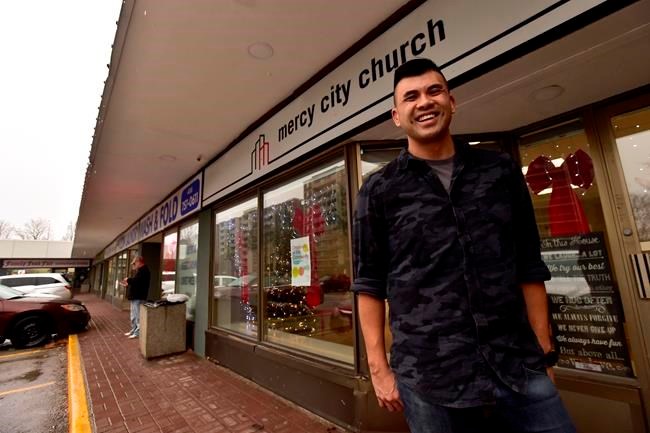
Yu says this type of facility is accessible and makes sense for his community. Mercy City if one of a number of so-called “church plants,” startup churches intended to draw non-believers to Christianity, and non-practising Christians to church services — not an easy task as the face of religion changes in Canada.
In 2011, the last time the census asked about religion, 67.3 per cent of Canadians identified as Christian, down from 80 per cent two decades before. During the same period, the proportion of respondents who said they had no religious affiliation jumped to 23.9 per cent from 12.3 per cent.
But where some might take this trend as evidence of a crisis of faith in Canada, Yu sees opportunity.
“As a pastor, our job, our passion, is to bring faith to people of all ages, all walks of life, but especially to those who don’t have faith at all,” he said. “You’ve got to take the message to where the people need it the most, and to where there’s nobody delivering it.”
Yu described his church’s community as “an inner-city neighbourhood with all the fixins” — economic and social disparity, addiction and crime.
The church is designed with the needs of the community in mind, Yu said, giving it an edge over existing churches also trying to recruit new members.
It’s open daily for after-school programs because there isn’t a community centre in the area, Yu said. Computers are there for people who might not otherwise have access to them. And services are in the evening, because many in the neighbourhood work during the day on Sunday. Other church plants are in affluent neighbourhoods, seeking to service young urban professionals.
Rev. Tom Sherwood, a retired United Church minister and adjunct research professor at Carleton University, said that in recent years he’s watched church plants open up in densely populated areas as established rural parishes close their doors.
“We’re kind of caught in the concept that the local congregation should last a hundred years or forever, or something like that,” Sherwood said. “They don’t. The demographics in Canada are shifting all the time.”
Religious leaders must understand the needs of their community, Yu said, and make their churches a necessary part of the neighbourhood. But bringing would-be worshippers through the door is not easy.
That’s where Church Planting Canada comes in, connecting different denominations and church planting networks and sharing information about what works.
Church plant websites are slick and modern, designed by creative marketing firms. They pay for video ads on Facebook that can garner 20,000 views apiece. And often, there is no mention of their denominational affiliation.
Yu insists he isn’t trying to hide Mercy City’s affiliation with the Evangelical Free Church of Canada, but says there’s no need to advertise it because the people who attend the church aren’t particularly concerned with denomination.
Graham Singh, executive director of Church Planting Canada and a church planter himself, says sometimes leaving out the denomination in the name of a church is done to avoid alienating would-be congregants.
“In certain cases, people will say, ‘I haven’t gone to church, my parents didn’t go to church, but I’m a Catholic,” Singh said. “Sometimes those brand loyalties are surprising.”
But by and large, those “brand loyalties” are dissipating, he said, leading to fuzzier boundaries between denominations. Singh is Anglican, but he leads a non-denominational church in Montreal called St. Jax.
Church Planting Canada is overseen by the Pentecostal Assemblies of Canada, but it represents 26 different denominations and church planting networks looking to grow.
Singh said the majority of groups that have invested in church planting are evangelical — a Bible-focused sect of Protestant Christianity often associated with charismatic preachers and conservative social views.
But different denominations have found themselves needing to let go of some of the beliefs that set them apart from other groups in order to attract new, younger members, Singh said.
“As the age shifts, and as the level of desperation shifts, we realize that God is so relevant, but the forms of church we’ve been using are so irrelevant,” he said. “I think that realization is actually what fuels the appetite for change.”
Brian Egert, of the Pentecostal Assemblies of Canada, said that while churches in his network may look a little different than they did a century ago, the message remains largely the same.
“From when Christ gave it 2,000 years ago, that mandate has never changed,” he said. “I think the methods have changed.”
Church planting, particularly in underserved and multicultural communities, is a method of spreading the gospel and following that millennia-old mandate, said Egert, who serves as director of Mission Canada and assistant to PAOC’s general superintendent.
The network, which is affiliated with 1,200 churches across Canada and about 4,000 credentialed pastors, helps foster church planters by coaching people who have both the “calling and the chops” to plant a church, Egert said.
But having the chops is no small feat. To be given ministerial credentials in the PAOC, one must “maintain biblical standards of holiness” and have what Egert calls an entrepreneurial spirit. Ministers are also barred from engaging in pre-marital or gay sex.
Pentecostal church planters who do make the cut can receive financial support from the institution, and Egert said it may also request members of one church join a church plant to help establish it in the community.
In addition to support from their denomination, church planters often ask for help from their pious friends and family, Singh said.

But those grants and donations generally can’t sustain a church forever, he noted; startup churches eventually make their money in much the same way as established churches.
For the most part, Singh said, congregants are expected to tithe — donating as much as 10 per cent of their paycheque to their place of worship — so the church can become self-sustaining.
The first year of a church plant’s life is hard, he said, costing between $50,000 and $100,000, about half of which comes from grants and the other half comes from the community.
“People involved in church plants tend to be quite generous with their giving,” Singh said, adding it is similar to the way that overseas missions raise money.
“Some of the most effective church planting organizations in Canada actually come from the places that used to be the overseas missionary fields,” he said. “A lot of missionary work in Canada is actually the reverse of what it was a hundred years ago.”
The Free Press acknowledges the financial support it receives from members of the city’s faith community, which makes our coverage of religion possible.