US surgeon general warns of teen risks from e-cigarettes
Advertisement
Read this article for free:
or
Already have an account? Log in here »
To continue reading, please subscribe:

Digital Subscription
One year of digital access for only $205*
- Enjoy unlimited reading on winnipegfreepress.com
- Read the E-Edition, our digital replica newspaper
- Access News Break, our award-winning app
- Play interactive puzzles
*First annual payment billed as $205.00 + GST for one year. This annual subscription will automatically renew at $233.00 + GST every 52 weeks (10% off the regular annual price of $259.35). Offer available to new and qualified returning subscribers only. Cancel any time.
To continue reading, please subscribe:
Add Free Press access to your Brandon Sun subscription for only an additional
$1 for the first 4 weeks*
- Enjoy unlimited reading on winnipegfreepress.com
- Read the E-Edition, our digital replica newspaper
- Access News Break, our award-winning app
- Play interactive puzzles
*Your next Brandon Sun subscription payment will increase by $1.00 and you will be charged $17.95 plus GST for four weeks. After four weeks, your payment will increase to $24.95 plus GST every four weeks.
Read unlimited articles for free today:
or
Already have an account? Log in here »
Hey there, time traveller!
This article was published 18/12/2018 (2777 days ago), so information in it may no longer be current.
WASHINGTON – The government’s top doctor is taking aim at the bestselling electronic cigarette brand in the U.S., urging swift action to prevent Juul and similar vaping brands from addicting millions of teenagers.
In an advisory Tuesday, Surgeon General Jerome Adams said parents, teachers, health professionals and government officials must take “aggressive steps” to keep children from using e-cigarettes. Federal law bars the sale of e-cigarettes to those under 18.
For young people, “nicotine is dangerous and it can have negative health effects,” Adams said in an interview. “It can impact learning, attention and memory, and it can prime the youth brain for addiction.”
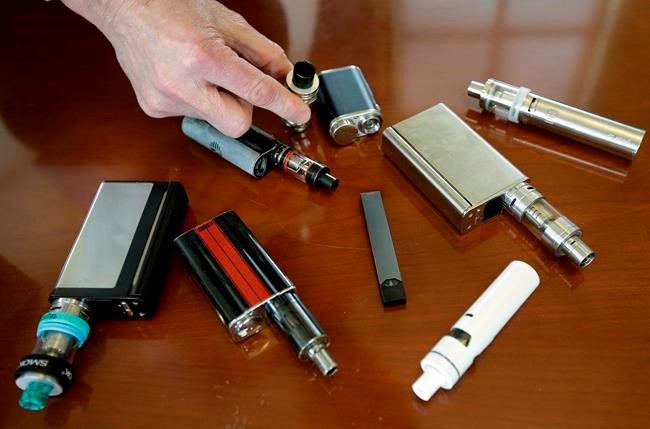
Federal officials are scrambling to reverse a recent explosion in teen vaping that public health officials fear could undermine decades of declines in tobacco use. An estimated 3.6 million U.S. teens are now using e-cigarettes, representing 1 in 5 high school students and 1 in 20 middle schoolers, according to the latest federal figures.
Separate survey results released Monday showed twice as many high school students used e-cigarettes this year compared to last year.
E-cigarettes and other vaping devices have been sold in the U.S. since 2007, growing into a $6.6 billion business. Most devices heat a flavoured nicotine solution into an inhalable vapour. They have been pitched to adult smokers as a less-harmful alternative to cigarettes, though there’s been little research on the long-term health effects or on whether they help people quit. Even more worrisome, a growing body of research suggests that teens who vape are more likely to try regular cigarettes.
Adams singled out Silicon Valley startup Juul. The company leapfrogged over its larger competitors with online promotions portraying their small device as the latest high-tech gadget for hip, attractive young people. Analysts now estimate the company controls more than 75 per cent of the U.S. e-cigarette market.
The surgeon general’s advisory notes that each Juul cartridge, or pod, contains as much nicotine as a pack of cigarettes. Additionally, Adams states that Juul’s liquid nicotine mixture is specially formulated to give a smoother, more potent nicotine buzz. That effect poses special risks for young people, Adams says.
“We do know that these newer products, such as Juul, can promote dependence in just a few uses,” Adams said.

Juul said in a statement that it shares the surgeon general’s goal: “We are committed to preventing youth access of Juul products.”
Last month, San Francisco-based Juul shut down its Facebook and Instagram accounts and halted in-store sales of its flavoured pods. The flavours remain available via age-restricted online sales. That voluntary action came days before the Food and Drug Administration proposed industrywide restrictions on online and convenience store sales of e-cigarettes to deter use by kids.
Adams recommends parents, teachers and health professionals learn about e-cigarettes, talk to children about the risks and set an example by not using tobacco products.
___
The Associated Press Health & Science Department receives support from the Howard Hughes Medical Institute’s Department of Science Education. The AP is solely responsible for all content.