US urges doctors to write more Rx for overdose antidote
Advertisement
Read this article for free:
or
Already have an account? Log in here »
To continue reading, please subscribe:

Digital Subscription
One year of digital access for only $205*
- Enjoy unlimited reading on winnipegfreepress.com
- Read the E-Edition, our digital replica newspaper
- Access News Break, our award-winning app
- Play interactive puzzles
*First annual payment billed as $205.00 + GST for one year. This annual subscription will automatically renew at $233.00 + GST every 52 weeks (10% off the regular annual price of $259.35). Offer available to new and qualified returning subscribers only. Cancel any time.
To continue reading, please subscribe:
Add Free Press access to your Brandon Sun subscription for only an additional
$1 for the first 4 weeks*
- Enjoy unlimited reading on winnipegfreepress.com
- Read the E-Edition, our digital replica newspaper
- Access News Break, our award-winning app
- Play interactive puzzles
*Your next Brandon Sun subscription payment will increase by $1.00 and you will be charged $17.95 plus GST for four weeks. After four weeks, your payment will increase to $24.95 plus GST every four weeks.
Read unlimited articles for free today:
or
Already have an account? Log in here »
Hey there, time traveller!
This article was published 19/12/2018 (2774 days ago), so information in it may no longer be current.
The U.S. government told doctors Wednesday to consider prescribing medications that reverse overdoses to many more patients who take opioid painkillers in a move that could add more than $1 billion in health care costs.
Assistant Secretary for Health Brett Giroir, a doctor appointed by President Donald Trump, announced the guidance, saying it’s important for doctors to discuss overdose dangers with patients.
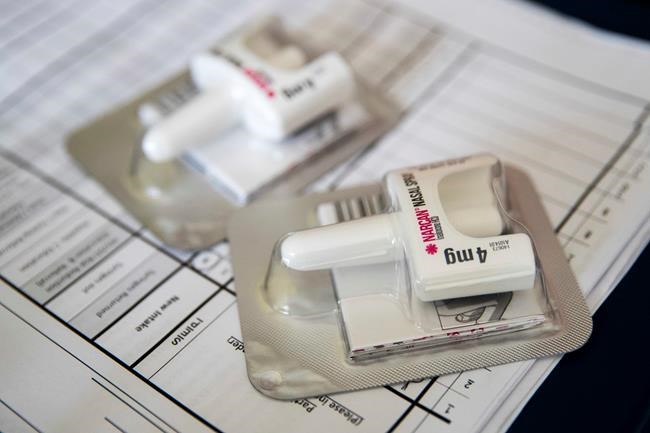
Prescribing naloxone such as Narcan along with opioids forces a conversation that will lead to “a more informed decision by the patient,” he said.
The action comes a day after a close vote from a Food and Drug Administration expert panel endorsing the idea of rewriting opioid drug labels to include a naloxone recommendation for many or all patients. An FDA document said such a move could add more than $1 billion in health care costs.
“Even at a billion, it would be an investment that is well worth it,” Giroir said.
More than 47,600 Americans died of opioid overdoses last year, a toll that has been rising for two decades. The street drug fentanyl is the top killer today, but prescription painkillers are still a problem, contributing to nearly 15,000 overdose deaths last year.
Naloxone comes in a nasal spray, an injection and an automatic injector. The Narcan nasal spray costs about $125 for a two-dose kit, although government programs can get it for less. The automatic injector can cost as much as $4,000 per kit, although its maker recently authorized a cheaper generic version.
Critics said prescribing the antidote to pain patients does not address the growing share of fatal overdoses caused by illicit opioids, and could cause shortages for programs that hand out the kits to street drug users.
It “will have the unintended consequence of derailing efforts to provide naloxone to the very effective community programs we know are successful in saving lives,” said Dr. Raeford E. Brown Jr., who heads an expert panel advising the FDA.
The new guidance tells doctors to consider prescribing the antidote to patients on high doses of opioids, heavy drinkers, people with sleep apnea and other breathing problems, people taking benzodiazepines such as Xanax and people with addiction or mental health problems.
It expands upon a similar recommendation from the Centers for Disease Control and Prevention.
In April, U.S. Surgeon General Jerome Adams issued the office’s first national public health advisory in 13 years, calling on more Americans to start carrying naloxone and urging more federal money to be dedicated to broadening access.
Most states allow people to get naloxone from a pharmacy or community program under a statewide prescription and some states require doctors to also prescribe naloxone to patients on high doses of opioids.
The FDA is working toward an over-the-counter version of naloxone.
Brown said the government should use its emergency authority to buy and distribute large quantities of naloxone and immediately make it available over the counter. Trump directed the health agency to declare the opioid crisis a public health emergency last year.

“That’s the difference between declaring a public health emergency and actually acting as if there’s a public health emergency,” Brown said.
___
Follow AP Medical Writer Carla K. Johnson on Twitter: @CarlaKJohnson
___
The Associated Press Health & Science Department receives support from the Howard Hughes Medical Institute’s Department of Science Education. The AP is solely responsible for all content.