What’s in the box?
Business is booming for subscription services that curate and deliver products -- health and beauty items, artisanal foods, selections for pets -- to curious consumers

Advertisement
Read this article for free:
or
Already have an account? Log in here »
To continue reading, please subscribe:

Digital Subscription
One year of digital access for only $205*
- Enjoy unlimited reading on winnipegfreepress.com
- Read the E-Edition, our digital replica newspaper
- Access News Break, our award-winning app
- Play interactive puzzles
*First annual payment billed as $205.00 + GST for one year. This annual subscription will automatically renew at $233.00 + GST every 52 weeks (10% off the regular annual price of $259.35). Offer available to new and qualified returning subscribers only. Cancel any time.
To continue reading, please subscribe:
Add Free Press access to your Brandon Sun subscription for only an additional
$1 for the first 4 weeks*
- Enjoy unlimited reading on winnipegfreepress.com
- Read the E-Edition, our digital replica newspaper
- Access News Break, our award-winning app
- Play interactive puzzles
*Your next Brandon Sun subscription payment will increase by $1.00 and you will be charged $17.95 plus GST for four weeks. After four weeks, your payment will increase to $24.95 plus GST every four weeks.
Read unlimited articles for free today:
or
Already have an account? Log in here »
Hey there, time traveller!
This article was published 09/12/2017 (3140 days ago), so information in it may no longer be current.
Four times a year, a beautiful box of full-sized beauty and health products lands on my doorstep and it is legitimately the most exciting piece of mail I receive.
Inside is a selection of seven or eight trendy items — creams and lotions, makeup, hair-care and wellness products, housewares, clothing and whatever else seems appropriate for the season. The items are a surprise and the box costs $70 (including tax and shipping); the total value is usually around $300.
This is what’s known as a subscription box — a curated selection of goods that arrives at regular intervals throughout the year. Depending on the company, some boxes are monthly, some are quarterly and some you can buy once just to try it out. There are subscription boxes available with pretty much any theme you can think of; from home goods and beauty to food and booze to clothes and pet products. There’s literally a box for everyone.
There aren’t a lot of statistics available for the Canadian subscription-box industry, but in the United States, sales are booming; as of March 2016, there were more than 2,000 different companies with various offerings. A 2016 consumer insights retail report found visits to top websites increased by nearly 3,000 per cent from 2013 to 2016 (from 722,000 to 21.4 million).
Last year, popular men’s Dollar Shave Club was sold to consumer goods company Unilever (which produces popular brands such as Dove, Lipton, Knorr and Hellman’s) for US$1 billion just five years after launching.
Two of the most popular boxes are Ipsy and Birchbox, both of which send out makeup and beauty products.
Birchbox has been credited with igniting the modern success of subscription services. In 2010, business school buds Katia Beauchamp and Hayley Barna designed a subscription service that, for just $10 a month, would send customers a selection of sample-sized beauty products curated by the Birchbox team and it took off.
Birchbox’s subscription list has grown to more than one million and it opened a brick-and-mortar store in New York; it also has operations in the United Kingdom, France, Spain and Belgium.
The increase in subscription-box competitors since Birchbox’s inception has taken a toll — the company was in the news earlier this year because of financial challenges — however, it is still widely regarded as a pioneer of this specific branch of e-commerce.
“I think people are sick of bad mail all the time; they want some good mail and it’s nice that it’s a surprise, so they get that kind of spontaneity out of it.”
But for Canadian consumers who want to get in on the subscription-box game, the options are slightly more limited (though still plentiful). Many of the U.S.-based boxes don’t ship to Canada, or, if they do, the cost of getting it over the border may end up making the box cost more than the value of what’s inside.
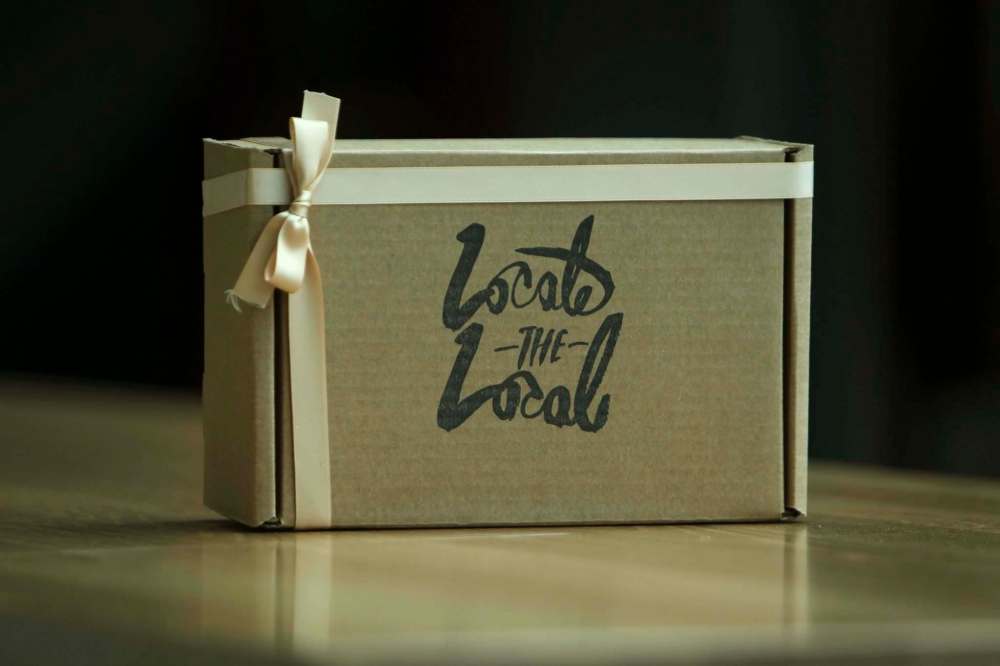
Alison Jonk, founder of the Winnipeg-based subscription box Locate the Local, saw the need for alternatives and decided to put together her own service featuring full-size products made by small Canadian businesses.
“Subscription boxes were taking off, but so many were out of the States, and I was finding that there weren’t any that I would want to sign up for myself — like bang-for-your-buck-wise, by the time you pay for shipping and exchange rate, you didn’t get what you were paying for, or they were samples,” Jonk says.
“I had friends who had signed up for ones that had makeup samples and they’re giving it all away, because how many lipstick samples do I need?
“I did a bit of research and thought, ‘OK, I’m going to do a subscription box, so what niche is not being filled?” So that’s why I got into the Canadian stuff,” she says.
Locate the Local (its website is locatethelocal.ca) offers many different types of options for boxes; annual subscriptions (four times yearly for $235), box-to-box orders (you buy one box for $55 and then decide if you’d like to subscribe) and pre-curated gift boxes for new babies, bridesmaids and groomsmen, birthdays and other occasions, ranging in price from about $30 to more than $100.
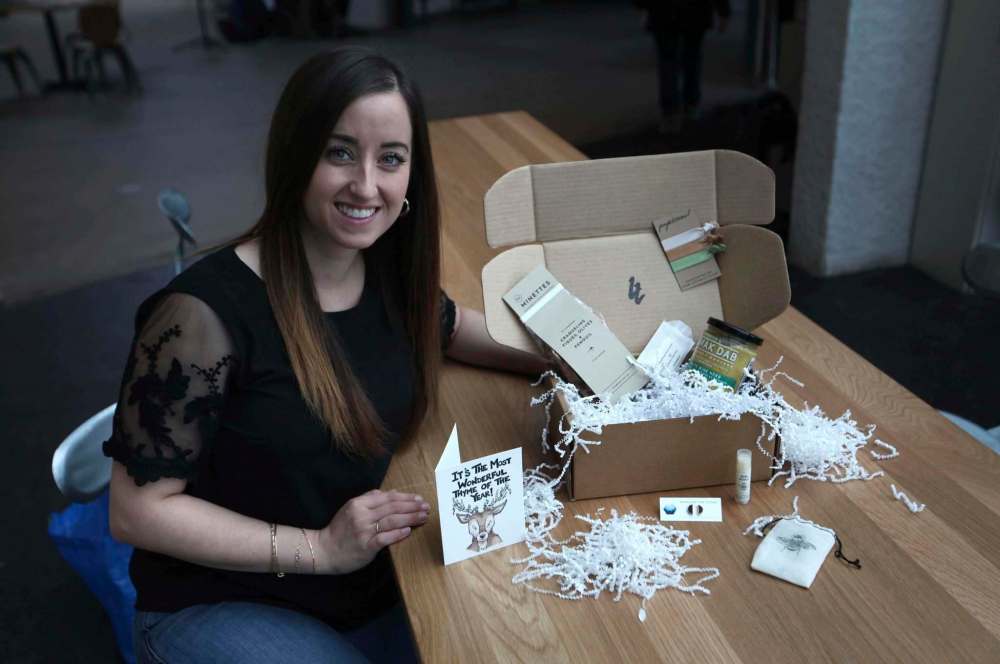
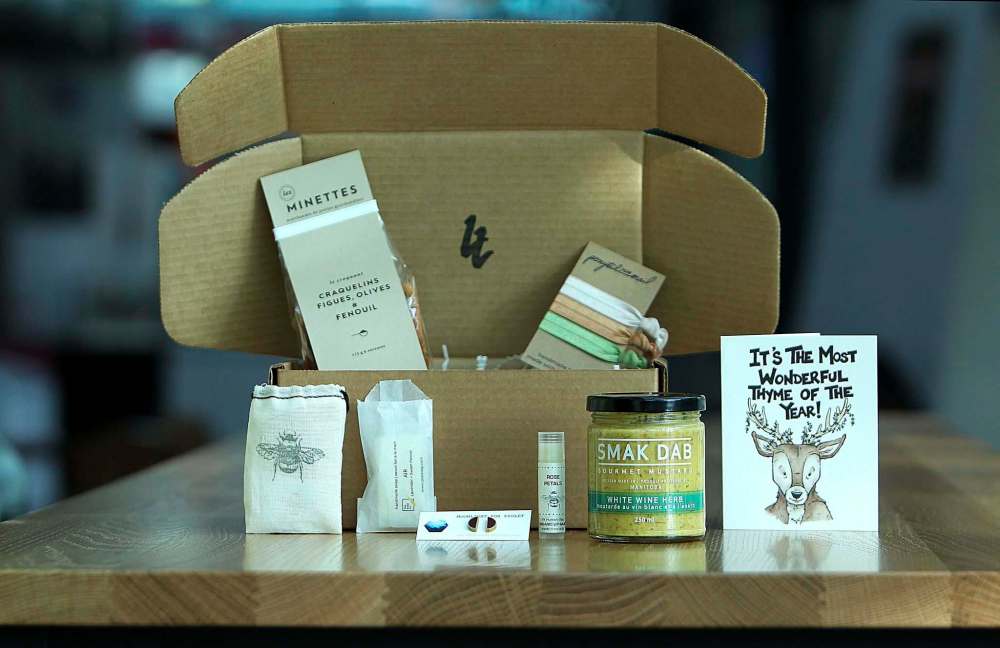
Inside the boxes, you’ll find beauty products such as lip balm or soaps, artisan food products, candles and stationery. For example, October’s box contained a jar of mustard, handmade crackers, stud earrings, hair ties, a holiday card, lip balm and a soap sample, along with cards offering information on the products.
Jonk has just wrapped up her first year of shipments (Locate the Local began taking orders in September 2016), and says her biggest hurdle so far has been sticking to her small product-purchasing budget while still keeping customers and suppliers happy, as well as having a few bucks left over for her own pocket.
“That’s probably the most difficult part of doing a subscription box — everything is pre-paid. So someone has already paid a certain amount of money for this box, so I have to work with that and I have other things I have to be mindful of, such as my packaging costs, my website, payment-processing costs… I have a very small margin that I have to fit all of my products in,” she says.
“And I want to work with full-sized products only and small businesses, and they’re not as cheap as other mass-produced products. And I also need to make sure I give people at least the value of what they’ve paid, if not more… and I have to make sure I’m still making a profit!”

Jonk thinks much of the appeal can be boiled down to the idea of surprise; both in terms of the products the subscriber receives and also when the box arrives at the door.
“If it comes every three months — which, to me, is a nice time frame because you kind of forget about it — they have time to use the products in between and then they get a new batch. They’ve gone through their candle, they’ve gone through their artisan mustard or whatever, so they’re not cluttering up their space with products,” she says.
“And I think people are sick of bad mail all the time; they want some good mail and it’s nice that it’s a surprise, so they get that kind of spontaneity out of it. It’s really easy to do as a gift, too — a lot of my customers buy as gifts for other people, for friends and family all over Canada who they don’t get to see very often.
“You go to the mailbox and instead of it being flyer, flyer, bill, flyer; it’s flyer, flyer, bill… box!”
erin.lebar@freepress.mb.ca Twitter: @NireRabel
Our newsroom depends on a growing audience of readers to power our journalism. If you are not a paid reader, please consider becoming a subscriber.
Our newsroom depends on its audience of readers to power our journalism. Thank you for your support.
Subscription boxes
If you’re looking to check out some subscription boxes for yourself or as a gift for someone this holiday season, here are a few different options that are either based in Canada or ship to Canada:
Topbox — A monthly beauty box with four hand-picked deluxe samples delivered to your door for $12 per month (topbox.ca).
Ellebox — A box specifically meant for menstruating women. You tell Ellebox how many tampons and/or pads you want, how long your cycle is, and the date of your last period and they make sure you have what you need, when you need it. The Ellebox runs between $13-$37 per month, depending on the type of subscription you choose (elleboxco.com).
Carnivore Club — Each box comes with four to six cured meats from top artisans in the industry at a cost of $50 per box, or $55 for a one-time purchase (carinvoreclub.co).
Baker’s Krate — A monthly delivery of gourmet-quality treats made by bakers across the country. Price ranges from $17.99-$19.99 per month depending on the type of subscription chosen (bakerskrate.com)
WineCollective — The WineCollective experts choose a variety of wines each month and add a tasting card for each, which includes information about the producer, region, grape variety, history and a “step-by-step breakdown on each facet of the wine (what it looks like, smells like, tastes like and food pairings),” says the website. Prices range from $57.24-$155.74, depending on how many bottles you would like per box (winecollective.ca).
Bowzer Box – A box for dogs that contains five or six items such as dog treats, toys and accessories handpicked by the Bowzer Box team for $33 a month (bowzerbox.ca) There is also another company, Meow Box, for the cat-lovers out there (meowbox.com).
Note: Shipping may cost extra for some of these subscription boxes.
Our newsroom depends on a growing audience of readers to power our journalism. If you are not a paid reader, please consider becoming a subscriber.
Our newsroom depends on its audience of readers to power our journalism. Thank you for your support.
Advertisement Advertise With Us
Advertisement Advertise With Us