Where the wild things are
Adventurous animals have been known to pop up in odd places
Advertisement
Read this article for free:
or
Already have an account? Log in here »
To continue reading, please subscribe:

Digital Subscription
One year of digital access for only $205*
- Enjoy unlimited reading on winnipegfreepress.com
- Read the E-Edition, our digital replica newspaper
- Access News Break, our award-winning app
- Play interactive puzzles
*First annual payment billed as $205.00 + GST for one year. This annual subscription will automatically renew at $233.00 + GST every 52 weeks (10% off the regular annual price of $259.35). Offer available to new and qualified returning subscribers only. Cancel any time.
To continue reading, please subscribe:
Add Free Press access to your Brandon Sun subscription for only an additional
$1 for the first 4 weeks*
- Enjoy unlimited reading on winnipegfreepress.com
- Read the E-Edition, our digital replica newspaper
- Access News Break, our award-winning app
- Play interactive puzzles
*Your next Brandon Sun subscription payment will increase by $1.00 and you will be charged $17.95 plus GST for four weeks. After four weeks, your payment will increase to $24.95 plus GST every four weeks.
Read unlimited articles for free today:
or
Already have an account? Log in here »
Hey there, time traveller!
This article was published 16/06/2018 (2949 days ago), so information in it may no longer be current.
Nothing generates as much excitement on a slow news day as reports of wild animals wandering into populated areas.
For example, Transcona residents were sweating earlier this month when a two-year-old black bear strolled into the neighbourhood and climbed a backyard tree.
“It’s not the way you usually start your day,” said Gerry Bates, in whose backyard the drama concluded when Manitoba conservation officers armed with a “jab pole” tranquilized the 55-kilogram bear, which was later released into the wild.
Earlier this week, an alligator made news when it was spotted meandering down the runway at Orlando International Airport. Orlando airport officials tweeted that pilots had to “pause on the taxiway and give right of way to a local resident out for a morning stroll. Passengers caught a rare glimpse of an alligator trudging from one pond to the next.”
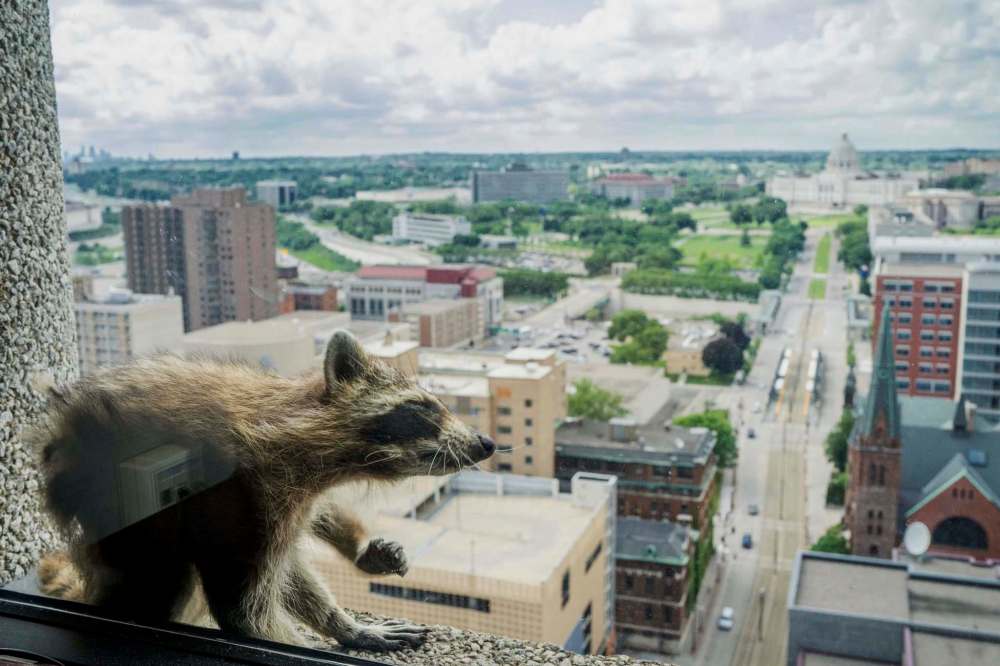
And the eyes of the world were focused on a tiny raccoon this week as it spent two days scaling a 25-storey skyscraper in St. Paul, Minn. The dumpster diver’s perilous journey became the top trending topic on Twitter and there was a sigh of relief online when it was safely captured on the roof early Wednesday.
But these plucky non-human newsmakers are far from alone, as we see from today’s beastly list of Five Wild Animals Famously Found in Extremely Strange Places:
5) The exotic critter: A wily coyote
The unusual location: The roof of a New York City bar
The wild story: It definitely wasn’t a joke — a coyote was spotted scampering back and forth across the roof of a bar in Queens, on the day before April Fool’s Day in 2015.
“It was a pretty big animal, by far the biggest coyote I’ve ever seen,” Brian Porter, owner of L.I.C. Bar, told news media at the time. “I’ll tell you one thing, he was well-fed.”
Porter speculated the coyote had been living in a sprawling vacant paint factory and likely hopped through an open window onto the roof of his bar. “He didn’t pay his bar tab, so he ran out onto the rooftop,” Porter quipped to the New York Daily News. T
he unlikely bar patron became a huge hit online and drew a large crowd of onlookers, including a worker from a nearby veterinary clinic, who bravely scaled a wall to get a closer look at the predator. “She came back pretty quick because she saw it was not a dog,” the bar owner said.
Police and animal control officers responded and tried to snare the Queens coyote with rope loops fixed to the end of poles, but the wily critter eluded them and fled back into the vacant building. “He escaped two police officers, and he jumped on the roof adjacent to me and then jumped through the window” of the former factory, Porter said.
According to National Geographic, coyotes have spread to the eastern U.S. and are becoming more comfortable hunting for prey in urban areas. Coincidentally, on the night the coyote visited, a band named “Coyote Anderson” was booked to play the bar. “You can’t make this up,” Porter chirped. “You really can’t.”
4) The exotic critter(s): “Killer” bull sharks
The unusual location: A golf course water hazard
The wild story: As every golfer knows, the water hazards on any course can pose a daunting challenge. On one Australian course, however, the lake feature has a little more bite than you might expect.
According to a 2011 report in Britain’s Daily Mail newspaper: “At the 14th tee at the Carbrook Golf Club, Brisbane, a dozen man-eating bull sharks are waiting to swallow any lost balls and the sight of their fins poking through the water has even made the place a tourist attraction.”
You would think this was some sort of elaborate golfing prank, but it’s the truth. It seems the sharks got onto the Queensland, Australia, golf course more than a decade earlier when the nearby Logan River burst its banks and covered the course in water, and thousands of fish, including an estimated eight juvenile sharks, became stranded in the land-locked lake when the water receded.
“You can’t believe how close you are… just six feet away,” club general manager Scott Wagstaff told the Daily Mail. “There’s no drama, it’s become a positive thing for the golf course.”
It appears the sharks, which can be up to 10 feet long, are growing in size and number. The lake is well stocked with fish, but Wagstaff sometimes tosses meat in to encourage his finned friends to come near the surface.
“I’m sure they are aggressive when you are in the water, but when you are out here feeding them, they are beautiful to watch,” he said. Thanks to its unusual guests, the club hosts an annual Shark Lake Challenge.
“The sharks… have proved quite a hit at corporate events and their fins have even been spotted during wedding ceremonies held on the course,” the newspaper noted. “Local children once jumped in the lake to retrieve lost golf balls for extra pocket money — but it is something they have not done for a while.”
3) The exotic critter(s): Hungry hungry hippos
The unusual location: A Colombian drug lord’s private zoo
The wild story: Back when you were a kid, you probably had a blast playing the famed tabletop game Hungry Hungry Hippos. But it wouldn’t be as much fun to encounter one of those massive creatures — they can weigh in excess of 1,500 kilograms — in real life. They may resemble bathtubs on legs, but hippos are considered one of the most aggressive animals on the planet, especially in their native home of Africa, where there are an average of 50 hippo-related deaths reported per year. Which may explain why infamous Colombian drug lord Pablo Escobar was fascinated by these mammals, four of which he illegally smuggled into Colombia and kept in a private menagerie at his vast ranch, the Hacienda Napoles, about 160 kilometres east of Medellin.
When Escobar was shot dead in 1993, the hippos were deemed too difficult to move and were abandoned on the estate.
“Natives of Africa, three females and one male hippo were left to their own devices in the ranch’s pond,” according to NationalGeographic.com. “With mild weather and no competition, the hippos thrived. Over time, some of the animals began to venture away from the pond, into nearby rivers and the surrounding areas. Villagers grew concerned about the large animals, which have a reputation for being dangerous.”
The so-called “Cocaine Hippos” have spread, crossing the gates of the hacienda to freedom in the Magdalena River, where the population is now thought to number at least 40.
“They are in a quiet area where they are reproducing,” biologist David Echeverri Lopez told euronews.com this year. “It is an invasive species that is causing problems for native systems… We have not had confirmed attacks. We have heard rumours, but there is no evidence. We have been fighting hippos for years. They are very unpredictable.”
In 2017, one hippo soared to social-media fame when it wandered through the streets of a local town.
2) The exotic critter(s): Black panthers
The unusual location: Merry Olde England
The wild story: Is it possible that huge jungle cats, including black panthers, are stalking the countryside in the land of Shakespeare, Chaucer and the Spice Girls? As surprising as this may be to hear, the answer is: maybe.
For years, there have been unconfirmed reports of so-called “British big cats” or “phantom cats” slinking through the British countryside. “Many have been debunked as hoaxes or misidentifications, but there are a few of the 2,000 or so that are recorded every year that remain as mysteries,” according to the BBC. “Many groups are gathering data around the U.K. to try to help explain strange goings-on near them.”
Reports typically describe the mysterious cats as being large and black, resembling a panther. It has been speculated that, when the Dangerous Wild Animals Act of 1977 took effect, owners of dangerous animals released them into the wild to avoid large fines.
In August 2017, Britain’s Daily Mail reported a delivery driver had spotted a “black panther” stalking the Lincolnshire countryside in what was the fifth “big cat” sighting across Britain that summer. According to the newspaper, driver Steve Parker, 45, photographed a big cat in a field near the village of Obthorpe in Lincolnshire.
“With the naked eye, I could clearly see it was a big cat, I would say a black panther,” he told the paper. “I managed to take a photo with my phone before it climbed up some logs to lie down and I couldn’t see it from where I was. It can’t be a horse, because horses can’t climb logs, it can’t be a cow because they can’t either, so it doesn’t leave much option other than a big cat.”
Amid a flurry of sightings in 2016, the Daily Mail reported that animal expert Jonathan Downes believed big cats were breeding in the wild in England. “Since the Dangerous Wild Animals Act, which came into law in 1977, people have not been allowed to keep big cats as pets,” he said.
“Many big cat sightings are of animals that were kept as pets and released. Or they may be ones that escaped from zoos or were purposely let out into the wild. I am certain that big cats such as leopards and pumas must be breeding, as they do not live 40 years in the wild.”
Tarzan could not be reached for comment.
1) The exotic critter(s): A zebra and a macaw parrot
The unusual location: The front seat of a truck outside a bar
The wild story: So a zebra and a parrot walked into a bar and… In what is arguably the strangest drunk-driving arrest in history, police in Cascade, Iowa, discovered 55-year-old Jerald Reiter in his car in the parking lot of the Dog House Lounge with (pause for dramatic effect) a pet zebra and macaw parrot in his front seat.
Officers gave Reiter a field sobriety test and said he had a blood-alcohol level of 0.14, exceeding Iowa’s legal limit of 0.08.
According to the Des Moines Register, the man told authorities he considered the animals his friends, and they often come on trips with him around town.
“He claimed he brought the animals to the Dog House Lounge Sunday night because the establishment often allows people to bring their pets with them, though bar owners told KCRG-TV that animals aren’t allowed inside,” the New York Daily News and other outlets reported at the time.
“When Reiter arrived at the bar with the zebra and macaw that night, he was told they’d have to stay outside. He told the Des Moines Register that he had three drinks with dinner before heading out, and that a group of gawkers gathered to take photographs of his animals before he got back into his truck. He said he thinks one of those people called police.”
He disputed his arrest, saying he was just about to get out of the truck and let a friend drive when police showed up. Just being in the driver’s seat is considered operating while intoxicated in Iowa. A friend reportedly drove the zebra and parrot home while their owner spent a few hours drying out.
Only the zebra ended up in stripes.
doug.speirs@freepress.mb.ca