Winnipeg’s 100-year war
City's "scientific" mosquito-control efforts began in earnest in 1923; in many ways, things haven't changed much
Advertisement
Read this article for free:
or
Already have an account? Log in here »
To continue reading, please subscribe:

Digital Subscription
One year of digital access for only $205*
- Enjoy unlimited reading on winnipegfreepress.com
- Read the E-Edition, our digital replica newspaper
- Access News Break, our award-winning app
- Play interactive puzzles
*First annual payment billed as $205.00 + GST for one year. This annual subscription will automatically renew at $233.00 + GST every 52 weeks (10% off the regular annual price of $259.35). Offer available to new and qualified returning subscribers only. Cancel any time.
To continue reading, please subscribe:
Add Free Press access to your Brandon Sun subscription for only an additional
$1 for the first 4 weeks*
- Enjoy unlimited reading on winnipegfreepress.com
- Read the E-Edition, our digital replica newspaper
- Access News Break, our award-winning app
- Play interactive puzzles
*Your next Brandon Sun subscription payment will increase by $1.00 and you will be charged $17.95 plus GST for four weeks. After four weeks, your payment will increase to $24.95 plus GST every four weeks.
Read unlimited articles for free today:
or
Already have an account? Log in here »
Hey there, time traveller!
This article was published 02/05/2020 (2320 days ago), so information in it may no longer be current.
This article was published originally in Manitoba Pageant by the Manitoba Historical Society in the winter of 1967.
Since creation began man has had to wage war with insects. Of these the greatest foe was the mosquito, not only as a destroyer of rest and sleep, but because it was a deadly carrier of infection. Malaria, yellow fever, poliomyelitis, equine encephalitis or ‘staggers’ in horses, all are carried by mosquitoes. Malaria caused the downfall of ancient Greece and ruined the attempt of the French engineer, de Lesseps to build a Panama Canal. Yellow fever brought epidemics of ghastly death until Walter Reed traced its cause to the mosquito.
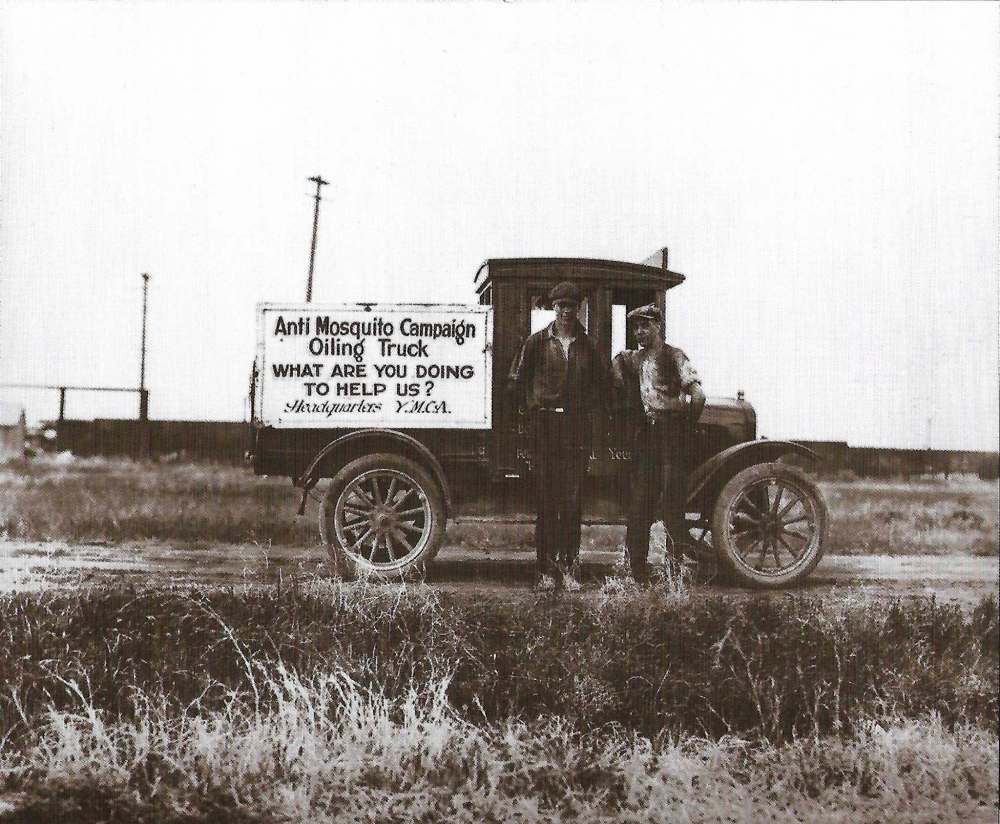
Fortunately, Canada is free from these two diseases but mosquitoes are at least a nuisance to man and beast. The first attempt on a scientific basis to control this nuisance was in 1923 when the Canadian Pacific Railway sought advice on how to prevent mosquitoes from driving away tourists from Banff. The Dominion Department of Entomology recommended that Eric Heale, of Alberta, undertake a plan of control. The method he suggested was to spread oil over stagnant pools of water in which mosquitoes breed.
Dr. H.M. Speechly of Winnipeg heard of this and had also read of the success of the American Army Medical Corps in fighting mosquitoes during the building of the Panama Canal in 1914.
In February 1927, Dr. Speechly invited the Natural History Society of Manitoba to appoint a committee headed by Dr. Charles O’Donoghue, Professor of Zoology, University of Manitoba, to examine the possibility of an Anti-Mosquito Campaign in the Winnipeg area. This committee consisted of representatives from the Natural History Society, the City of Winnipeg Parks Board, the Y.M.C.A. and the Young Men’s Section of the Board of Trade. The committee reported that a campaign was feasible. With generous publicity through press and radio an educational campaign was effected in March and April 1927 and the first Anti-Mosquito Campaign was launched.
The area selected for the test lay between Assiniboine and Kildonan Parks in Greater Winnipeg. Two University science students, Jack Tully and Jim Richards, were hired to apply oil to mosquito-hatching areas. The City of Winnipeg Parks Board, the Canadian Pacific and Canadian National Railways and the golf clubs assisted by oiling their respective properties. Old crankcase oil collected from filling stations was used. In the first year the public donated $750.85 of which $435.56 was spent.
Results were apparent in lesser infestation but drainage was found to be essential. The area to be treated was widened to include Sturgeon Creek, Fort Garry, St. Vital, Elmwood, St. Boniface, Norwood, East and North Kildonan. A budget of $4,000 was set for 1928.
The Anti-Mosquito Campaign had to battle apathy as well as mosquitoes. Education overcame apathy but there were many setbacks. The depression years of the 1930s caused lessening of financial support but unemployed men dug many miles of useful ditches. The Annual Tag Day, the main source of funds, was suspended in 1935. However, the Free Press opened its columns to a subscription list and with the sales of a special mosquito issue sufficient funds were raised to carry on the work. After the intense heat of May 1936 had produced an overwhelming horde of mosquitoes the Tag Day was reinstated. In August 1937, a heavy infestation caused the question to be raised: “Is mosquito control of value in Greater Winnipeg?” The fact that outside these two years Winnipeg had not been subjected to any intense plague of mosquitoes was evidence of its value. The conclusion reached was that parks, gardens and play areas must be protected.
In 1940, the Winnipeg City Council agreed to support the campaign. The Young Men’s Section of the Board of Trade organized a meeting of municipal representatives. Two recommendations were approved (1) that effective mosquito control was feasible and possible, (2) that councillors of municipalities recommend to their councils that financial support for mosquito control be made available on a 0.3 cent per capita basis.
Ten of eleven municipalities contributed toward mosquito control in 1946. In the next year Winnipeg was represented at the American Mosquito Control Association convention held in New Jersey. The newly introduced insecticide, commonly known as D.D.T. was found to be successful and the Greater Winnipeg Anti-Mosquito Campaign purchased its first power sprayer. Since 1949 the banks of the Red and the Assiniboine have been sprayed with D.D.T. Following the 1950 flood two more sprayers were purchased to make it possible to fog all streets and lanes continually through the summer. The spraying was also done from an airplane and the 1950 campaign was acknowledged to be a great success.

From 1927 to 1942 the Chairman of the campaign was Dr. Speechly, but he continued his interest until his death on March 17, 1951. His son-in-law, Mr. E. J. Stansfield, was an able field manager from 1949 until his death ten years later.
An act to incorporate the Greater Winnipeg Mosquito Abatement District was passed by the Manitoba Legislature and received Royal Assent on March 25, 1954. Oiling was superseded by DDT spraying. A boat — the “Harry M.” — was purchased to fog the river banks. In 1960 an office and a garage building at 3 Grey Street, were completed. Thus, the recommendation of Dr. Speechly made in 1929 was finally carried out.
Equipment of the Mosquito Abatement Branch of the Metropolitan Corporation of Greater Winnipeg on Sept. 1, 1965, was as follows: ten trucks (two radio-equipped), eleven foggers, ten sprayers, one portable sprayer and duster, four air mists, and two boats: the “Harry M.” and the “Dr. Thor.” The latter is named for Dr. Thorsteinson, Department of Entomology, University of Manitoba, who directs the scientific work on which Metropolitan Mosquito Abatement is based. Methods used are under the direction of qualified scientists.
Today the people of Metropolitan Winnipeg may sit outdoors in the evenings or enjoy picnics or walks without hearing the shrill trumpeting of the female mosquito or enduring her sting. Throughout North America Winnipeg has become known for its efficient mosquito control.
For more information or to become a member of the Manitoba Historical Society, call 204-947-0559 or email: info@mhs.mb.ca. The MHS is on Facebook, Twitter and Instagram as manitoba-history.