Cadillac leads the way in vehicle communication
New technology could make roads safer
Advertisement
Read this article for free:
or
Already have an account? Log in here »
To continue reading, please subscribe:

Digital Subscription
One year of digital access for only $205*
- Enjoy unlimited reading on winnipegfreepress.com
- Read the E-Edition, our digital replica newspaper
- Access News Break, our award-winning app
- Play interactive puzzles
*First annual payment billed as $205.00 + GST for one year. This annual subscription will automatically renew at $233.00 + GST every 52 weeks (10% off the regular annual price of $259.35). Offer available to new and qualified returning subscribers only. Cancel any time.
To continue reading, please subscribe:
Add Free Press access to your Brandon Sun subscription for only an additional
$1 for the first 4 weeks*
- Enjoy unlimited reading on winnipegfreepress.com
- Read the E-Edition, our digital replica newspaper
- Access News Break, our award-winning app
- Play interactive puzzles
*Your next Brandon Sun subscription payment will increase by $1.00 and you will be charged $17.95 plus GST for four weeks. After four weeks, your payment will increase to $24.95 plus GST every four weeks.
Read unlimited articles for free today:
or
Already have an account? Log in here »
Hey there, time traveller!
This article was published 05/01/2018 (3190 days ago), so information in it may no longer be current.
It’s here. Cars can talk to each other! It is currently very limited — presently the only vehicles on the road able to communicate with each other are 2017 Cadillac CTS models built since March 2017 — but this is an important first step in improving safety for all drivers.
Vehicle-to-vehicle (V2V) communications are done using dedicated short-range communications and global positioning sensors which send a thousand messages per second up to nearly 300 metres of distance between vehicles.
The messages are sent on the 5.9-gigahertz band. This radio frequency was set aside for automotive use by the United States Congress in 1999 as an unlicensed frequency able to send messages from roadside nodes as part of an intelligent transportation system, or from vehicle-to-vehicle.
In Canada, the 5.9 GHz frequency is dedicated for automotive use by Innovation, Science and Economic Development Canada.
There are many auto manufacturers working on V2V communications, including BMW, FCA, Ford, Honda, Audi, Toyota, Volvo and Mercedes-Benz — but Cadillac is the first to actually bring it to market.
While the safety advantages of the system are very limited when it is only on the Cadillac CTS, it is a case of which comes first, the chicken or the egg? As more vehicles enter the marketplace with V2V communications, the safer it will make all vehicles with V2V communications.
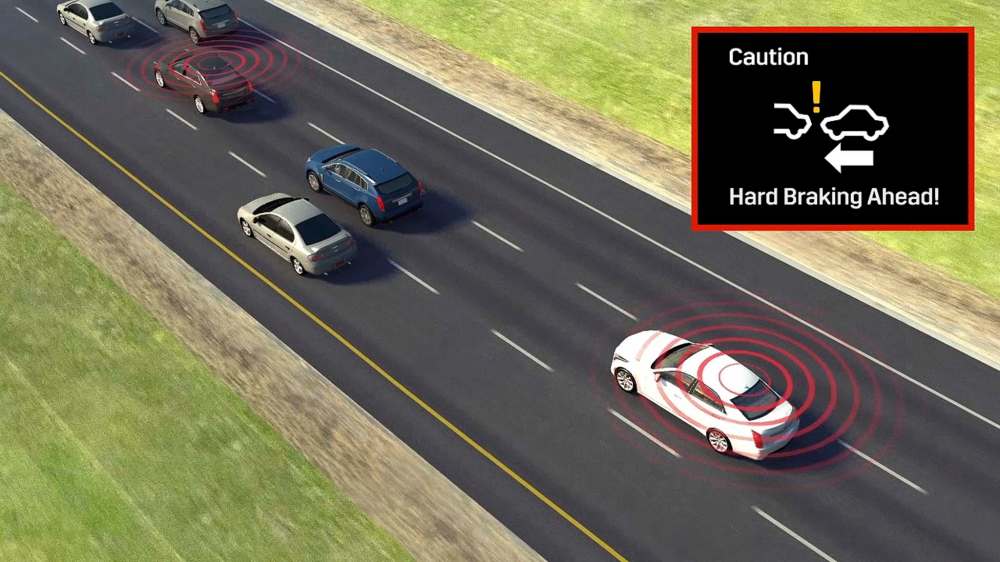
So how does it work? The on-board transmitter will send the location, speed, direction and traffic conditions out to connected vehicles to warn other drivers of potential hazards, which may otherwise be invisible.
One of the priorities of the system is to protect customer privacy. The vehicle does not send out any identifying information such as vehicle serial number, registration information or wireless identity code. Firewalls and encryption are used to ensure the signals cannot be interfered with so they can only be exchanged between valid modules.
To ensure this, a rapidly changing security code is sent out with each signal so only valid signals will be used for information.
One of the signals sent occurs when a vehicle’s brakes are applied hard. This will flash a caution message and warning chime on the receiving vehicle, advising there is hard braking ahead. This gives the driver additional time to react, which is especially useful on blind curves or hills, in dense traffic or when travelling at highway speeds.
If the stability or ABS system on a transmitting vehicle is activated due to slippery or rough roads, a caution message is received in the following vehicle and advises there is slippery road ahead. The driver can then drive with additional caution.
If the hazard lights are activated or an airbag has deployed on a transmitting vehicle, the following vehicle receives a caution message there are hazard lights ahead and a range to the other vehicle is given.
This is especially useful when there is limited visibility such as fog, heavy rain or snow.
Cadillac is leading the way with V2V communications and is committed to pioneering innovative advanced safety technology.
V2V supports Cadillac’s vision of zero collisions. Right now the system is limited because it is only on the CTS and they won’t comment on future vehicles, but I would expect future Cadillac vehicles will also include V2V communications, and other manufacturers won’t be far behind.
A few seconds of warning could make the difference between a safe drive and a serious collision, and V2V communications can give us much-needed additional time to help keep us safe.
Even vehicles not equipped with V2V communications can benefit, as their drivers respond to vehicles that have been warned in advance — resulting in fewer last-second reactions.
james.kerr@sasktel.net