

To your health, WINNIPEG
The city can drink deeply and safely, thanks to a 90-year-old marvel
Advertisement
Read this article for free:
or
Already have an account? Log in here »
To continue reading, please subscribe:
Monthly Digital Subscription
$1 per week for 24 weeks*
- Enjoy unlimited reading on winnipegfreepress.com
- Read the E-Edition, our digital replica newspaper
- Access News Break, our award-winning app
- Play interactive puzzles
*Billed as $4.00 plus GST every four weeks. After 24 weeks, price increases to the regular rate of $19.95 plus GST every four weeks. Offer available to new and qualified returning subscribers only. Cancel any time.
Monthly Digital Subscription
$4.99/week*
- Enjoy unlimited reading on winnipegfreepress.com
- Read the E-Edition, our digital replica newspaper
- Access News Break, our award-winning app
- Play interactive puzzles
*Billed as $19.95 plus GST every four weeks. Cancel any time.
To continue reading, please subscribe:
Add Free Press access to your Brandon Sun subscription for only an additional
$1 for the first 4 weeks*
- Enjoy unlimited reading on winnipegfreepress.com
- Read the E-Edition, our digital replica newspaper
- Access News Break, our award-winning app
- Play interactive puzzles
*Your next Brandon Sun subscription payment will increase by $1.00 and you will be charged $17.95 plus GST for four weeks. After four weeks, your payment will increase to $24.95 plus GST every four weeks.
Read unlimited articles for free today:
or
Already have an account? Log in here »
Hey there, time traveller!
This article was published 02/08/2009 (6127 days ago), so information in it may no longer be current.
WAUGH, Man. — In the northwest corner of Shoal Lake, two artificial fingers of land stick into a corner of Indian Bay where humans are not allowed.
Buoys and warning signs tell boaters to stay 500 metres away from a nondescript concrete wall that sits between the base of the two fingers — the source of every drop of drinking water that flows out of taps in Winnipeg.
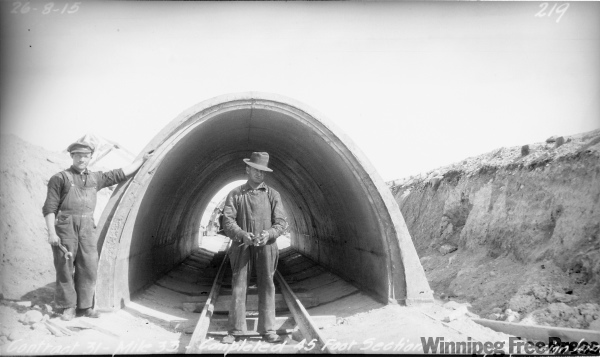
Below the surface of the water, underneath the wall, two channels serve as the intake for the Winnipeg Aqueduct, a 90-year-old gravity-powered engineering marvel that extends 156 kilometres to the west.
Up until the 1970s, tourists used to take weekend train rides on the Greater Winnipeg Water District Railway to visit the picturesque intake site. But concerns about security now take precedence at Waugh, which sits on Indian Bay two kilometres west of the Ontario border.
"A little while back, a couple of guys on a fishing boat landed here and didn’t want to leave. One of them was actually leaning on the ‘no trespassing’ sign," says aqueduct intake foreman Toni Willis, one of a handful of city of Winnipeg employees who work and live in Canadian Shield cottage country.
The belligerent fishermen fled after Willis recorded the registration of their boat. These days, the only people allowed to arrive at the intake site are seasonal workers from the nearby Shoal Lake 40 First Nation.
Everything else that arrives at the aqueduct – workers, supplies and even heavy machinery – arrives by train along the city-owned G.W.W.D. Railway completed in 1915, when forward-thinking politicians decided to build an aqueduct big enough and durable enough to satisfy all of Winnipeg’s water needs for almost a century.
"It blows your mind, when you think of the foresight," says Willis, standing on the west intake finger on a rainy, mid-July day. "It’s hard to think of anyone doing something like this today."
The best decision Winnipeg ever made
At the turn of the 20th Century, railway-boom Winnipeg was growing faster than its supply of water. Private enterprises like the Winnipeg Water Works Company took pumped water straight out of the muddy Assiniboine River, which was increasingly polluted by human and farm animal waste, according to historian George Siamandas.
Our drinking water was so filthy, as many as one in 50 Winnipeggers died of typhoid, cholera and other water-borne diseases, making the Manitoba capital one of the least safe cities on the planet to take a swig.
In 1906, the city started pumping water out of artesian wells. But the supply was too small to put out major fires.
So the city began to mull its options for a permanent and plentiful source of clean drinking water. City councillors wound up with three contenders: A larger series of wells north of the city, the Winnipeg River and Shoal Lake.
The debate over the choice was boisterous and divisive, especially after an American water consultant named Charles Schlicter pegged the price of the Shoal Lake option at $13.5 million, in 1912 dollars.
Schlicter based his decision on the fact Winnipeg was one of the fastest growing cities in the world at the time. Based on future population projections, it would need a substantial water supply.
"Winnipeg has entered into a class of world cities. It cannot afford to be committed to a temporary solution and it should not postpone the inevitable," wrote Schlicter, according to Siamandas.
Then-councillor Thomas Deacon, who had lived near Shoal Lake, pushed for the Indian Bay option. He won the decision in 1913 and was elected mayor later that year, succeeding Richard Waugh.
As it turned out, Schlicter was partly wrong: Winnipeg’s runaway growth halted in 1912. But the decision to build the aqueduct was fortuitous in the sense it has wildly exceeded its expectation, in terms of both capacity and longevity.
Deacon is now immortalized by the Deacon Reservoir just east of Winnipeg. Waugh received the secondary honour of lending his name to the unincorporated community at the intake site.
Building through bog and boreal forest
On paper, the Winnipeg Aqueduct was a simple device: Gravity carries water from Shoal Lake to Winnipeg, a vertical drop of 92 metres spread out over 156 kilometres.
But before construction could begin, the city had to build a railway all the way to the intake site to transport all the manpower, machinery and materials to build the aqueduct. Concrete and steel could not be schlepped on foot or horseback over the prairie, forest and bog that separated Winnipeg from Indian Bay.
The Greater Winnipeg Water District Railway was laid down between 1913 and 1915 by 1,200 local and migrant workers. They then went to work on the task of building the aqueduct itself, which features a flat bottom of steel-reinforced concrete with a horseshoe-shaped concrete arch over top, which derives its strength from its own weight.
Every mile along the aqueduct, the top of the arch was reinforced with steel to allow for future road crossings. Rural Manitoba has a network of roads spaced one mile apart, and the designers wanted to make sure motor vehicles would not destroy the aqueduct.
The circumference of the aqueduct varied, depending on the terrain: flatter sections where the water flows slowly needed to be larger. The depth of the aqueduct also varied: it’s buried several metres below the surface in the bog just west of Shoal Lake, but exists as a mound right below the surface in most other sections.
All that digging amounted to a massive excavation job. Historical photos suggest the work was conducted by hand, horsepower as well as what appear to be hydraulic backhoes.
Hectares of forest along the route were harvested and several small towns – Ostenfeld, Ross, Hadashville, McMunn and East Braintree among them – sprang up along the way.
The project also saw workers build a causeway across Indian Bay to wall off the west side and divert the peaty water from Falcon Creek – which is safe but brown from tannins – into more distant Snowshoe Bay.
When the aqueduct opened in 1919, the cost of the project had ballooned to $17 million. That’s roughly equal to $210 million in 2009 dollars, based on consumer-price inflation.
But today, the actual cost of this project this size would be much higher – perhaps more than $1 billion – due to disproportionate increases in the cost of both labour and construction materials over the past 90 years.
How the water flows
When Winnipeg’s aqueduct opened, Shoal Lake water was so pristine that it did not require any treatment, given the standards of the day.
The city began adding chlorine to water at the intake site in the 1950s, but had no need to add new steps to the water-treatment process until this decade.
In 2006, water-treatment engineers at the Deacon Reservoir flipped the switch on a new ultraviolet-radiation facility that inactivates cryptosporidium, a nasty micro-organism that can’t be killed off by chlorine treatment alone.
Later this year, a state-of-the-art, $300 million water-treatment plant will go online at the same site. It will improve the taste and smell of our water and use new treatment processes that will reduce the need for chlorination, a process that produces byproducts called trihalomethanes, which have been linked to a variety of diseases.
But for the next few months, water treatment remains a remarkably simple process, another testament to the wisdom of choosing Shoal Lake as a source.
After flowing past the fingers, which were built to slow wave action, our water passes below a headwall facing the lake. A boom extends along the front of the fingers to dissuade pickerel, which are attracted to moving water, from swimming toward the headwall.
But fish can’t swim into the aqueduct, as a pair of screens – a stationary filter for large objects such as sticks and reeds, plus a rotating, fine-mesh screen to capture fish eggs and insects – prevents solid objects from entering the big pipe.
Even at this early stage in the flow, Winnipeg’s water looks pristine. Inside the aqueduct intake building, a concrete-and-steel bunker built into a dynamite-blasted cavity in a granite ridge, the city’s untreated water appears to be as translucent as artesian well water.
From here, the water flows into the aqueduct itself, where it then gets treated with chlorine. The chemical is added early on to allow it time to kill giardia, another lake-borne micro-organism.
The use of chlorine at this stage may be reduced or even eliminated after the Deacon water-treatment plant goes online, says Diane Sacher, Winnipeg’s water services manager. But for now, it exists in our water along the entire 156-kilometre journey from Indian Bay, which takes about 30 hours.
Under normal conditions, gravity carries the water along the entire route. But if water levels on Indian Bay plummet, intake operators can switch on pumps to give the aqueduct flow the extra lift it needs to flow all the way to Winnipeg.
The last time the pumps had to be used was during the early-summer heat wave of 1988. Intake operators who had never had to use the pumps were forced to scramble their way through manuals, intake foreman Willis says.
Now, the city has procedures in place to deal with the prospect of another heat wave. But water use in Winnipeg has actually plummeted since the late ’80s, thanks to conservation and the popularity of low-flow toilets and energy-efficient dishwashers.
How much water is enough?
When the aqueduct was completed, it had a capacity to carry 387 million litres of water a day. Today, it only carries an average of 225 million litres, as water use in Winnipeg has levelled.
During the June 1988 heat wave, which saw schools close at noon and water-use soar, the city almost issued an order for people to stop watering their lawns. At the time, daily water use peaked around 500 litres per person. But it’s now only 326 litres per person, per day, Sacher says.
That has led Winnipeg to shelve plans to find a new water source to amend the existing aqueduct. Although Winnipeggers could certainly find ways to conserve more water, our collective behaviour has already changed, Sacher says.
"People will let their lawns go dormant if it doesn’t rain," she says. "That didn’t use to be the case."
Amazingly, the water and waste department actually shuts the aqueduct down for as long as a week at a time every year for routine maintenance. That’s possible because the Deacon Reservoir can hold a 28-day supply of water – about 8.4 billion litres – inside its four cells just east of the Red River Floodway.
Keeping the aqueduct ducky
Historically, aqueduct inspectors who wanted to take a peek at the interior of the big pipe used boats or even rode specially tricked-out bicycles. Today, inflatable dams are placed inside sections of the aqueduct and then filled with water to prevent the structure from floating while it’s empty.
"It can act like a submarine in boggy sections," Sacher says. Indeed, entire kilometres of aqueduct are covered with crushed granite, which act as ballast in wetter areas.
While major aqueduct maintenance jobs are usually conducted once a year by a team of 10 city workers, the entire pipe is actually monitored constantly by a combination of human eyes and electronic sensors.
Throughout the length of the aqueduct, sensors placed inside and outside the pipe convey information about water flow, pressure and even vandalism to the aqueduct intake station. Remote sections of aqueduct are serviced by solar-powered monitoring stations.
Aqueduct workers also conduct visual inspections of every centimetre of the route no less than a twice a week. This work would be impossible without the city-owned G.W.W.D. Railway, which is traversed by converted GMC vans as well as conventional railcars.
The railway is also used to haul in heavy equipment such as excavators, which are used to destroy beaver dams near the aqueduct or cut new drainage channels in the bog.
While the pipe can handle pressure from above, it’s vulnerable to uneven loads of water pressure that result from beaver activity on one side. It’s also vulnerable to the effects of spring or summer flooding, especially from the Boggy River, near East Braintree.
Aqueduct maintenance workers also clear brush or trees from the area around the pipe to prevent damage from roots. But they don’t use any pesticides to control weeds, Sacher says.
"If there’s a break, we just want to deal with the problem, not contamination," she says.
Maintenance to the railway itself is also a constant concern. The city employs two crews of four railway-maintenance workers out of stations at Ross and Hadashville.
City workers, remote location
Throughout the year, three to five people work out of the aqueduct intake station at Waugh, easily the most remote and unusual jobsite run by the city of Winnipeg.
Workers can spend weeks at a time at Indian Bay, as they have to hang around when they’re on standby. There are usually three on the job during the winter and five in the summer, including seasonal workers who commute three kilometres by motorboat from Shoal Lake 40 First Nation.
The aqueduct crew seems small compared to the quarters at their disposal: The site includes a mostly empty dorm facility with a kitchen, recreation room and beds for up to two dozen.
Back when politicians and senior city officials used to hold retreats at Waugh, the dorm facility was run as a resort, on a break-even basis. But the retreats fell out of fashion and the resort operations were closed, Sacher said.
Workers at Indian Bay must love the wilderness and the solitude that goes with it, says Andrew Weremy, a water services engineer who administers the intake site from his office in Winnipeg.
"It’s very quiet. It’s very isolated. If you like going to restaurants, you’re going to have some trouble," he says.
The site has Internet service and satellite TV, but no road access whatsoever. A railcar is required for trips to East Braintree, the nearest town.
There are also unique workplace hazards. One of the black bears that hangs around the site is a yearling with a brown face that appears to have no fear of people. A hand-scrawled message on an intake control station blackboard warns staff and visitors that the critter is prone to chasing people.
Still, water and waste department employees still compete for the right to work here.
"It’s a very unique place and very important to the city," says Willis, the intake foreman for the past three years.
Concerns for the future
In the 1980s, when more Winnipeggers began building cottages in and around Shoal Lake, there were concerns about the future quality of Indian Bay water. City officials feared cottage activity could lead to nutrient loading and the presence of more algae in the lake water.
So in 1989, the city and province reached an agreement with Shoal Lake 40 First Nation that would see the Anishinabe community resist the temptation to develop cottages in exchange for sustainable development expertise as well as funds flowing from a $6 million trust fund.
"We don’t want to stagnate their development," said Sacher, noting the city has no problem with the community extending its modest network of roads. Shoal Lake 40 also has a septic system that was built to the satisfaction of the city of Winnipeg.
But another community on Indian Bay – Iskatewizaagegan 39 First Nation, eight kilometres northeast of Waugh – is serviced by sewage lagoons. There are reports the band is in the midst of a dispute with Ottawa over the sewage-treatment funding and maintenance.
Right now, Iskatewizaagegan’s waste water problems are placing the remote community at risk but not the city of Winnipeg, Sacher says. The lagoon is far enough from Waugh to be diluted by Indian Bay, though there is no risk of contamination right now, she said.
But in the event Indian Bay takes a turn for the worse for some reason, Winnipeg’s new water-treatment plant will be able to handle any biological contamination threat, she added.
The state-of-the-art plant in the R.M. of Springfield will employ four new water-treatment processes once it’s online next year. Odour-causing algae will be clumped together by coagulants, forced to the surface with tiny air bubbles and then skimmed off into settling ponds. Ozone will break down organic molecules into smaller, more easily destroyed chains. Carbon filters will strain out particles and a beneficial slime will gobble up bacteria.

These processes will be added to two existing measures – ultraviolet radiation treatment to inactivate the cryptosporidium and chlorination to kill single-celled animals like giardia.
The end result means Winnipeggers won’t really be drinking Shoal Lake water when the plant goes online this fall. We’ll be drinking a highly processed version, free of the lake’s microscopic flora and fauna.
But the supply of water has remained unchanged for almost a century, thanks to the unusual decision to build a 156-kilometre link between the city and the Lake of the Woods watershed.
bartley.kives@freepress.mb.ca