

Careful motorists cut cash for cops
Police happy more drivers paying heed to photo radar
Advertisement
Read this article for free:
or
Already have an account? Log in here »
To continue reading, please subscribe:

Digital Subscription
One year of digital access for only $205*
- Enjoy unlimited reading on winnipegfreepress.com
- Read the E-Edition, our digital replica newspaper
- Access News Break, our award-winning app
- Play interactive puzzles
*First annual payment billed as $205.00 + GST for one year. This annual subscription will automatically renew at $233.00 + GST every 52 weeks (10% off the regular annual price of $259.35). Offer available to new and qualified returning subscribers only. Cancel any time.
To continue reading, please subscribe:
Add Free Press access to your Brandon Sun subscription for only an additional
$1 for the first 4 weeks*
- Enjoy unlimited reading on winnipegfreepress.com
- Read the E-Edition, our digital replica newspaper
- Access News Break, our award-winning app
- Play interactive puzzles
*Your next Brandon Sun subscription payment will increase by $1.00 and you will be charged $17.95 plus GST for four weeks. After four weeks, your payment will increase to $24.95 plus GST every four weeks.
Read unlimited articles for free today:
or
Already have an account? Log in here »
Hey there, time traveller!
This article was published 18/09/2009 (6203 days ago), so information in it may no longer be current.
WINNIPEG drivers are running significantly fewer red lights and slowing down near photoradar cameras this year — at least in part, police believe, because of all the controversy over construction-site enforcement.
More careful drivers also translates into less cash for the Winnipeg Police Service, however. The expected drop in photo-radar violations, which is based on tickets issued this year so far, will create a $4.7-million shortfall in the police budget by the end of the year if the trend toward safer driving continues, Winnipeg police Chief Keith McCaskill said.
Earlier this year, when a court challenge forced the city to change the way it enforces speed limits at construction sites, the city and province became embroiled in a public dispute over who was responsible for what many motorists considered a gouge.
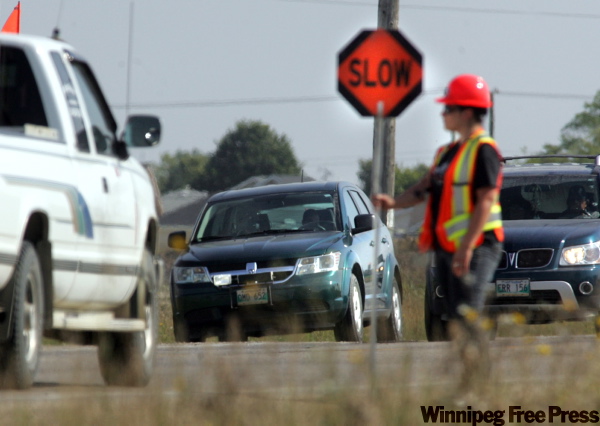
Ironically, all the media attention and public outrage led to more awareness about the need to drive safely and real results on the streets, McCaskill told city councillors Thursday.
"We want people to stop speeding, we want people to stop at red lights, and it’s happening," McCaskill told city council’s finance committee, predicting police will issue 103,992 photo-radar offences by the end of 2009, down almost a third from the 2008 total of 167,767 tickets. "Really, I think (the controversy) helped a lot."
Surpluses in other city budget line items will fill the $4.7-million hole, as is the standard city accounting practice, City of Winnipeg’s chief financial officer Mike Ruta said. But the potential for continued volatility in photo-radar revenues — that is, huge swings in the number of violations and fines from year to year — means the city might want to consider creating a stabilization fund for photo-radar revenue, said finance committee chairman Justin Swandel (St. Norbert).
The Winnipeg Police Service rotates 33 photo-radar cameras among 48 locations. The police have no plans to buy more cameras or increase the number of enforcement locations right now, McCaskill said. He insisted he has no problem with the police budget shortfall because traffic safety, not revenue, is the main objective of photo-radar enforcement.
Overall, Ruta said, the city is expecting to run a deficit of $5.6 million by the end of the year, based on June 30 financial statements. But that does not mean the city will actually run a deficit on its $785-million operating budget, as surpluses usually materialize in enough budget line items later in the fall to place the city in the black by the end of year.
In addition to the police-budget shortfall, the city is forecasting a $5.1-million snow-clearing shortfall that stemmed from the cost of cleaning up after ice storms early this year. But $4.4 million remains in the snow-clearing stabilization fund to whittle down that figure and the cost of fall 2009 snow-clearing remains unknown. Ruta also said it cost Winnipeg $6.2 million to fight the spring flood of 2009, but the province will likely pick up $4.5 million of the floodfighting tab. The Winnipeg Fire Paramedic Service is also expected to be $2 million over budget by the end of the year, mainly because of increased wages and the continued absence of an ambulance-funding deal between the city and province.
On the positive side of the ledger, the city is again expecting to earn more investment revenue this year, as it did last year, because institutional investors such as governments — which have access to bonds and other guaranteed investments that are not available to smaller investors — continue to enjoy relatively good returns during volatile economic times.
bartley.kives@freepress.mb.ca
Related Articles
Replay: Court of Public Opinion with Mike McIntyre
Advertisement Advertise With Us
Advertisement Advertise With Us