

Poster educates immigrants on prostitution
New Canadians over-represented in john arrests: police
Advertisement
Read this article for free:
or
Already have an account? Log in here »
To continue reading, please subscribe:
Monthly Digital Subscription
$1 per week for 24 weeks*
- Enjoy unlimited reading on winnipegfreepress.com
- Read the E-Edition, our digital replica newspaper
- Access News Break, our award-winning app
- Play interactive puzzles
*Billed as $4.00 plus GST every four weeks. After 24 weeks, price increases to the regular rate of $19.95 plus GST every four weeks. Offer available to new and qualified returning subscribers only. Cancel any time.
Monthly Digital Subscription
$4.99/week*
- Enjoy unlimited reading on winnipegfreepress.com
- Read the E-Edition, our digital replica newspaper
- Access News Break, our award-winning app
- Play interactive puzzles
*Billed as $19.95 plus GST every four weeks. Cancel any time.
To continue reading, please subscribe:
Add Free Press access to your Brandon Sun subscription for only an additional
$1 for the first 4 weeks*
*Your next subscription payment will increase by $1.00 and you will be charged $16.99 plus GST for four weeks. After four weeks, your payment will increase to $23.99 plus GST every four weeks.
Read unlimited articles for free today:
or
Already have an account? Log in here »
Hey there, time traveller!
This article was published 20/01/2010 (5918 days ago), so information in it may no longer be current.
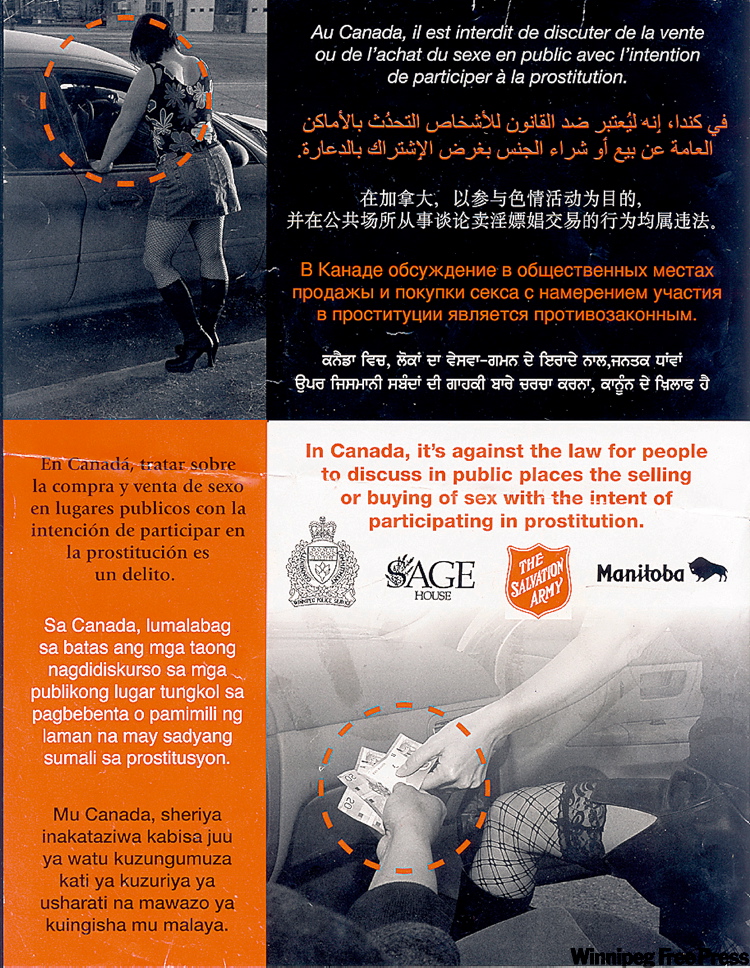
A scantily clad woman wearing fish-net tights is featured on a new poster that gives immigrants a blunt message: In Canada, prostitution is wrong.
Winnipeg officials have long noticed an over-representation of new Canadians in street arrests of johns. The problem is often that these men come from cultures with different attitudes about buying sex.
About 1,500 copies of the poster, in nine different languages, will be distributed across Winnipeg in the coming months, along with 2,500 smaller handouts.
"What we found is that the people we were dealing with were predominantly ethnic. That sort of became evident when we realized we had some language issues in a lot of cases," said Sgt. Kerry Baldwin, head of the Winnipeg Police Service’s vice unit.
He said officers started realizing in about 2006 they needed a way of educating some johns they arrested about Canadian law.
"A lot of them, the response was: ‘What’s the big deal? Where I’m from this is tickety-boo,’" he said.
He added later: "It was just becoming evident to us on a daily basis."
The poster features a woman accepting a handful of cash, her leg hoisted provocatively on a car seat. It warns people that it’s "against the law for people to discuss in public places the selling or buying of sex with the intent of participating in prostitution."
Officials who worked with johns said new Canadians may not be aware of thesocial and legal damage caused by buying sex.
"I think there are people (who) don’t realize it’s illegal," said Salvation Army’s prostitution offender program co-ordinator Dianna Bussey. She said more than 25 per cent of program participants (nine of 35 people involved) in 2009 were recent to Canada.
Bussey said the campaign isn’t about targeting any particular groups.
"If we can keep people from getting involved by doing something like this, then I think it’s worth doing," she said.
"It’s sensitive … might we ruffle some feathers? Probably."
She said the languages chosen for the poster were based on men who have come into contact with the Prostitution Offender Program.
The one-day program counsels johns who are first-time offenders. By taking the program and acknowledging they purchased sex, the men avoid the court process and possible conviction.
"The general public still views the person who’s selling the sex much more harshly than the person who’s buying," said Bussey. "We need to educate that buying sex is not good for anyone either."
The poster campaign received funding from the province’s Neighbourhoods Alive program and works with Mount Carmel Clinic’s Sage House, a Dufferin Avenue centre for street-involved women.
Bussey said organizers originally wanted to use the image of a handcuffed man standing in front of an impounded vehicle for the poster.
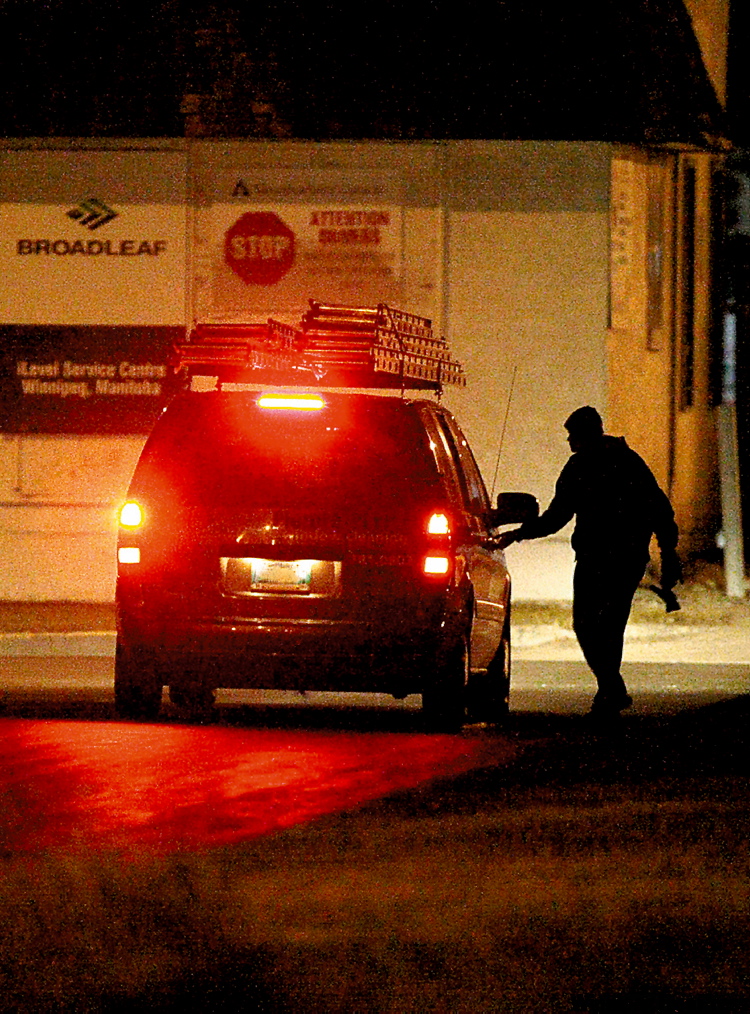
However, she said the images changed after consulting with a focus group of about 15 new Canadians in June 2008.
"We needed something that would capture people’s attention, and so they look a little over-the-top," she said.
"But we hopefully got something that is fairly obviously prostitution and that would draw people to actually then reading what is on the page."
Police laid 185 prostitution-related charges against people buying or selling sex in 2008.
In 2009, about 35 first-time offenders took the Salvation Army’s prostitution offender program as of November.
Bussey said she’s had interpreters come to the prostitution offender program to work with the johns.

Tammy Reimer, manager of Mount Carmel Clinic’s Sage House, said the number of women involved in the sex trade has stayed fairly stable in Winnipeg during the last five years.
She said heightened attention — like after high-profile police busts — can change public perception of the level of prostitution in the city.
gabrielle.giroday@freepress.mb.ca
The john poster (above) is in nine languages: French, Arabic, Chinese, Russian, Punjabi, Spanish, Tagalog, Swahili and English.