

Hearing on papers won’t be closed
Ruling says media, elders may attend
Advertisement
Read this article for free:
or
Already have an account? Log in here »
To continue reading, please subscribe:
Digital Subscription
One year of digital access for only $75*
- Enjoy unlimited reading on winnipegfreepress.com
- Read the E-Edition, our digital replica newspaper
- Access News Break, our award-winning app
- Play interactive puzzles
*Billed as $5.77 plus GST every four weeks. After 52 weeks, price increases to the regular rate of $19.95 plus GST every four weeks. Offer available to new and qualified returning subscribers only. Cancel any time.
Monthly Digital Subscription
$4.99/week*
- Enjoy unlimited reading on winnipegfreepress.com
- Read the E-Edition, our digital replica newspaper
- Access News Break, our award-winning app
- Play interactive puzzles
*Billed as $19.95 plus GST every four weeks. Cancel any time.
To continue reading, please subscribe:
Add Free Press access to your Brandon Sun subscription for only an additional
$1 for the first 4 weeks*
- Enjoy unlimited reading on winnipegfreepress.com
- Read the E-Edition, our digital replica newspaper
- Access News Break, our award-winning app
- Play interactive puzzles
*Your next Brandon Sun subscription payment will increase by $1.00 and you will be charged $17.95 plus GST for four weeks. After four weeks, your payment will increase to $24.95 plus GST every four weeks.
Read unlimited articles for free today:
or
Already have an account? Log in here »
Hey there, time traveller!
This article was published 09/03/2010 (5922 days ago), so information in it may no longer be current.
JOURNALISTS and First Nations elders won’t be barred from a hearing into whether Canada must hand over hundreds of secret documents that could prove Ottawa culpable for hydro-dam flooding that devastated three northern reserves.
On Monday, a federal court judge rejected a Crown request to ban journalists, aboriginal elders and the public from court while lawyers haggle over whether 259 briefing notes, legal opinions and letters are covered by lawyer-client privilege and must be kept secret forever.
But it was a somewhat hollow victory.
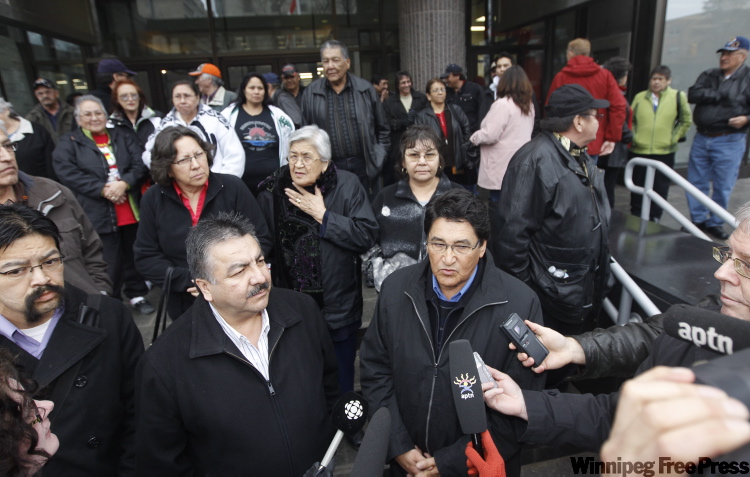
Federal Court Prothonotary Roger Lafrenière, a special judge who handles many pretrial and administrative matters, said the court must always err on the side of openness.
But if the lawyers find they need to discuss the content of any disputed document, the courtroom will need to be cleared to protect Ottawa’s possible claim of confidentiality.
That means the 50 or so elders and First Nations leaders who jammed the courtroom Monday morning may only get a hint at what the documents say, who authored them and how much liability Canada believed it had, if any.
It’s the latest snafu in a case that’s dragged on for nearly 20 years and will likely last years more.
At issue is whether Ottawa failed in its duty to protect three bands — Grand Rapids, Chemawawin and Opaskwayak — in the early 1960s when Manitoba Hydro and the province built the Grand Rapids dam and flooded thousands of aces of prime hunting and trapping land.
The case could be worth tens of millions in compensation to the bands.
"This is sort of a waste of time and money," said Chemawawin Chief Clarence Easter of the years of litigation. "What we really want is to sit down and negotiate."
Easter said his band has asked repeatedly for talks, most recently four years ago.
The band has been told that Ottawa would be willing to negotiate a settlement if new evidence of culpability emerges.
The hearing on whether the documents must remain secret continues today.
maryagnes.welch@freepress.mb.ca
IF you want to maintain order in the court, take a lesson from your elders.
Cree elders, that is.
In an unusual moment during Monday’s hearing, about 50 elders from three northern bands held an impromptu meeting in the courtroom to debate whether to ask for a new judge.
Perched on the corner of a lawyer’s table, slipping in and out of Cree and English, Grand Rapids Chief Ovide Mercredi quietly described the situation to the elders. At issue was whether the judge might be seen as biased because he once worked for the Department of Justice Canada.

"It’s Justice that’s destroying this case for us," Mercredi told the solemnly hushed room. "That’s what I am nervous about. I don’t feel good about it."
But Mercredi said the judge alerted the court to his old job, an honest move.
As discussion began, one gentleman noted a delay to find a new judge might mean some of the elders with stories of the flood could die before ever sharing their knowledge with the court or seeing the case concluded. Another asked how long it might take to get a new judge and another set of court dates.
At least two months, replied one of the lawyers.
After a few more moments of reflection, Mercredi nodded to Chemawawin Chief Clarence Easter, who said he thought the case should go ahead with the sitting judge.