

Fargo not caught napping
Stung last year, residents were ready this time

Advertisement
Read this article for free:
or
Already have an account? Log in here »
To continue reading, please subscribe:

Digital Subscription
One year of digital access for only $205*
- Enjoy unlimited reading on winnipegfreepress.com
- Read the E-Edition, our digital replica newspaper
- Access News Break, our award-winning app
- Play interactive puzzles
*First annual payment billed as $205.00 + GST for one year. This annual subscription will automatically renew at $233.00 + GST every 52 weeks (10% off the regular annual price of $259.35). Offer available to new and qualified returning subscribers only. Cancel any time.
To continue reading, please subscribe:
Add Free Press access to your Brandon Sun subscription for only an additional
$1 for the first 4 weeks*
- Enjoy unlimited reading on winnipegfreepress.com
- Read the E-Edition, our digital replica newspaper
- Access News Break, our award-winning app
- Play interactive puzzles
*Your next Brandon Sun subscription payment will increase by $1.00 and you will be charged $17.95 plus GST for four weeks. After four weeks, your payment will increase to $24.95 plus GST every four weeks.
Read unlimited articles for free today:
or
Already have an account? Log in here »
Hey there, time traveller!
This article was published 20/03/2010 (6041 days ago), so information in it may no longer be current.
FARGO, N.D. — When the flood came here, it came two weeks too early.
But despite having only five days to scrape up a seam of earth and sandbag dikes, despite still recovering from a 2009 surge that almost claimed the city, on Friday afternoon three words were operative in Fargo and its smaller Minnesotan sister, Moorhead: "Things are calm."

"People are a lot more prepared," said Jason Holm as he walked a dog down the permanent earth dike near his parents’ riverside home south of Fargo’s antique downtown. Holm grew up there and now lives in Minneapolis-St. Paul; he came back this week to help his parents prepare for the flood. "Having (a flood) two years in a row means that things get reinforced," he said. "They become old habits."
On Thursday afternoon, volunteers laid their last sandbag and went home to wait. The next morning, a confetti of snow swept across the cities, freezing the dikes to the ground. The temperature, which sunk to a wind-whipped -4 C, actually slowed the river’s swell, said city officials. And that potentially eased pressure on the dikes.
How much pressure? By Friday morning, the Red was sitting at 35 feet and rising an inch per hour. At that rate, the river is expected to reach its predicted 38-ft. crest on the weekend; most dikes were built to 40 feet. So with its defences up and the end in sight, the city hunkered down to wait, and watch. "The word of the day is get rested, get ready and get vigilant," said Fargo Commissioner Tim Mahoney at a city hall press conference.
And also, get ambitious. On Thursday morning, a joint flood-planning group approved a plan for a $1.3-billion flood diversion, similar to Winnipeg’s floodway. The plan will be voted on by local government and then sent to Congress in late 2010 or early 2011. Between approvals and rounding up funding, the diversion might take 50 years to complete, officials said. But it could provide up to 500 years of protection to an area hammered by floods that seem to be coming ever more often.
It’s not the only lesson learned from Manitoba. "Canada has always been an example. If you drive up Pembina to Winnipeg, every piece of property is elevated," said Fargo Mayor Dennis Walaker, who has been in touch with Manitoba Premier Greg Selinger to share flood tips.
"They understand (flood protection) better than we do. We need to get there."
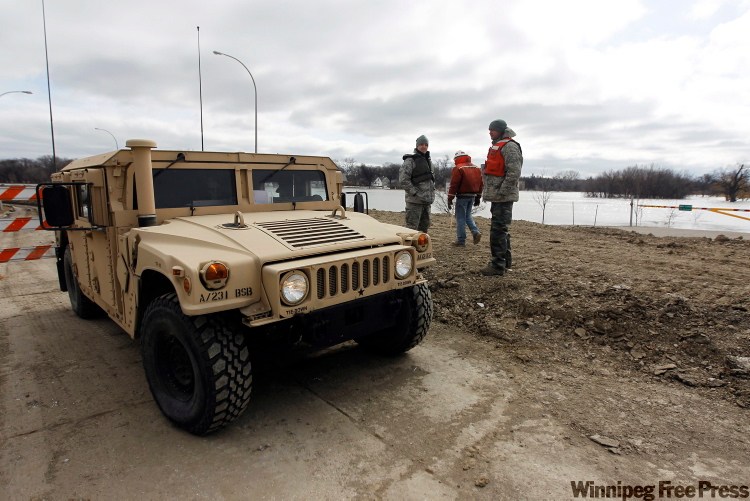
If 2010 is any indication, they will get there. At posts across the cities, observers stood guard over the dikes, in case a leak should spring. In the south Fargo development of Rose Creek, a police officer sat in her cruiser near a roadblock by the surging Red River, reading a book. Near the watery line between Fargo and Moorhead, two of the 700 National Guard soldiers in the area leaned on their sand-coloured Humvee, watching the river sneak closer to the grassy earth dike that snakes around the city’s downtown.
And that calm, asserted on Friday by elected officials, police officers and residents of threatened houses, didn’t just highlight the difference between 2009’s crest, nearly 41 feet, and this year’s anticipated 38-ft. crest: The calm told the story of what most agreed was a more organized flood-fighting force. "Unfortunately, we’re becoming very good flood fighters," Mahoney said. "Last year, there were a lot of people who hadn’t been in the ’97 flood, who had to learn how to build a sandbag dike. Now everybody knows."
On his way to work on Friday morning, Moorhead resident Ben Stevermer agreed. "This year, everything’s more under control," he said. For 21 years, Stevermer, 45, has lived in the same rental house that overlooks Moorhead’s sprawling Woodlawn Park.
In the summer, Stevermer calls the greenspace "Woodstock Park," owing to the college kids who strip down to sunbathe; but now, the entire park is a sea ringed by paper-thin sheets of ice. Only a pair of road signs and the top of a baseball backstop peek above the water.
Still, things are — here’s that word again — calm. "If there’s a sombre mood, it’s more that we haven’t seen the sun for like, three weeks," Stevermer grinned, pointing at the grey sky.
Around the corner, Mark Altenburg squatted behind a plastic-wrapped sandbag dike, fiddling with a small sump pump that will help protect one of the last homes that still abuts the flood-prone park. "We’re out here fighting as hard as we can," Altenburg said.
It’s a familiar job for him. In 2009, Altenburg spent hours battling back the Red. This year, he’s doing it more officially. After businesses were shut down for two weeks to deal with the emergency, families pushed over the edge of poverty began lining up at the food bank Altenburg runs. Frustrated by what he saw as a poor flood planning and the pain of his struggling neighbours, Altenburg ran for Moorhead’s city council. He won. So did two other people who were well-known local flood fighters.
"Last year… there was a general sense of panic. This year you don’t see that," Altenburg said, noting that in 2009, rapidly changing crest predictions also complicated the protection effort. "Every 15 minutes, something was going horribly wrong. This year, it’s much more stable… but for the river residents, especially those in their 50s and 60s, this is getting to be too much," he sighed.
There aren’t many of those river residents left now. Most of the rambling old Victorians near Woodlawn have been bought up by the local government. Soon, they’ll be torn down and the waters will be allowed to flow over what’s left of their foundations.
David Fitzgerald is one of two residents left on his street near the riverbend and he isn’t planning on leaving. In 2008, the 68-year-old man and his wife, Lisa Faulkner, bought a stately 104-year-old home on Elm Street. The couple came to the Fargo area from Chicago to relish life away from the big city; the location was perfect, with a "great price, a great location and a great view, other than one week every year."
Last year, that one week — flood week — sent five feet of water into the home’s unfinished basement, trashing the couple’s furnace. This year, they hope two sandbag dikes will keep that from happening again. "We knew moving in was a risk, but it’s a great old house that needs restoration," Fitzgerald said, surveying the clay dikes that lined his street. "It’s much more comfortable (this year). The city’s planning has greatly improved. They got everything they needed, and (even though the flood came early), we’re still ahead of the game this year."
Taking lessons learned from 2009, planners divided Moorhead into eight zones, each captained by a police officer, an engineer, and a posse of other flood experts. That way, residents only had to liaise with one set of officials, and officials got to know each resident in their zones by name. The cities also stockpiled sandbags, holding them in heated warehouses to stave off the bag-freeze that made building last year’s dikes like "stacking frozen turkeys," as Altenburg described it.

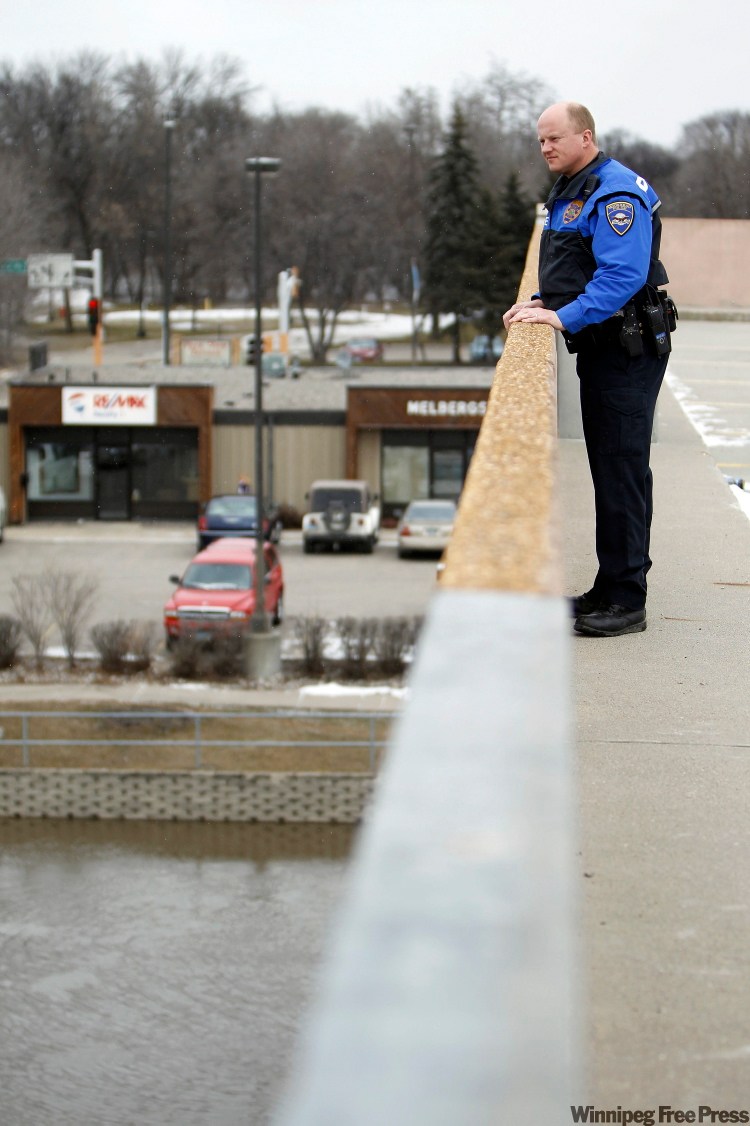
"There’s not much action right now and that’s good," sighed zone leader and Moorhead police officer Jeff Nelson. "It makes us a bit nervous. We’re hoping everybody’s not too calm… but the engineers are as calm as anybody, and if they’re calm, then we should be too."
Nelson called reporters to meet him on the top level of the parking ramp at the Moorhead Center Mall. The view, he said, would be dramatic. The ramp and its feeder streets flood every year, he said. But unlike 2009, this year the water will probably stay there. "The biggest thing is, one, we got all our ducks in a row early. Two, the planning was more simplified," Nelson said.
Still, it wasn’t without its problems. In Timberline, a ritzy suburb on the southern edge of Fargo, a pipe underneath a clay dike sprang a leak on Thursday night. Residents woke up to a "code red" alert to start stacking 20,000 sandbags.

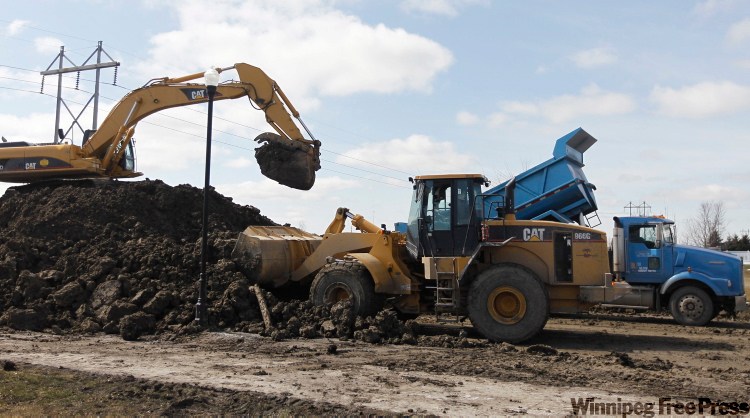
But even as dozens of dump trucks laden with dirt rumbled down neat, airy streets lined by American flags, the mood in the suburb was "upbeat," nodded resident Jeff Laliberte, 42, moments after throwing the day’s final sandbag. "They say it’s the fourth-highest crest on record, but we’re prepared. It’s actually interesting. Last year, people were panicking. This year, we just took care of it."
melissa.martin@freepress.mb.ca
Melissa Martin
Reporter-at-large
Melissa Martin reports and opines for the Winnipeg Free Press.
Every piece of reporting Melissa produces is reviewed by an editing team before it is posted online or published in print — part of the Free Press‘s tradition, since 1872, of producing reliable independent journalism. Read more about Free Press’s history and mandate, and learn how our newsroom operates.
Our newsroom depends on a growing audience of readers to power our journalism. If you are not a paid reader, please consider becoming a subscriber.
Our newsroom depends on its audience of readers to power our journalism. Thank you for your support.
Melissa Martin
Reporter-at-large
Melissa Martin reports and opines for the Winnipeg Free Press.
Every piece of reporting Melissa produces is reviewed by an editing team before it is posted online or published in print — part of the Free Press‘s tradition, since 1872, of producing reliable independent journalism. Read more about Free Press’s history and mandate, and learn how our newsroom operates.
Our newsroom depends on a growing audience of readers to power our journalism. If you are not a paid reader, please consider becoming a subscriber.
Our newsroom depends on its audience of readers to power our journalism. Thank you for your support.
Related Articles
With celebration cigars ready, Fargo calmly waits for river to crest and flood threat to pass
Advertisement Advertise With Us
Advertisement Advertise With Us