

Funnel clouds spotted near Winnipeg
Advertisement
Read this article for free:
or
Already have an account? Log in here »
To continue reading, please subscribe:
Digital Subscription
One year of digital access for only $75*
- Enjoy unlimited reading on winnipegfreepress.com
- Read the E-Edition, our digital replica newspaper
- Access News Break, our award-winning app
- Play interactive puzzles
*Billed as $5.77 plus GST every four weeks. After 52 weeks, price increases to the regular rate of $19.95 plus GST every four weeks. Offer available to new and qualified returning subscribers only. Cancel any time.
Monthly Digital Subscription
$4.99/week*
- Enjoy unlimited reading on winnipegfreepress.com
- Read the E-Edition, our digital replica newspaper
- Access News Break, our award-winning app
- Play interactive puzzles
*Billed as $19.95 plus GST every four weeks. Cancel any time.
To continue reading, please subscribe:
Add Free Press access to your Brandon Sun subscription for only an additional
$1 for the first 4 weeks*
- Enjoy unlimited reading on winnipegfreepress.com
- Read the E-Edition, our digital replica newspaper
- Access News Break, our award-winning app
- Play interactive puzzles
*Your next Brandon Sun subscription payment will increase by $1.00 and you will be charged $17.95 plus GST for four weeks. After four weeks, your payment will increase to $24.95 plus GST every four weeks.
Read unlimited articles for free today:
or
Already have an account? Log in here »
Hey there, time traveller!
This article was published 04/06/2010 (5826 days ago), so information in it may no longer be current.
brightcove.createExperiences();
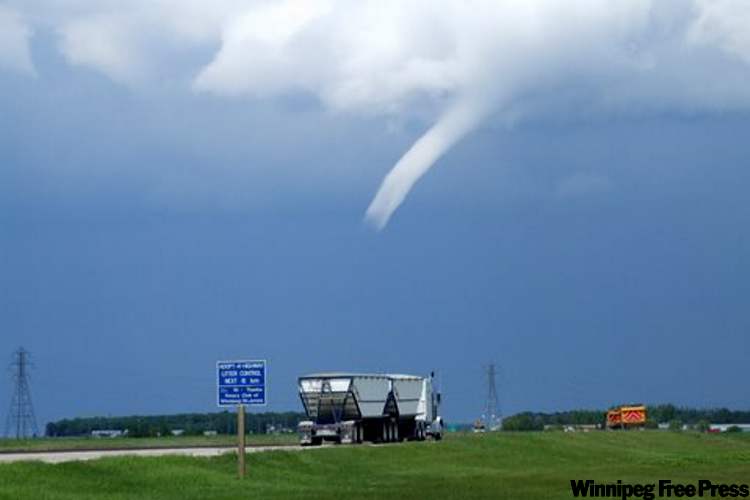
WINNIPEG – If you think you’ve seen a funnel cloud in the sky today, you’re probably right. Environment Canada has confirmed that funnel clouds were seen dropping from the sky over Charleswood and south of the city early Friday afternoon.
But Environment Canada meteorologist Sandy Massey said there were no reports that any of the funnel clouds had touched the ground. Until a funnel cloud touches the ground it can’t be called a tornado.
“There are weather watches out across most of southern Manitoba,” she said. “We expect, like yesterday, that they will be over in another couple of hours (by about 5 p.m.).”
Environment Canada issued a severe thunderstorm watch for the City of Winnipeg this afternoon. The alert is for the potential development of severe thunderstorms with large hail and damaging winds. Rain showers are expected this afternoon and into the evening.
Thunderstorm warnings were also issued for the RM of Lakeview, including Langruth and Lakeland, the RM of Westbourne, including Gladstone and Plumas, and the RM of Lansdown, including Arden and Tenby.
What to do if a tornado strikes
- Take shelter immediately, if available, preferably in the lower level of a sturdy building. Stay away from windows, doors and exterior walls.
- In a house, go to the basement and take shelter under a stairway or a sturdy work table in the center of the house.
- In a house with no basement, the safest spot is the ground floor in the center of the house. Small rooms tend to be more structurally sound so seek shelter in a hallway, small room, closet or bathroom (the plumbing may provide some structural stability). Lying in the bathtub with a mattress on top of you may provide good protection.
- Avoid wide-span buildings, such as barns, auditoriums, shopping centres and supermarkets with large roofs.
- At school, seek shelter in small windowless rooms such as a washroom instead of a gymnasium.
- In high rise buildings, move to lower levels, small interior rooms or stairwells. Stay away from elevators and windows.
- If no shelter is available, lie flat in a ditch, ravine or other low-lying area, and shield your head with your arms.
- Don’t get caught in a vehicle or mobile home, which the tornado can lift. Take shelter elsewhere or, if none is available, even a ditch offers better protection. Choose a location where your vehicle won’t be hurled or rolled on top of you.
- Beware of flying debris. Even small objects such as sticks and straw can become lethal missiles.
Source: Environment Canada
Related Articles
Water, water everywhere, but are you insured?

Advertisement Advertise With Us
Advertisement Advertise With Us
History
Updated on Friday, June 4, 2010 2:40 PM CDT: updated information