

Hydro picks its west side route
Advertisement
Read this article for free:
or
Already have an account? Log in here »
To continue reading, please subscribe:
Digital Subscription
One year of digital access for only $1.44 a week*
- Enjoy unlimited reading on winnipegfreepress.com
- Read the E-Edition, our digital replica newspaper
- Access News Break, our award-winning app
- Play interactive puzzles
*Billed as $5.77 plus GST every four weeks. After 52 weeks, price increases to the regular rate of $19.95 plus GST every four weeks. Offer available to new and qualified returning subscribers only. Cancel any time.
To continue reading, please subscribe:
Add Free Press access to your Brandon Sun subscription for only an additional
$1 for the first 4 weeks*
- Enjoy unlimited reading on winnipegfreepress.com
- Read the E-Edition, our digital replica newspaper
- Access News Break, our award-winning app
- Play interactive puzzles
*Your next Brandon Sun subscription payment will increase by $1.00 and you will be charged $17.95 plus GST for four weeks. After four weeks, your payment will increase to $24.95 plus GST every four weeks.
Read unlimited articles for free today:
or
Already have an account? Log in here »
Hey there, time traveller!
This article was published 29/07/2010 (5781 days ago), so information in it may no longer be current.
Manitoba Hydro’s massive new transmission line will skirt several parks and First Nations Reserves but run through hundreds of miles of private farm land.
About a third of the 1,350-kilometre route will tower over private land, and Hydro is now beginning negotiations with farmers and ranchers over compensation.
After months of public consultations, Hydro this morning picked its favourite of three main routes down the province’s west side.
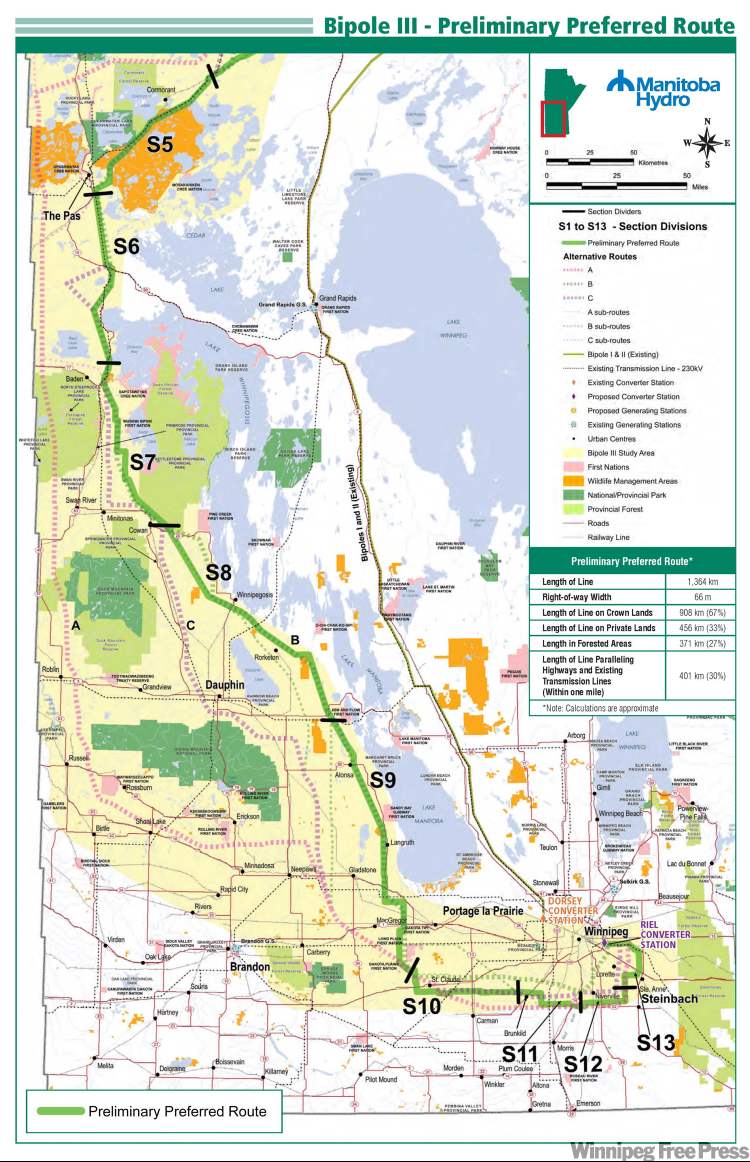
The route will run from dams in northeastern Manitoba, past Thompson and The Pas, to the east of the Porcupine Forest Reserve and the Duck Mountain Provincial Park and then hug the western shores of Lake Manitoba
Near the town of St. Claude, it will take a sharp turn east and run south of Niverville and loop around Winnipeg’s east side, stopping at a new converter station.
The total cost of the line is $2.2 billion, far more than a line down the east side of Lake Winnipeg which many critics favour as a cheaper, faster and more efficient route.
Another round of public consultations will happen before Hydro finalizes the route and applies for an environmental licence.