

Cairn with victims’ names to be unveiled
Leaders hope marker lets healing begin
Advertisement
Read this article for free:
or
Already have an account? Log in here »
To continue reading, please subscribe:
Monthly Digital Subscription
$1 per week for 24 weeks*
- Enjoy unlimited reading on winnipegfreepress.com
- Read the E-Edition, our digital replica newspaper
- Access News Break, our award-winning app
- Play interactive puzzles
*Billed as $4.00 plus GST every four weeks. After 24 weeks, price increases to the regular rate of $19.95 plus GST every four weeks. Offer available to new and qualified returning subscribers only. Cancel any time.
Monthly Digital Subscription
$4.99/week*
- Enjoy unlimited reading on winnipegfreepress.com
- Read the E-Edition, our digital replica newspaper
- Access News Break, our award-winning app
- Play interactive puzzles
*Billed as $19.95 plus GST every four weeks. Cancel any time.
To continue reading, please subscribe:
Add Free Press access to your Brandon Sun subscription for only an additional
$1 for the first 4 weeks*
*Your next subscription payment will increase by $1.00 and you will be charged $16.99 plus GST for four weeks. After four weeks, your payment will increase to $23.99 plus GST every four weeks.
Read unlimited articles for free today:
or
Already have an account? Log in here »
Hey there, time traveller!
This article was published 30/07/2010 (5757 days ago), so information in it may no longer be current.
First Nations leaders hope people whose loved ones died in a Manitoba tuberculosis sanatorium can begin to heal after a memorial to honour patients buried in unmarked graves is unveiled near Ninette on Sunday.
A 4.5-metre granite cairn with the names of 300 TB patients who died in Ninette’s sanatorium — including many First Nations patients who were buried in unmarked graves — has been erected in Belmont’s Hillside Cemetery. There are many graves hidden between shallow indentations in the cemetery’s grass that are not marked with crosses or headstones.
Burial records that identified which grave contained each patient were destroyed when Belmont’s funeral parlour caught fire in the 1960s. Decades after the sanatorium closed its doors, many relatives still don’t know where their loved ones are buried.
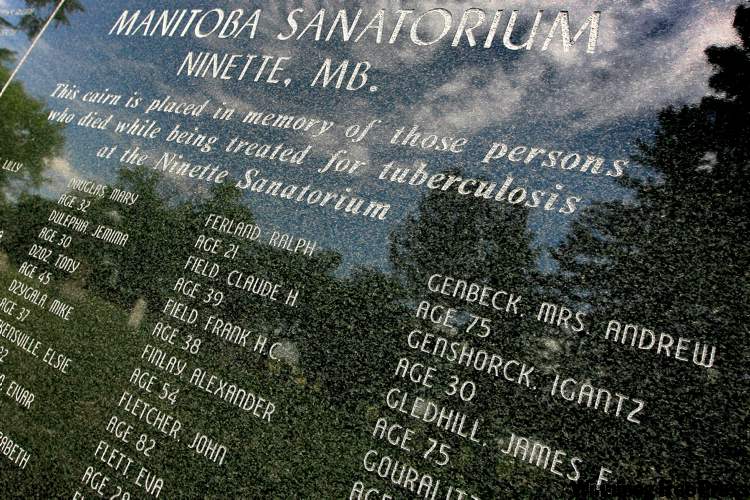
Municipal officials say the cairn is engraved with the names of all the TB patients who died in Ninette, and will give closure to families who are unsure whether their relatives are buried there. The memorial also includes the names of TB patients who were buried nearby in Ninette and Dunrea.
"All these people died and there’s just nothing there," said Carolyn Davies, the chief administrative officer for the RM of Strathcona. "There was no closure for anybody who is looking for their family members. It was a humanitarian project to give them something to visit."
Davies said the municipal council started work on the memorial in 2006 when they began fundraising and asked the Sanatorium Board of Manitoba for their patient records from Ninette. The list of names includes First Nations people, army personnel and immigrants who died of TB at the Ninette sanatorium.
She said the province, the Thomas Sill Foundation and the Killarney Foundation contributed donations. There will be a dedication ceremony to unveil the cairn at 1:30 p.m. on Sunday at Hillside Cemetery.
"There were never any headstones put up and there were just wooden crosses that broke down over time and eventually disappeared," Davies said.
The memorial comes amid renewed calls from First Nations leaders to develop a process to identify aboriginal TB patients in unmarked graves and notify their families.
The death rate among First Nations people in sanatoriums was shockingly high. Sanatorium Board documents show 40 per cent of aboriginal patients admitted to a northern Manitoba sanatorium in 1947 died, in part because the majority were admitted with moderate to advanced TB. That same year, the number of white people who died in Ninette declined, and only eight per cent of white patients there died.

"All these injustices that happened to our people are coming to the forefront and being acknowledged, and that is a good thing so our people can begin to heal," said Grand Chief Ron Evans.
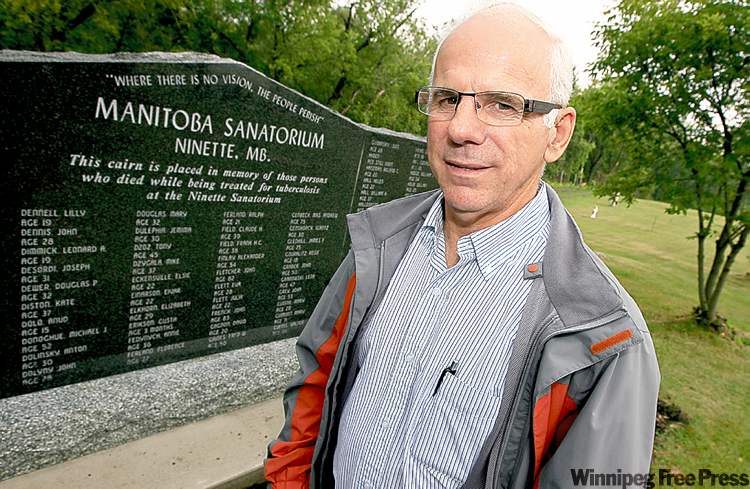
Evans called the memorial a "beginning" and said there is still more work to be done to bring closure to families. He said the Assembly of Manitoba Chiefs will support families who want the bodies of their loved ones exhumed and returned to their home communities.
"Some families would prefer that they be not disturbed, and other would probably request the body’s return," Evans said. "Either way, we would support the wishes of the family members."
jen.skerritt@freepress.mb.ca