

City drivers going around the bend got it wrong: expert
Advertisement
Read this article for free:
or
Already have an account? Log in here »
To continue reading, please subscribe:

Digital Subscription
One year of digital access for only $205*
- Enjoy unlimited reading on winnipegfreepress.com
- Read the E-Edition, our digital replica newspaper
- Access News Break, our award-winning app
- Play interactive puzzles
*First annual payment billed as $205.00 + GST for one year. This annual subscription will automatically renew at $233.00 + GST every 52 weeks (10% off the regular annual price of $259.35). Offer available to new and qualified returning subscribers only. Cancel any time.
To continue reading, please subscribe:
Add Free Press access to your Brandon Sun subscription for only an additional
$1 for the first 4 weeks*
- Enjoy unlimited reading on winnipegfreepress.com
- Read the E-Edition, our digital replica newspaper
- Access News Break, our award-winning app
- Play interactive puzzles
*Your next Brandon Sun subscription payment will increase by $1.00 and you will be charged $17.95 plus GST for four weeks. After four weeks, your payment will increase to $24.95 plus GST every four weeks.
Read unlimited articles for free today:
or
Already have an account? Log in here »
Hey there, time traveller!
This article was published 06/10/2010 (5765 days ago), so information in it may no longer be current.
WINNIPEG is one of the last major Canadian cities out of the gate when it comes to ‘traffic calming,’ a soothing term for road slowdown measures that have left some residents anything but calm.
Toronto and Vancouver were among the first to hop on board, with road-calming upgrades to bikeways and greenways going back a decade. Even Saskatoon, with a population less than one-third of Winnipeg’s, has curb extensions in 1,000 locations.
But Winnipeg’s introduction to bump-outs and traffic circles in the name of active transportation has been more controversial than calming, with some residents complaining of insufficient consultation and politicians caught in an evolving blame game.
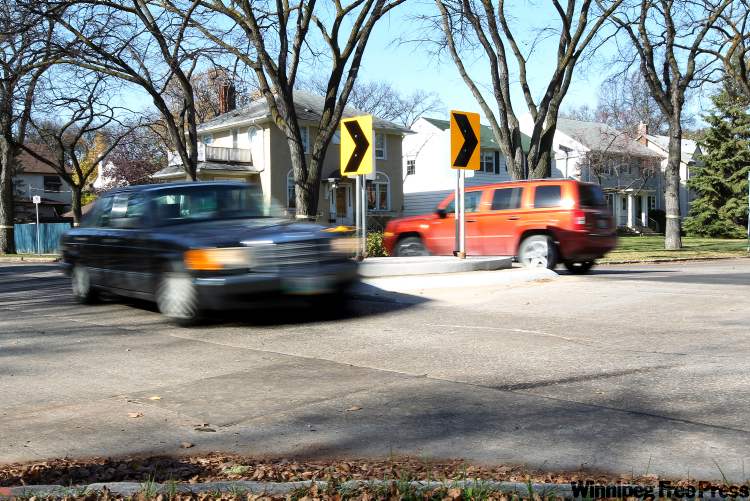
Experts say the key to public buy-in is strong consultation as well as education. Poor planning and lack of public engagement can lead projects to fail.
Traffic calming is a catch-all term for a host of measures aimed at curbing driving speeds on roads to make them safer for pedestrians and cyclists. That might include widened curbs, narrowed lanes, speed bumps or changes in road texture.
Changing driver behaviour is central, says calming guru Ian Lockwood, who argues route-changing measures such as street closures fall under a different category.
The calming concept has its roots in the Netherlands, where as early as the 1960s streets were converted into roadways on which pedestrians and cyclists get priority over drivers. Traffic calming spread throughout Europe in the years that followed.
The concept was slower to take root in North America, which “resisted it tooth and nail” for decades, says Lockwood, who’s consulted on hundreds of calming projects in North America.
But the idea has since become entrenched in cities such as Seattle, whose hundreds of traffic circles have had “a dramatic effect on reducing crash rates,” Lockwood says.
In Canada, Winnipeg is one of the last larger cities to implement calming measures on an area-wide scale, according to a 2005 Transport Canada study.
Lockwood said although some complaining is inevitable, cities new to traffic calming tend to need more guidance and hand-holding early on.
“Normally it has to do with the quality of the plan, whoever’s behind the design of the plan… . If people are objecting to it, they did a poor job in their planning and/or they did a poor job at public consultation,” he says.
Walkable Communities co-founder Dan Burden consults on pedestrian-friendly street changes across North America and says while most succeed, he’s seen a few projects backfire.
“Every time it’s been a success, it’s because the right civic engagement process was carried out. And every time we’d have a hiccup, it’s always been that folks didn’t understand how important that would be and only later realized that was the critical part.”

Even when residents want calmer roads, the changes don’t always work. Saskatoon installed three traffic circles at the request of residents five years ago but removed them after complaints from those same residents.
Vancouver saw gripes in the early days of its bikeway upgrades, which included hundreds of traffic circles.
In the past the city got rid of calming projects that met with heavy criticism, said transportation engineer Ross Kenny, but that’s no longer the case. In fact, some areas where initial plans for traffic circles were scrapped over objections are now getting them belatedly, he said, due to increased traffic from both cyclists and vehicles.
Residents can also petition to get a traffic circle on their streets, and pay for it themselves, said Kenny.
lindsey.wiebe@freepress.mb.ca