

Tied to the Titanic
Museum exhibit highlights stories of 30 passengers with links to province
Advertisement
Read this article for free:
or
Already have an account? Log in here »
To continue reading, please subscribe:
Monthly Digital Subscription
$1 per week for 24 weeks*
- Enjoy unlimited reading on winnipegfreepress.com
- Read the E-Edition, our digital replica newspaper
- Access News Break, our award-winning app
- Play interactive puzzles
*Billed as $4.00 plus GST every four weeks. After 24 weeks, price increases to the regular rate of $19.95 plus GST every four weeks. Offer available to new and qualified returning subscribers only. Cancel any time.
Monthly Digital Subscription
$4.99/week*
- Enjoy unlimited reading on winnipegfreepress.com
- Read the E-Edition, our digital replica newspaper
- Access News Break, our award-winning app
- Play interactive puzzles
*Billed as $19.95 plus GST every four weeks. Cancel any time.
To continue reading, please subscribe:
Add Free Press access to your Brandon Sun subscription for only an additional
$1 for the first 4 weeks*
*Your next subscription payment will increase by $1.00 and you will be charged $16.99 plus GST for four weeks. After four weeks, your payment will increase to $23.99 plus GST every four weeks.
Read unlimited articles for free today:
or
Already have an account? Log in here »
Hey there, time traveller!
This article was published 12/02/2011 (5530 days ago), so information in it may no longer be current.
Like something out of a romantic movie, the gold locket opens to reveal sepia-toned portraits of two young English sweethearts, Charles and Adelaide.
The century-old heirloom, cherished by a Winnipegger, has a poignant connection to the Titanic, the magnificent steamship that succumbed to the icy Atlantic on its maiden voyage.
In April, 1912, Charles Sedgwick, a 25-year-old engineer from Liverpool, had been married for only a week to Adelaide. They were about to emigrate from London to Mexico City, where Charles had been hired to run the municipal waterworks.

They were taking along Leslie Radcliffe, their adventurous 11-year-old nephew. But at the last minute, the escalating violence of the Mexican revolution made it too dangerous for the woman and the boy. Sedgwick booked second-class passage on the new White Star luxury liner by himself, intending to send for his loved ones later.
His body was never recovered.
His nephew, Leslie, grew up to become the purser on the Titanic’s sister ship, the Olympic. In the mid-1920s, he came to Winnipeg via the U.S. and settled down. He raised a family in Crescentwood.
The locket Leslie inherited from his widowed aunt has been handed down to his son, Mike Radcliffe, a 66-year-old Winnipeg lawyer and former MLA.
It’s on loan to the Manitoba Museum as one of the artifacts in Titanic: The Manitoba Connection, a special exhibit that opens today and runs to Sept. 5.

As the centenary of the April 15, 1912 disaster approaches, the public continues to be enthralled by the ship’s stories, says Sharon Reilly, social history curator at the museum.
“People have a fascination for events that really shook the world,” she says. “We thought, ‘There is a Manitoba story to be told here.'”
The local display is designed to complement Titanic: The Artifact Exhibition, a much more elaborate Atlanta-based touring show that traces the story of the ill-fated liner and displays about 200 artifacts salvaged from the wreck site. It opened Friday at the MTS Centre Exhibition Hall and runs until June 12. The Manitoba Museum looked into presenting the touring show itself, but didn’t have the budget or the space to host it.
The travelling and local shows are working in partnership and promoting each other.
The bilingual exhibit in the Manitoba Museum’s Parklands Pier gallery is included with regular admission. It uses text panels, photographs and about 160 artifacts from the museum collection — from clothing and toiletry items to farm implements and dishes — to help illustrate the stories of some of the 30 Titanic passengers who had connections to Manitoba.

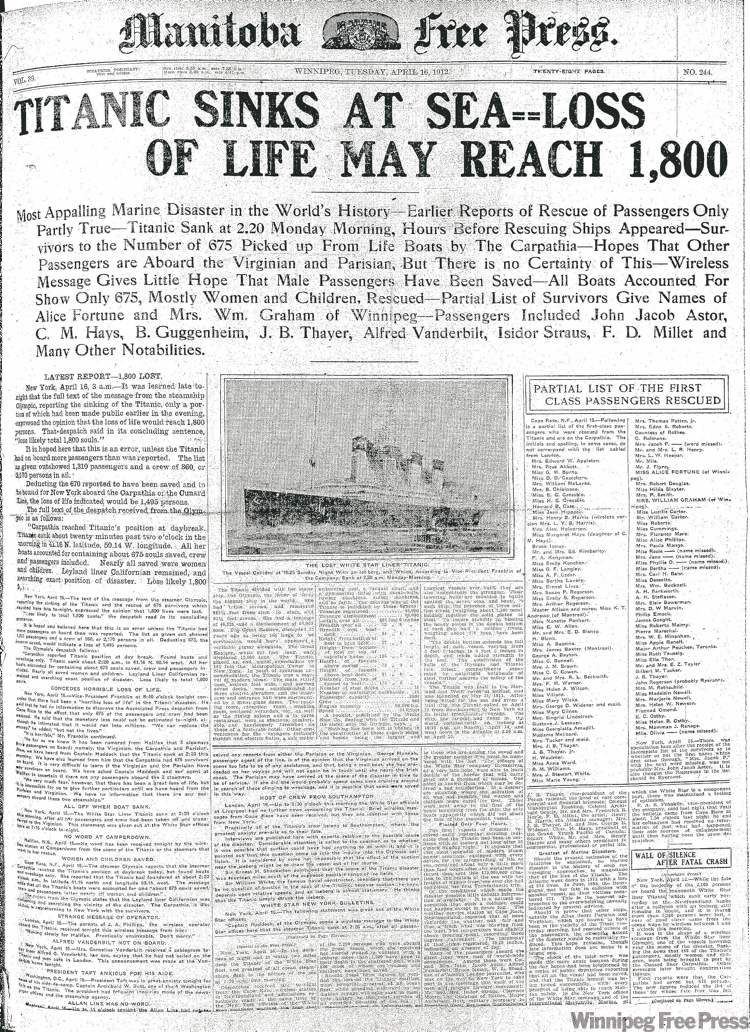
According to the book Titanic: The Canadian Story, 130 passengers were bound for Canada. Winnipeg had a large contingent, partly because the booming city had so many millionaires who liked to take winter holidays.
While the elite victims earned the majority of the local attention, the ship — a microcosm of its era — was also transporting immigrants with dreams of a new life.
One story concerns three brothers — Leonard, 24, Lewis, 30, and Stanley Hickman, 20 — who were on their way to Manitoba from England to work as farm labourers. Leonard had emigrated to Neepawa in 1908. He persuaded the entire Hickman family to join him, but only two of his brothers were able to secure second-class passage with him on the Titanic. Four friends of the Hickmans also made the trip. All seven perished.
A Swedish farm couple with five children, the Anderssons, were also bound for Manitoba as third-class passengers. None survived.
About 10 artifacts in the exhibit, including Radcliffe’s locket, have an actual link to the ship. There are, for instance, woodworking planes that belonged to John “Wat” Thomson, a carpenter who worked on building the Titanic in Belfast. Thomson declined a chance to sail on the Titanic and emigrated to Winnipeg in 1913.

Other items came to light when Reilly put out a public call for family stories and artifacts. She was amazed to receive some 60 responses.
One anonymous lender came forward with a rare Royal Doulton vase. It’s the very one that the T. Eaton Co. presented to the widow of George Graham, who was in charge of crockery and china for Eaton’s in Winnipeg. He was lost on the Titanic on the way home from a European buying trip.
Graham had planned to sail home on the Mauretania, but rebooked on the Titanic in order to get home three days earlier. Tragically, his wife received a telegram on April 16 that he had sent before the sinking. “She assumed he was OK,” says Reilly. When the truth came through, Eaton’s Winnipeg store closed for half a day in his memory.
Some Manitobans contacted Reilly with tales of how fate seemed to prevent their relatives from stepping onboard. “One family was supposed to get on the Titanic (to emigrate),” she says. “They were turned back because one child had an infected burn on her arm.”
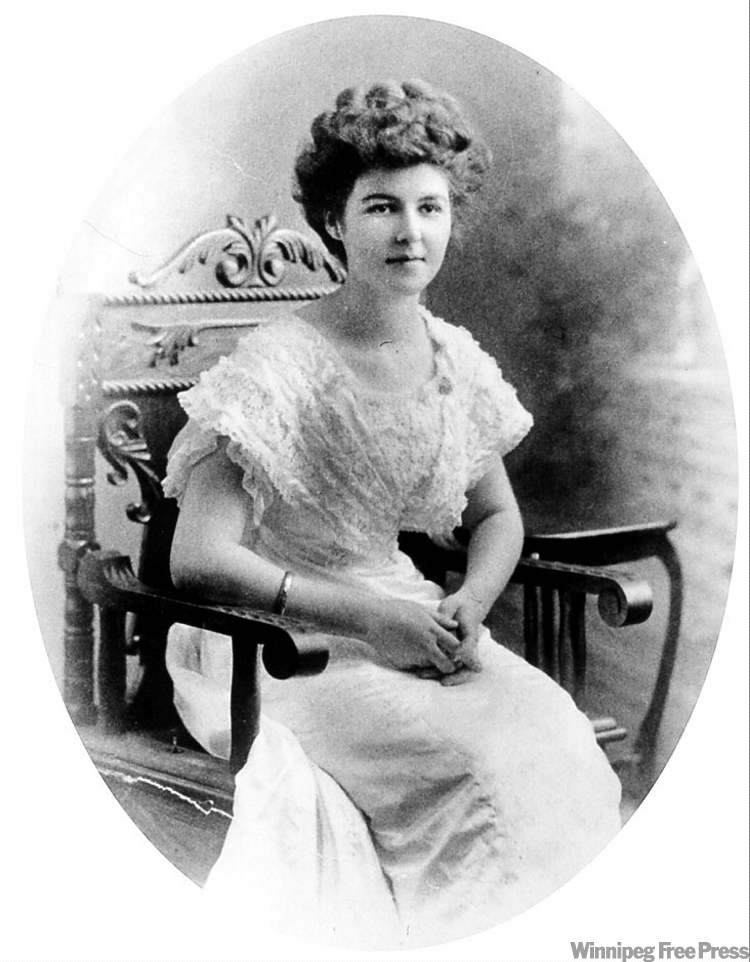
Conversely, the three-member Hart family from England was booked on another ship, but because of a coal strike was transferred to the Titanic. They were emigrating to Winnipeg, where Benjamin Hart was to open a hardware store.

He died in the catastrophe, while seven-year-old daughter Eva and her mother — who had experienced a powerful premonition of disaster — survived and went back to England. Eva became one of the best-known Titanic survivors, publishing a memoir, finally visiting Winnipeg in 1980, and appearing in the Imax film Titanica.
And what about Leslie Radcliffe, the 11-year-old who lost his uncle Charles Sedgwick and narrowly missed climbing the Titanic gangplank himself? Living out his days in Crescentwood, he wasn’t one to dwell on it.

“He said, ‘You don’t try to second-guess the future. You live each moment to the fullest,'” his son Mike remembers.
One thing Leslie told the family was that Uncle Charles had gold bullion in his baggage to start his Mexican life. That nest egg was lost forever. “There was never a settlement for loss of property,” says Mike.
Leslie, Mike recalls, was a rugged character — part of the same bold, risk-taking Edwardian generation that helped make Winnipeg the “Chicago of the North” in 1912. That year has been pinpointed as the one in which Winnipeg reached its peak of economic power and prominence. The failure of the “unsinkable” Titanic, Radcliffe believes, was one of the signals that the buoyant era would soon end.

“They thought they were unbeatable,” he says. “Titanic showed to that age group that they were mortal.”
alison.mayes@freepress.mb.ca
Tales from the wreckage
-- Winnipeg's two bronze memorial plaques to Titanic victims are on loan from their usual locations for the Manitoba Museum exhibit Titanic: The Manitoba Connection. The one from city hall, which council voted to erect just a week after the 1912 tragedy, honours "lamented citizens" Mark and Charles Fortune, John Hugo Ross, Thomson Beattie, George Graham and John Borebank, who "died that women and children might live."
Winnipeg's Hugo Street, Borebank Street and Fortune Street had been named prior to the Titanic sinking, curator Sharon Reilly believes, because all three men were in real estate.
-- Three artifacts in the exhibit came in a roundabout way from a now-defunct Titanic museum in Portage la Prairie: a cribbage board and a trinket box carved from ship debris, and a deck chair believed to be from the rescue ship Carpathia (which was recognized post-disaster in the naming of Winnipeg's Carpathia Road).
-- A newspaper clipping in the exhibit deals with a concert held in Calgary to raise money for the families of the Titanic orchestra members. The same kind of concert was held at Winnipeg's Walker Theatre on May 5, 1912.
-- St. Vital resident Bruce Johnston, 73, has loaned the exhibit a miniature brass anvil on a wooden base, small enough to hold in one's palm. His uncle, William Johnston, was a Belfast shipwright who worked on building the Titanic's boilers. The tiny anvil was a souvenir given to the workers by the construction company, made from Titanic scraps.
Bruce's father, David, was three years old when his big brother William, then 23, took him on an employees' tour of the newly completed Titanic. All his life, David told the story of being awestruck by the glittering electric lights and the immensity of the world's largest ship.
William, the shipwright, emigrated to Winnipeg the same year as the Titanic disaster and worked for Eaton's. He died in the First World War at age 28. His name is on the bronze war memorial for Eaton's employees that is now in the MTS Centre -- right across the street from where salvaged Titanic artifacts are being displayed. "It brings (the story) in an interesting circle," says family member Kathleen Christensen.
Do you have a family connection to the Titanic? The Manitoba Museum is still collecting stories and artifacts. Email titanic@manitobamuseum.ca
Related Articles
Winnipeg lives lost in tragedy
Advertisement Advertise With Us
Advertisement Advertise With Us