

Echoes of Mayerthorpe
Convicted accomplice recants; was he lying then, or now?
Advertisement
Read this article for free:
or
Already have an account? Log in here »
To continue reading, please subscribe:
Monthly Digital Subscription
$1 per week for 24 weeks*
- Enjoy unlimited reading on winnipegfreepress.com
- Read the E-Edition, our digital replica newspaper
- Access News Break, our award-winning app
- Play interactive puzzles
*Billed as $4.00 plus GST every four weeks. After 24 weeks, price increases to the regular rate of $19.95 plus GST every four weeks. Offer available to new and qualified returning subscribers only. Cancel any time.
Monthly Digital Subscription
$4.99/week*
- Enjoy unlimited reading on winnipegfreepress.com
- Read the E-Edition, our digital replica newspaper
- Access News Break, our award-winning app
- Play interactive puzzles
*Billed as $19.95 plus GST every four weeks. Cancel any time.
To continue reading, please subscribe:
Add Free Press access to your Brandon Sun subscription for only an additional
$1 for the first 4 weeks*
*Your next subscription payment will increase by $1.00 and you will be charged $16.99 plus GST for four weeks. After four weeks, your payment will increase to $23.99 plus GST every four weeks.
Read unlimited articles for free today:
or
Already have an account? Log in here »
Hey there, time traveller!
This article was published 07/05/2011 (5466 days ago), so information in it may no longer be current.
EDMONTON — Until now, Shawn Hennessey has never given his full account of what went on between him and mass murderer James Roszko.
During the lengthy RCMP investigation into Hennessey’s role in the Mayerthorpe massacre, the young Barrhead, Alberta, man never said much to the police or to his wife or father or anyone else. He and his brother-in-law Dennis Cheeseman pleaded guilty to four counts of manslaughter, so Hennessey never testified in court about what went on the night of March 2, 2005, when he and Cheeseman supplied Roszko with a rifle and drove the angry man back to his property. They dropped him off eight or nine hours before Roszko’s massacre of four RCMP officers.
Hennessey had wanted to testify at the recent fatality inquiry into the mass murder, but he wasn’t allowed. Judge Dan Pahl said the information Hennessey and Cheeseman might provide went beyond the limited scope of the inquiry, which was to examine the causes of death and to determine what can be done to prevent similar deaths.
The two men had signed an agreed statement-of-facts when they pleaded guilty, Pahl said, and that document would be sufficient for the inquiry.
For many people — and certainly for any legal proceeding — the agreed statement-of-facts on this case is the final word on the matter. It’s a damning document that spells out that on the evening of March 2, 2005, Hennessey and Cheeseman knew Roszko was enraged with the RCMP, but failed to warn the police that an armed madman was stalking them. Both Hennessey and Cheeseman stood up in court at their January 2009 sentencing hearing and agreed that the facts in the agreed statement were true. Hennessey got a 15-year sentence for his crime; Cheeseman got 12.
Case closed, right?
Not according to Hennessey or his father, Barry, who are waging a fight to get Hennessey’s sentence reduced and to clarify Hennessey’s dealings with Roszko on the night before the mass murder. Shawn Hennessey says he only helped Roszko because he was afraid for his life and his family, and he had no idea the RCMP were at Roszko’s farm that night or that Roszko intended to harm them. That’s why he never warned the police Roszko was coming.
Both Hennessey and Cheeseman are working on appeals of their sentences to the Supreme Court, with their cases taken up by two of Canada’s best defence lawyers, Calgary’s Hersh Wolch and Edmonton’s Peter Royal.
For his part, in a lengthy interview at the Grande Cache Institution, a minimum/medium federal prison, Hennessey now says the agreed statement-of-facts is riddled with errors. It’s not based on things he ever said, but on the various and contradictory confessions made by Cheeseman, largely to undercover RCMP agents. Hennessey only agreed to adopt the statement-of-facts, he says, because he was charged with first-degree murder. It was better, he reasoned, to accept the Crown’s offer of manslaughter than to risk conviction for murder and a life sentence.
X X X
Hennessey met Roszko around 2002, after Roszko got out of jail for sexually assaulting a minor. Hennessey says he knew nothing of Roszko’s criminal past or his now well-documented quarrels with the Mayerthorpe RCMP in the 1990s.
Roszko’s farm is near Mayerthorpe, but Roszko had worn out his welcome in that town, so he took his business 30 minutes down the highway to Barrhead. Few, if any, people there knew of his criminal past and predatory proclivities. Roszko started to come into the Barrhead Kal-Tire, where Hennessey worked, with an odd request: he claimed he was looking for big thick tires from oilfield trucks, saying he needed old ones to cut in half and use as feeders for his cattle.
Such tires rarely came in, so Roszko had plenty of opportunity to drop in and ask for them, then chat up the staff for 15 or 20 minutes.
Perhaps Roszko just wanted those tires, or maybe just some human contact, but it certainly appears as if Roszko, a small, middle-aged and ill-at-ease man, was also engaged in his practice of sexual predation.
Roszko had an appetite for the sexual conquest of teenage males, but he was deeply in the closet and had reacted violently in the past if anyone said he was gay. His method of seduction was to win favour with a group of young men by offering them cheap or free marijuana or booze, by fixing up their trucks on the cheap, or by offering them work at a good wage. He would worm his way into a group of young men, then pick off one or two of his targets.
That Roszko was using Hennessey as an “in” into the Barrhead social scene has crossed Hennessey’s mind in recent years. “Now when I think back it was just a play to get to know someone in Barrhead,” he says.
Roszko once overheard Hennessey talk about hunting. Roszko mentioned he had a bear problem and asked if he could borrow Hennessey’s rifle. Hennessey agreed. Roszko came out to Hennessey’s acreage one day to pick up the rifle, returning it a few days later.
Hennessey and his peer group smoked marijuana now and then at parties. Roszko quickly used this as another way in. One day, he offered Hennessey a bag of marijuana. “Take this and tell me what you think of it,” Roszko said. “Tell me if you think you could move it.”
Hennessey says he had never dealt marijuana and was just a casual user. He saw no harm in taking Roszko’s gift and smoking it with his friends.
Some time later, Roszko called him up to ask what he thought of the pot. When the two met, Roszko asked Hennessey if he could move two or three ounces. Roszko wanted $150 an ounce for the pot. The going price in Barrhead was $80 a quarter ounce.
Hennessey quickly sold the pot to a handful of his friends. Through the summer, fall and winter of 2004-05, Hennessey says he had about five transactions with Roszko, dealing only to his peer group. He estimates he sold roughly $9,000 of Roszko’s pot, making a profit for himself of about $2,000, with $7,000 going to Roszko.
In the weeks leading up to the mass murder, Roszko complained to Hennessey that he was in a dispute with an Edmonton dealership about damage done to his Ford F-350 truck, so he had stopped paying for it. At about the same time, Hennessey says Roszko also gave him a warning over their marijuana dealings, telling Hennessey he had better be careful if he ever thought about going to the police to rat him out. According to Hennessey, Roszko said: “If you ever decided you don’t want to do this anymore, that’s not the right way to do things. I know people, so don’t make the mistake of going to the cops.”
Roszko’s predatory schemes advanced in Barrhead when he met Hennessey’s young brother-in-law, Dennis Cheeseman, born in January 1984. Cheeseman had a rough upbringing. His father died in a car crash, his mother struggled with gambling. Cheeseman spent much of his time in his basement room playing video games.
Hennessey was the first positive male role model in his life. He helped Cheeseman, a Grade 10 dropout, get a driver’s licence and a job at a local hardware. “Dennis was like a little brother to me,” Hennessey says.
Once when Hennessey went to dig post holes at Roszko’s place, Cheeseman also came to help. Hennessey is not sure if Cheeseman ever went out on his own to work at Roszko’s place.
Cheeseman would later tell an RCMP undercover agent that Roszko had stalked him and knew all his movements. He would tell his own family members that Roszko had sexually assaulted him at gunpoint. But while Roszko was alive, Cheeseman said not a word to his family about Roszko’s harassment.
On March 2, 2005, bailiffs came to seize Roszko’s F-350 at his farm at about 3 p.m.
Roszko cursed the bailiffs and took off in the truck. The bailiffs called the RCMP, who got to Roszko’s place around 3:40 p.m. Roszko was nowhere in sight.
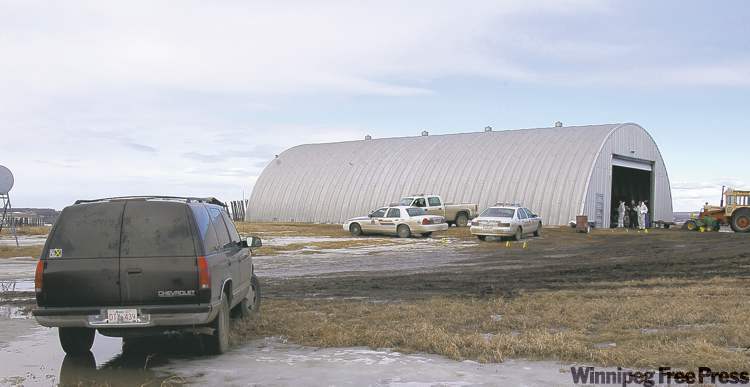
The police searched the place, found the chop shop and marijuana grow-op in a quonset, then left a cruiser there to secure the scene. The RCMP went about getting a warrant to search. They didn’t return in force until 8:40 p.m. .
Roszko first called Hennessey at 3:34 p.m. BRoszko tried to con Hennessey into letting him park his truck on Hennessey’s property, which was far from any bailiffs.
Hennessey says he refused Roszko’s request: “No, you can’t leave it here. I don’t want to be involved.”
Hennessey says he felt no anxiety or fear in turning down Roszko. He saw Roszko as crafty and slippery; not your average farmer for sure, but not some violent maniac.
According to the agreed statement-of-facts, one other crucial thing happened that evening: Hennessey stopped in Barrhead to see Dennis Cheeseman, who was helping a friend to move.
The agreed statement reads: “Hennessey asked Cheeseman to speak to him alone, and indicated that he needed Cheeseman’s help because there were RCMP officers at Roszko’s farm, and Hennessey was involved in the grow operation at Roszko’s property. He further asked Cheeseman to get home as soon as he could.”
Hennessey says this statement — which was cited by the sentencing judge as a reason for giving him such a long sentence — isn’t just false, it makes no sense.
First of all, he was no big-time marijuana dealer or investor and had nothing to do with operating Roszko’s grow-op, so he had no reason to care if the police were searching the quonset.
As for seeking out Cheeseman to help deal with Roszko and the RCMP, Hennessey is adamant he did no such thing. He did bump into Cheeseman that day in Barrhead on his way home from work, he says, but Hennessey says he had no idea Roszko was in trouble with the RCMP, just that Roszko wanted to stash his truck.
“I’m not even sure I mentioned Roszko at all.”
X X X
That evening, according to the agreed statement-of-facts, Roszko was on his cellphone with his mother, making five calls between 8:13 p.m. and 11:55 p.m. Roszko was still trying to find a place to stash his truck.
He and his mother enlisted the help of Roszko’s aunt, who had a property between Mayerthorpe and Barrhead.
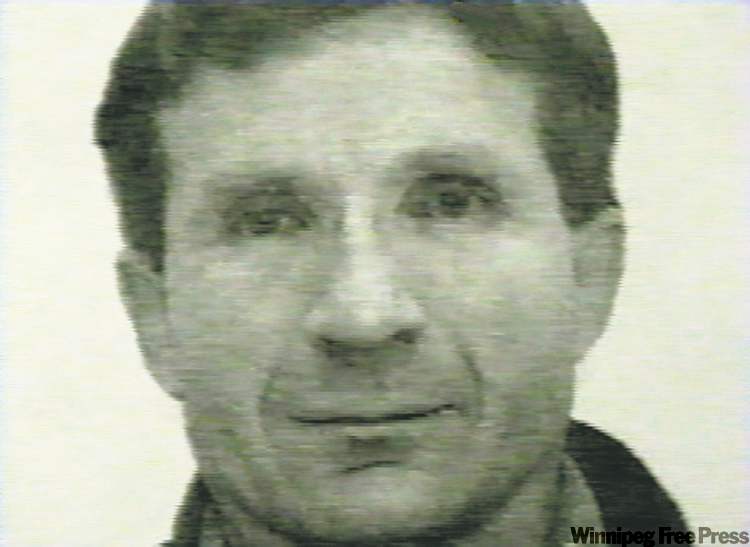
Hennessey’s next contact with Roszko came later that night. Hennessey says he was going to sleep. He noticed headlights pulling up to the house. He heard a knock on the door and figured it was Cheeseman, who lived in the basement, forgetting his keys and needing to be let in.
When he opened his door, Hennessey says he faced an armed Roszko. The agreed statement says Roszko’s handgun was tucked in his pants. Hennessey says the gun was in Roszko’s hand, pointing directly at Hennessey’s face. .
Hennessey now says he wishes he had simply fought Roszko, but in that moment his automatic response was instead to give in to Roszko’s demands, in the hope of Roszko going away.
“I need that rifle,” Hennessey says Roszko told him. “Go get that rifle.”
Hennessey went and picked up the rifle case from inside his house. The case also contained shells. He brought it out to Roszko, who was standing on the porch. Roszko opened the case and took the rifle and the ammo.
“I just need a ride home,” Roszko told Hennessey. “I found somewhere else to leave my truck. Just give me a ride.” Roszko said he was going back to his farm to put a hole in the fuel tanks near his quonset, to burn down the thing.
Hennessey said he didn’t think about Roszko’s story or his motives, though he was aware that the quonset was almost certainly where the marijuana was kept. His only thought was: “Get him out of here. Whatever I’ve got to do, let’s just go, just get out of here.”
The agreed statement makes it clear that Hennessey and Cheeseman knew Roszko was enraged at the RCMP: “Roszko ranted and complained about the RCMP and threatened to get even with them. He indicated that he was going to burn down the quonset. Cheeseman described his ranting as ‘devil talk.'”
Today, Hennessey insists Roszko never once said anything about the RCMP being on his property or about any plan to kill police officers.
Hennessey can’t recall asking Cheeseman to come along with him to help drive Roszko to his aunt’s farm. “I don’t know if I asked him or he just took the initiative and got in.”
They didn’t talk at all on the drive, following Roszko in his truck as he made his way to his aunt’s. “(Dennis) sees I’m white as a ghost,” Hennessey says. “Clearly he’s seen there was an issue.
At his aunt’s place, Roszko quickly got out of his truck and into the front seat of Hennessey’s car. What was Roszko’s mood?
“It was hard to see if he was upset. He was a very, very hard guy to read,” Hennessey says. Roszko rode in the front seat of Hennessey’s vehicle, Cheeseman in back. They drove to Roszko’s farm.
“There was no conversation from the time he told me what he was going to do until I dropped him off,” Hennessey says.
When they got close to Roszko’s place, Roszko ordered Hennessey to turn off the highway and away from the destination.
Roszko directed Hennessey on a roundabout route, ending up across the field from Roszko’s place, on Roszko’s mother’s side of the property. There, after passing Roszko’s mother’s house, Roszko asked Hennessey to stop. Roszko got out, one gun in his hand, the rifle at his side. He left without saying a word, Hennessey says. “The door opened and away he went.”
Hennessey recalls seeing lights up at Roszko’s place, but he saw no police car flashers. It didn’t occur to him that the RCMP were there, he says.
After the drop-off, an exhausted Hennessey headed home.
He recalls Cheeseman asking him if they should call the police.
“No, I don’t think so,” Hennessey says he replied. “Why?”
Cheeseman gave no answer.
Hennessey mulled over Cheeseman’s suggestion. He had no major concerns about Roszko and his intent. “He’s going to burn his quonset hut down,” Hennessey recalls thinking at the time. “I don’t care what he does. It didn’t matter to me if he burned it down or not.”
At the same time, Hennessey had been involved in a criminal activity with Roszko. At that moment, he recalled the threat Roszko had previously made about someone coming after him if Hennessey ever ratted on him.
Having just escaped Roszko, the last thing he wanted was to later be confronted by him or his associates later on.
“He just pointed a gun in my face. What’s the point of calling the police, knowing he could come back?” Hennessey says.
So no call was made, the one thing that many RCMP officers and the families of the slain officers cannot accept or forgive when it comes to Hennessey’s conduct. As Kelly Johnston, the wife of Leo Johnston, one of the murdered officers, has said: “I don’t have sympathy for anybody, or for anybody’s reasoning and fear, that prevented them from saving my husband when it was so simple to do … Roszko might have pulled the trigger, but they enabled him … The blood is on their hands.”
This failure to make a call came up repeatedly at the fatality inquiry. RCMP deputy commissioner Rod Knecht, now Edmonton’s police chief, testified the only thing that would have made a difference would have been the RCMP knowing that an armed Roszko was on the way. “If we knew what the threat was going to be, our members would have responded differently”
X X X
The next morning, Hennessey woke up early and headed to Edmonton to attend a course. On his way there and again later that day on his way home, he listened to CDs, not the radio. When he pulled up into the driveway, Christine met him to tell him the news of the massacre.
“It was devastating,” Hennessey says. “It was a huge tragedy.”
Hennessey knew he had given a rifle to Roszko registered to his grandfather John. He lied to John and other members of his family, saying he had actually given that rifle to Roszko one year earlier.
“I have no clue why I wouldn’t tell him (his grandfather) the truth,” Hennessey says.
The police approached him five days later, knowing he was involved in some way because of the phone records showing Roszko had called him. In his interview, Hennessey lied to the police, saying he had gone to bed and hadn’t heard or seen Roszko after Roszko left the Hennessey acreage late on the afternoon of March 2.
Hennessey says he had one goal at that time: “To place myself as far away from Roszko as possible.”
As the police continued to pursue him, Hennessey came to believe the homicide investigators were locked into proving he was Roszko’s friend, business partner in the quonset and accomplice in homicide.
He looked up a criminal defence lawyer in the Edmonton phone book. The two met, Hennessey told him his story, and the lawyer advised him to meet with the police and relay the same story to them. Hennessey accepted this advice.
The following day, however, he says the same lawyer called back to say his firm had a conflict of interest on the case. Hennessey never went to the RCMP, though he now sees that was a mistake.
“I should have gone to the RCMP from Day 1. Absolutely … I wish I had of. It would never have led to the lies and deceit, the Mr. Big (sting).” Hennessey got a new advocate, Ed O’Neill, and his partner, D’Arcy Depoe, experienced criminal defence lawyers in Edmonton. O’Neill told him not to talk to the RCMP, which is standard advice.
“You’re best not to talk to the police,” Hennessey recalls O’Neill saying. “Go home and live your life. Any time the cops come and want to talk to you, give them my card.”
The police were not to be trusted, Hennessey was told: “Anything you say to the police, they will twist, turn and misconstrue.”
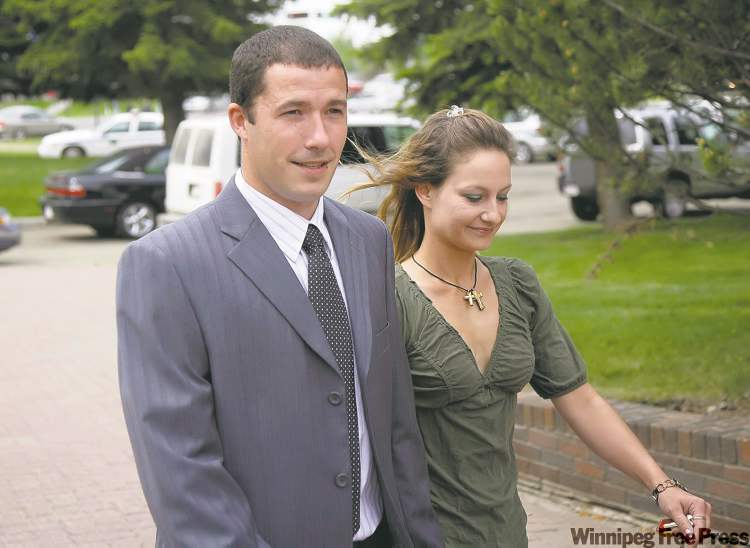
Hennessey was also told to be careful about what he said to others and that his house would be bugged.
He never talked much to either his wife or to Cheeseman about what had gone on that night with Roszko.
In April 2006, a new face showed up in Barrhead, an undercover RCMP operator, “Wally” (his real name and undercover name are protected by court order) posing as a fledgling businessman. Wally said he was escaping the pressure of the city to set up a welding shop. Within one or two meetings, Hennessey says he was sure Wally was an RCMP officer.
At one point, Wally suggested they hide their quads in the bush and make false insurance claims. “Hey man, you’re a cop,” Hennessey shot back.
“You don’t think I’m a cop,” Wally replied, big smile.
In November 2006, the RCMP turned their undercover operation on Cheeseman, sending an attractive young officer, “Sue,” his way.
Hennessey was suspicious. “I told Dennis she was a cop right away.”
Her story was fishy, Hennessey thought. She had apparently been stranded in her broken down car in front of Sepallo Foods in Barrhead, where Cheeseman worked. But if her car was really breaking down, Sepallo was a strange place to end up. She would have to drive right into town past a car garage to get to Sepallo. And if her car was broken, how did she back it into Sepallo’s parking lot?
Hennessey never said much more to Cheeseman about Sue. “To each your own,” he says. “Dennis seemed happy. He was no longer in his bedroom all the time. He was always in the city. He was always with people. He had a life. A pretend one.”
The moment when Cheeseman himself became convinced Sue was not a cop came in late February 2007 when the RCMP staged a bizarre scenario. First it was reported to Cheeseman that Sue had been beaten by an old boyfriend, then he saw her with her face made up to look as if it had been pulverized. Finally, Cheeseman and his undercover agent friends went to beat up the ex-boyfriend, tracking him down in a hotel room.
After that incident, Hennessey says, “Dennis was adamant there was no way they were cops.
He said, ‘He beat her. We kicked in the door and beat up this guy.’ ” “You physically hit him?” Hennessey asked Cheeseman.
“No,” Cheeseman said, adding he was told not to touch the ex-boyfriend himself.
“Good enough,” Hennessey said. “They’re cops.”
In the late spring of 2007, the RCMP tried hard to ensnare Hennessey as they had done with Cheeseman. Cheeseman was doing numerous jobs for a fake gang of undercover agents posing as mobsters. Cheeseman was lured into phoney schemes, where he committed supposedly criminal but non-violent acts for which he would be paid a few hundred dollars each time. Cheeseman — who had never had any real money — was suddenly wearing new dress clothes and had money to pay off his bills and do whatever he wanted in his leisure time.
Hennessey says he doesnt hold a grudge against Cheeseman for getting sucked in by the RCMP. His sympathy for Cheeseman has only intensified with the story coming out about Roszko sexually assaulting Cheeseman at gunpoint and later stalking him.
“I don’t hate on the guy,” Hennessey says. “He was in a pretty rough spot. I can only imagine what he went through if Roszko was doing whatever to him. My heart goes out to the guy.”
He does wonder, though, why Cheeseman would lie to the police and to undercover operators, and in one of his many versions of what went on that night of March 2, 2005, say that Hennessey understood Roszko’s intent was to kill police officers.
“It hurts,” Hennessey says of Cheeseman’s statements. “Why would he says these things? … I’m just stumped where he comes up with all this.”
When they were cellmates at Edmonton’s Remand Centre, the two didn’t talk about the case much. They feared their cell might be bugged. Only once after Cheeseman had told a family member about Roszko’s sex assault of him did Hennessey broach that subject. Cheeseman reacted emotionally, but refused to say anything.
X X X
In early July 2007, the Mr. Big in Cheeseman’s fake criminal gang flew into Barrhead to talk to Hennessey, purportedly to offer to destroy a satellite photograph of Hennessey’s licence plate on the night he drove Roszko back to his farm. Hennessey says he knew it was all an RCMP crock, but by that point he had enough. The pressure of keeping his story inside was too much.
“I finally said, ‘Whatever! If these guys are cops and you want to hear my story, listen in, here it is.’ “
When Mr. Big pulled out the so-called satellite photos of Hennessey’s car, Hennessey says he laughed because he thought they were so phoney.
In this confession, Hennessey told Mr. Big t he had given Roszko a ride back to his place, believing that Roszko was going there to burn down the quonset by using the rifle to shoot some nearby gas tanks and start a fire. The morning after his first talk with Mr. Big, when Hennessey woke up for work, he says he felt terrible. “I was absolutely sick to my stomach.”
He felt sick all morning, then sick again when the undercover officers returned that day to talk to him at his work. The RCMP were trying to firm up their story, to find out if Hennessey knew of Roszko’s murderous intent and knew police were out at Roszko’s place. But the most Hennessey said with any real clarity is that he saw headlights at Roszko’s farm that night.
“I don’t know where my mind was at,” Hennessey says of this final interrogation. “At that time, I’m just fed up. Emotionally drained.
“There was a car for sure. Whether there was more than one, I can’t be certain.”
Based on his statements to Mr. Big, Hennessey was arrested. On June 6, 2008, at his preliminary hearing Judge Peter Ayotte indicated there was “abundant” evidence against Cheeseman for the charge of first-degree murder, but not so much against Hennessey. The verdict could go either way, but there was enough evidence to go to trial on murder charges, Ayotte said.
With first-degree murder charges hanging over his head, Hennessey decided he must listen to his lawyer and plead guilty to manslaughter.
In the end, he made a bet on getting a lighter sentence, and agreed to a statement of facts he now claims is false.
He is working toward getting out on parole, while awaiting his sentencing appeal. He can apply to go to a halfway house next January, then apply for full parole six months after that.

Once he gets out, his plan is to do construction work around Barrhead for a time, then maybe return to the oilpatch to get the family out of debt.
“I want to live a normal life again.”
His one hope, he says, is that others are open to hearing about what happened between him and Roszko. “I hope they see it for what it is. I hope they see the truth behind it, that it’s not like the Mounties portray it to be.”
— Edmonton Journal