

Rightist opposition party wins Cyprus parliamentary elections
Advertisement
Read this article for free:
or
Already have an account? Log in here »
To continue reading, please subscribe:

Digital Subscription
One year of digital access for only $205*
- Enjoy unlimited reading on winnipegfreepress.com
- Read the E-Edition, our digital replica newspaper
- Access News Break, our award-winning app
- Play interactive puzzles
*First annual payment billed as $205.00 + GST for one year. This annual subscription will automatically renew at $233.00 + GST every 52 weeks (10% off the regular annual price of $259.35). Offer available to new and qualified returning subscribers only. Cancel any time.
To continue reading, please subscribe:
Add Free Press access to your Brandon Sun subscription for only an additional
$1 for the first 4 weeks*
- Enjoy unlimited reading on winnipegfreepress.com
- Read the E-Edition, our digital replica newspaper
- Access News Break, our award-winning app
- Play interactive puzzles
*Your next Brandon Sun subscription payment will increase by $1.00 and you will be charged $17.95 plus GST for four weeks. After four weeks, your payment will increase to $24.95 plus GST every four weeks.
Read unlimited articles for free today:
or
Already have an account? Log in here »
Hey there, time traveller!
This article was published 21/05/2011 (5590 days ago), so information in it may no longer be current.
NICOSIA, Cyprus – Rightist opposition party DISY narrowly won Cyprus’ tightly contested parliamentary elections on Sunday, handing defeat to the governing AKEL party, final results show.
But the results indicate that voter support for leftist President Dimitris Christofias’ handling of long-running talks with breakaway Turkish Cypriots to reunify the divided island remains steady.
Official results showed that DISY got 34.27 per cent or 1.6 per cent more than its traditional communist-rooted rival AKEL, a party which Christofias had led for two decades before resigning his post in 2008.
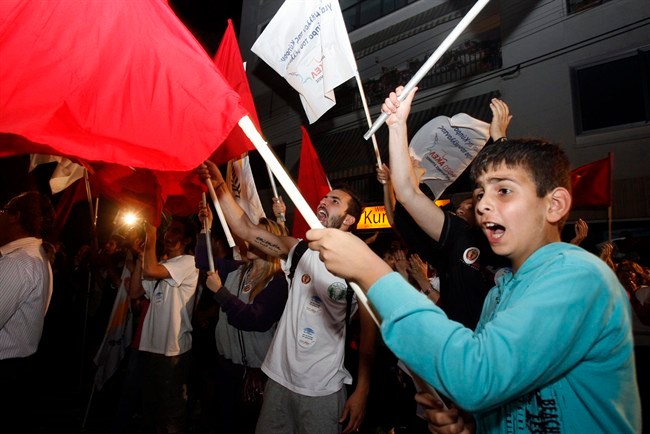
Cyprus is governed under a presidential system, meaning that parliamentary elections don’t result in a change of government. But they reflect public sentiment on a government’s performance and are used to measure party strength in alliance building for presidential elections next due in 2013.
DISY’s narrow victory margin coupled with the fact that AKEL managed to nudge its overall support numbers up by more than a percentage point over the previous poll suggests that Christofias continues to enjoy broad public backing in reunification efforts that have dominated the island’s politics for decades, said political analyst Tim Potier.
“It’s a win-win situation for all concerned, they can all be satisfied with the result,” Potier said.
Cyprus was split into a Greek Cypriot south and a Turkish Cypriot north in 1974 when Turkey invaded after a coup by supporters with Greece. The island joined the European Union in 2004, but only the internationally recognized south enjoys membership benefits.
Numerous United Nations-mediated attempts at reunification since then have failed and the latest round of talks that Christofias launched with leftist Turkish Cypriot leader Mehmet Ali Talat in 2008 have produced little in the way of real progress after Talat was swept from power by right-wing rival Dervis Eroglu last year.
Christofias’ hawkish detractors have accused him of making too many concessions in the talks without getting much in return, but Potier said the election outcome rested more on voters’ concern over the continuing economic crisis and its impact on the Cypriot economy.
Christofias has come under heavy criticism for not doing enough to curb government spending and to tackle high unemployment levels.
Although fiercely critical of Christofias’ fiscal policies, DISY avoided attacking him on his peace talks line so as not to signal that Greek Cypriots are drifting away from a peace deal based on power-sharing under a federal roof, said Potier.
Despite its loss, AKEL party chief Andros Kyprianou hailed the result as a success since ruling parties in other European countries have suffered huge election losses.
Some 530,000 voters in the south were eligible to cast their ballots, but this election was marked by a record low turnout for Cyprus standards of around 80 per cent — 9 per cent lower than the previous balloting.