

First Nations, Métis get behind prohibition on moose hunting
Advertisement
Read this article for free:
or
Already have an account? Log in here »
To continue reading, please subscribe:
Monthly Digital Subscription
$0 for the first 4 weeks*
- Enjoy unlimited reading on winnipegfreepress.com
- Read the E-Edition, our digital replica newspaper
- Access News Break, our award-winning app
- Play interactive puzzles
*No charge for 4 weeks then price increases to the regular rate of $19.95 plus GST every four weeks. Offer available to new and qualified returning subscribers only. Cancel any time.
Monthly Digital Subscription
$4.99/week*
- Enjoy unlimited reading on winnipegfreepress.com
- Read the E-Edition, our digital replica newspaper
- Access News Break, our award-winning app
- Play interactive puzzles
*Billed as $19.95 plus GST every four weeks. Cancel any time.
To continue reading, please subscribe:
Add Free Press access to your Brandon Sun subscription for only an additional
$1 for the first 4 weeks*
*Your next subscription payment will increase by $1.00 and you will be charged $16.99 plus GST for four weeks. After four weeks, your payment will increase to $23.99 plus GST every four weeks.
Read unlimited articles for free today:
or
Already have an account? Log in here »
Hey there, time traveller!
This article was published 06/07/2011 (5301 days ago), so information in it may no longer be current.
WOLVES, ticks and a deadly parasite are killing so many Manitoba moose that hunters, including those from First Nations and Métis communities, are ready to lay down their rifles.
This week, Manitoba announced a ban on moose hunting near the Duck and Porcupine Mountains of western Manitoba, expanding a ban imposed in 2010 in the Swan Lake and Pelican Lake regions, west of lake Winnipegosis.
Some Manitoba aboriginal leaders say conservation trumps politics during a crisis like this. “I know we have treaty rights to hunt but if there’s nothing to hunt, what good are they? We have to support whatever can bring the population back up,” said Grand Chief Ron Evans, head of the Assembly of Manitoba Chiefs.
Evans said Tuesday that co-management with the province is critical for First Nations, who face a population boom at the same time moose numbers are crashing.
The Métis, unlike First Nations, lack treaty hunting rights, but Manitoba courts recognize Métis aboriginal hunting rights.
The Manitoba Métis Federation said the decline in moose in western Manitoba is a major worry.
“It’s hard to say to our people, ‘Don’t hunt,’ ” said Ken Leforte, MMF’s natural resources minister.
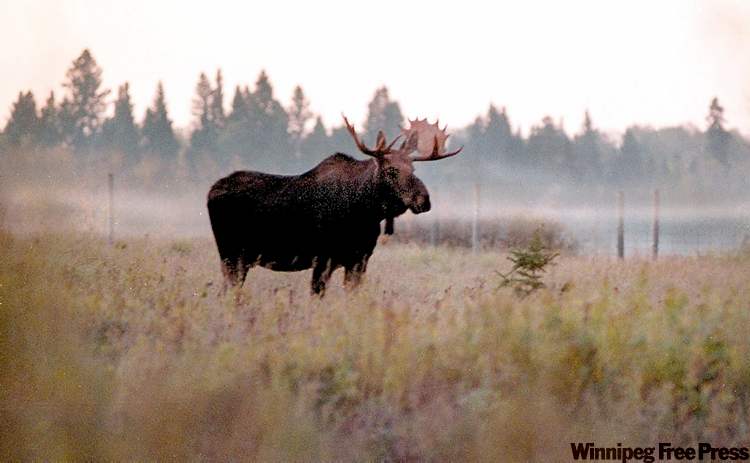
Moose are called the monarch of the boreal forest for good reason. Some giants weigh in at 2,500 pounds with antler spans two metres wide or more.
The provincial government charted moose trouble to an area in western Manitoba. Moose numbers have dropped up to 90 per cent over the last 20 years in some regions.
“There has been a serious decline of moose population in certain areas of our province and if they drop any further, there’s a risk they may not recover,” Conservation Minister Bill Blaikie said.
The ban covers game hunting in a triangle bordered by the Saskatchewan border to the west, Lake Winnipegosis to the east and Duck Mountain to the south.

It is effective immediately. The province is considering similar measures in eastern Manitoba.
In a twist on hunting, the province wants hunters to go after wolves, effectively turning the two biggest predators of moose against each other.
The province will pay $250 a pelt to trappers who hand over tissue samples from the carcasses and raise the limit for hunters to two wolves from one.
Moose populations are also affected by parasites such as the winter tick and the brain worm, said Dan Bulloch, a senior policy analyst with Manitoba Conservation.
alexandra.paul@freepress.mb.ca